
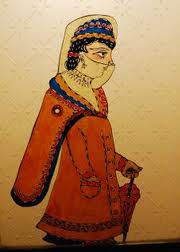
The shy and reserved Zenne, image from the Asian Shadow Theatre Exhibition's photostream at Flikr
Today, it is time to meet Zenne, the Karagoz puppet that I refer to as “the nervous nellie like a bowl of jelly.” I realized that this moniker was befitting of her when I passed by Nervous Nellie’s Shop – in Deer Island, Maine. They have some delicious, albeit wobbly and shaky jelly. Zenne was so nervous about trying this new jelly, that she shivered and shook and worried that she might stain her silken veil with the wild blueberry jelly I was encouraging her to try, and the nickname was born.
So, Zenne, she is a very sweet and well-meaning lady, but very timid. She wants to make a good impression. She wants to do “the right thing.” As Tiryaki Bey is addicted to opium – she is addicted to the worry about “doing the right thing” even if it is something that leads to her undoing. So, how did Zenne come to be the way she is? And why is she here in my mind? Rumor has it that her first words as a child were “Mummy, I wowwy about dat” but that is the extent of what we know about her origins other than that she was brought into Sultan Selim I‘s court as a Çengi from the Aegean region after being noticed in the village market by the entourage. She worried about whether she would be chosen, whether she should go back to her family after being chosen and about whether she would please the Sultan since being chosen. So, since that toddler-infused sentence was uttered, she basically has not stopped since then with the worrying, it is just part of who she is. She does her best to put her worry to good use – reframed as an analytical mind on steroids, thinking multiplicatively about all possible options on any given matter. She really drives people nuts, but there is a sheer genius to her brain sometimes – like juggling with concepts. Her worry, though, can devolve into dysfunctional in a hot minute. Generally, the other puppets are tender with her – except for the merciless Karagöz, who taunts her without end.
In the depiction of Zenne above left, we see a rather proper-looking lady with a veil – no? Sniffing disdainfully as she throws her chin towards the chorus of little dancing ladies, (Çengi) , Kenne interrupts me here, “she is most certainly a proper lady, unlike that other lot!” Zenne was also a Çengi for many years – due to her nervousness, she was usually the puppet that would start the pre-puppet-show on screen, which always starts with a scantily clad dancing girl – she had to start, because she was too nervous to wait. But she gave this all up, as just before she drank from the fountain of youth with Khadijah, she had converted to Islam, and to a life of pious service to others. This led to her use of the veil in the stereotypical sense we think of today – the veil as a guardian of female modesty.
While in reality, this image above may likely be a 19th-century re-imagination of the women of the Karagöz puppet troupe, we like to keep her this way over here at slowly-by-slowly. So, let’s talk about that. Now, the stereotype about the women amongst the traditional Karagöz puppet troupe is that they are temptresses extraordinaire, always being “unabashed flirts” and “setting snares for men,” at least so says Dror Zeʼevi, whose 2006 book, entitled Producing desire: Changing sexual discourse in the Ottoman Middle East, 1500-1900 covers all sorts of unexpected topics, as described here at this link.

A close up of a rose geranium flower from Zenne's summer garden
Related articles
- The Twelve Days of Christmas: Karagöz puppet-style (slowly-by-slowly.com)
- On the 2nd day of Christmas: Meet Bebe Ruhi, a Karagöz puppet with Dwarfism and a whole lotta goof (slowly-by-slowly.com)
- On the 5th day of Christmas: Meet Kenne the traditional lady in search of maintained honor (slowly-by-slowly.com)
- On the 1st day of Christmas: Meet Esma, the hippie Karagöz puppet (slowly-by-slowly.com)
- Karagöz: Consider this a formal introduction to himself (slowly-by-slowly.com)
- On the 3rd day of Christmas: Meet Khadijah, a worker from Egypt (slowly-by-slowly.com)

 Slowly-by-Slowly
Pingback: On the 9th day of Christmas: Meet Safiye Rakkase, the vainglorious dancing girl | Slowly-by-Slowly
Pingback: On the 10th day of Christmas: Meet Yehuda Rebbe, the Jewish wise man | Slowly-by-Slowly
Pingback: On the 11th day of Christmas: Meet Perihan, the fairy godmother | Slowly-by-Slowly
Pingback: Surviving and thriving: Christmas 2011 with the Karagöz puppet troupe | Slowly-by-Slowly
Pingback: Writamatrix and Hacıyatmaz: On the rote hard labor and love of writing | Slowly-by-Slowly
Pingback: The Karagöz Puppets Attend a Tenure Hearing | Slowly-by-Slowly
Pingback: Meet the motley crew of Ottoman Turkish puppets | Slowly-by-Slowly
Pingback: Kenne recommends the nar (pomegranate) cure for our middle-aged tummies | Slowly-by-Slowly
Pingback: Kenne, the Queen of Manners and Maintenance of Ladylike behavior – hits the rakı! | Slowly-by-Slowly
Pingback: The Karagöz puppets reflect on the culture shock of seclusion | Slowly-by-Slowly
Pingback: When I found my teaching spark: A Sufi-like exchange with Hacivad Bey on the work of teaching | Slowly-by-Slowly
Pingback: Hacivad Bey consults Rumi on the topic of work | Slowly-by-Slowly
Pingback: Eggs and Ottoman music: On cultural responsivity gone wrong in one Turkish American marital moment | Slowly-by-Slowly
Pingback: Keşmekeş: The Karagöz puppets wreak (helpful) havoc | Slowly-by-Slowly
Pingback: Turkey for Thanksgiving – or – Dinner with Donkeys in Dipkarpaz | Slowly-by-Slowly
Pingback: Twelve months, twelve moments and one blue slug: The Puppets reflect on 2014 | Slowly-by-Slowly