
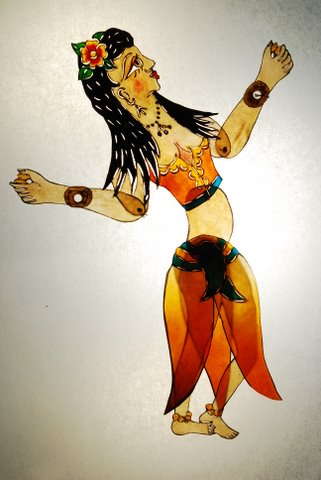
Safiye, showing as much skin as possible - she loves Lady Gaga and Madonna (thanks to the Asian Shadow Theatre Exhibition's Flikr photostream for this image)
Safiye Rakkase (Sah-fee-yeh rah-kah-seh), that’s who you are meeting today. As stated, she may be a hot mamma – but she is one vainglorious hot mamma. She is the ringleader of the chorus of dancing ladies, often referred to in the Ottoman court as dancing girls, or çengi …according to the website www dot turkishculture dot org “during the time of the Ottoman Empire dancing was form of entertainment enjoyed both at court and amongst ordinary people. Unfortunately these dance traditions have not survived to the present day, and our information about them is restricted mainly to Ottoman miniatures and drawings and paintings by Europeans who visited Turkey in past centuries. When exploring the history of Ottoman dance it is important not to confuse such authentic documents with the works of European Orientalist painters, who depicted not what they had seen but what they imagined. Such fruits of fantasy include female slaves dancing naked in harems. Ottoman miniatures on the other hand, reflect the true nature of this dancing, as do pictures by eye witnesses, many of them not professional artists, whose job was to collect written and visual information about the Ottoman Empire for the monarchs of Europe. Ottoman dances had their origins in theatre, the performers enacting a subject by means of pantomime in the form of dance, using body language to convey their meaning. These dances were of three types. The first was performed by dancers known as çengi, who originally included both men and women, but in later times came to be women only. The word çengi is derived from çeng, a type of harp played upon the knees and no longer used today. The çengi dancers held a type of castanet known as çarpara in their hands, and sometimes also handkerchiefs. Their costumes were highly ornate, concealing every part of the body apart from the face and hands. Some çengis whirled china plates on the tips of their fingers while they danced, and were then known as kâsebaz or ‘dish jugglers’.”
Now, unlike the description above, Safiye Rakkase does not cover all but her face and hands…apparently her outfit morphed over time to include more of a modern-day belly dancing outfit. She was never much for spinning china on the tips of her fingers, either, but she can do it in a pinch. Safiye Rakkase, often referred to as just Safiye for short, is overly obsessed with her looks and tends to spend way too much time primping and preening when she goes out. She is the puppet in my head who supports my Turkish family in encouraging me to dye my silver hair back to brown – though I don’t mind the silver, nor does M., not that I would ever act on it if he did. M. gets upset, for example, when I succumb to the pressure of having every single family member consistently chant through the day “in Turkey, we dye our hair,” this is a true story. In any case – Safiye Rakkase loves it when they do this – and plants seeds of doubt across my cerebellum on a regular basis.

I wonder what Safiye Rakkase would think of Safiye Ali, the first Turkish doctor to treat the troops during the Balkan Wars - Image via Wikipedia
Safiye Rakkase scoffs at my feminist upbringing – and encourages me to use my “feminine whiles” to get what I need in life. She is clearly the voice in my head that actually, much to my shame now, wore a miniskirt to court one day at the request of the head lawyer on the team I worked for while in a public defender office. That head lawyer was also a woman, who also wore a miniskirt that day, as she knew the criminal court judge in question liked to look at ladies’ legs. That was total Safiye Rakkase territory. And yes, we got what we needed for our client that day. Who knows if it was related.
These days, I let Safiye Rakkase worry about what I wear – but not much else. She is still a major bit of noise in my head, as if those insane, negative body image magazines have set up a permanent loudspeaker in my head, much as everyday North Koreans have to put up with Kim Jong Il‘s propaganda broadcasts 24 hours per day – in their apartments!
I try to love Safiye Rakkase for who she is, but I do hope she will see the light one day. As for her? Well, she still let’s me cut loose on the dance floor on occasion, it’s all her moves, not mine.
Related articles
- Strike a pose: Puppets gone fashionista in the middle of the night! (slowly-by-slowly.com)
- The Twelve Days of Christmas: Karagöz puppet-style (slowly-by-slowly.com)
- On the 7th day of Christmas: Meet Zenne, nervous nellie like a bowl of jelly (slowly-by-slowly.com)
- On the 6th day of Christmas: Meet Tiryaki the opium addict with narcolepsy (slowly-by-slowly.com)
- On the 3rd day of Christmas: Meet Khadijah, a worker from Egypt (slowly-by-slowly.com)
- On the 1st day of Christmas: Meet Esma, the hippie Karagöz puppet (slowly-by-slowly.com)
- On the 2nd day of Christmas: Meet Bebe Ruhi, a Karagöz puppet with Dwarfism and a whole lotta goof (slowly-by-slowly.com)

 Slowly-by-Slowly
Pingback: On the 10th day of Christmas: Meet Yehuda Rebbe, the Jewish wise man | Slowly-by-Slowly
Pingback: On the 11th day of Christmas: Meet Perihan, the fairy godmother | Slowly-by-Slowly
Pingback: The Karagöz puppets debate the use of second-hand clothes (Sener Sezer) « Slowly-by-Slowly
Pingback: Approaching death in a Turkish-American relationship: Is it time to stir the irmik helvası? « Slowly-by-Slowly
Pingback: The puppets get worried, up Turkish tea infusions | Slowly-by-Slowly
Pingback: Grieving differently in Provincetown: Ottoman space invaders take the Cape tip | Slowly-by-Slowly
Pingback: Safiye Rakkase gets into old Turkish cinema | Slowly-by-Slowly
Pingback: Meet the motley crew of Ottoman Turkish puppets | Slowly-by-Slowly
Pingback: The Karagöz puppets reflect on the culture shock of seclusion | Slowly-by-Slowly
Pingback: How to relax after a hard day’s work? Karagoz chortles and snorts | Slowly-by-Slowly
Pingback: Kolay gelsin: On the hard work of deciding what’s the hardest work | Slowly-by-Slowly
Pingback: Eggs and Ottoman music: On cultural responsivity gone wrong in one Turkish American marital moment | Slowly-by-Slowly
Pingback: #DirenTurkiye: The Karagoz Puppets provide a socio-historical cheat-sheet for what led to #OccupyGezi | Slowly-by-Slowly
Pingback: The Karagöz Puppets muse on Turkish (neo-colonialist?) influences in Kuzey Kibris | Slowly-by-Slowly
Pingback: Esma and Safiye Rakkase brawl over a pistachio nut-fueled metropolis | Slowly-by-Slowly
Pingback: The Karagöz puppets review “Mustang” | Slowly-by-Slowly