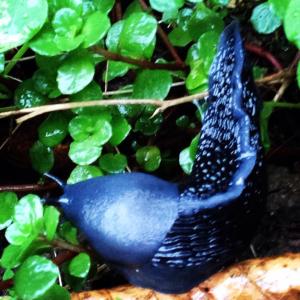
Carpathian blue slug found in the Black Sea region of Turkey (photo by Liz Cameron)
For days and days, Karagöz, ever the trickster, has been hounding me with one question – “Yılbaşı? Yılbaşı? Yılbaşı? Where are we going to celebrate the new year?” Embracing our middle-aged personas, we headed for our beloved curl at the end of the earth – Provincetown! It is a wonderful and quiet place to contemplate the old, celebrate with dear friends and then forge a path forward in the light of tomorrow, wishing all a “Mutlu Yıllar!” or “Happy New Year!” But for now, the puppets tell me, the job of the moment is to reflect on the past twelve months, in list form. And just in time, twelve of the puppets have stepped up to share their moment of choice!

Wild strawberry jam at the Moyy Miniotel in Çamlıhemşin
12. Esma, ever the etherial and quirky hippie puppet, eeks out her space in the line of twelve with her clear favorite – “My favorite moment was a series of moments experienced at the Moyy Miniotel in Çamlıhemşin, where we tasted at least 12 different kinds of homemade jam – including wild strawberry jam that had twelve berries per spoon because they were so tiny!” 11. Mercan Bey, the Arabian spice trader puppet considers Esma’s favorite, and continues on down the culinary path – citing the eleven dishes of extraordinary Anatolian cuisine experienced at the now world-famous Çiya Sofrası on the Asian side of the Bosphorus strait…they even had candied black walnut in the shell with kaymak! (It was also, M’lady notes, the first time she experienced a menopausal hot flash although she resisted stripping down to her skivvies due to the veiled ladies in the room).
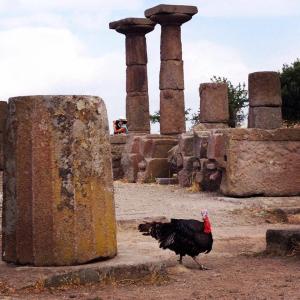
A turkey we saw strutting about at the Temple of Athena in Assos/Behramkale in June
10. Zenne, the nervous Nellie like a bowl of nectarine jelly, actually gets brave for once as she steps forward from the group. “My favorite, if I may say so, were the ten cats per day we saw all over Turkey while showing M’lady’s niece, stepsister and stepmother around. I was even brave enough to take a cat ride along with the little chorus of dancing lady puppets!” Blushing, she rushes hurriedly back into the shadows, hoping her mistress, Kenne, the Queen of Manners and Maintenance of Ladylike Behaviors can see her. Kenne looked a lot like the strutting turkey we saw at the Temple of Athena in Assos this summer. 9. And sure enough, when Kenne is done scolding Zenne for stepping out of the servant’s quarters (what is this, Downton Abbey?), she steps up and reveals HER favorite moment of the year, none other than the 9th of September when M’lady donned her working clothes for the first time in two years and went back to work at the University! “At least you look presentable these days, and have sworn off (sniff) JEANS most of the time!” 8. And then the crack of a whip could be heard. Yes, it was the Write-A-Matrix, that academic dominatrix – or – as it turns out – retired academic dominatrix! You may recall this puppet – she was often seen around here several years ago when M’Lady was up to her eyeballs in academic work 24-7, it seemed like. After two years away from work, the Write-A-Matrix has a new lease on life – and instead of churning out manuscript after manuscript, she is focused on writing at a more sustainable pace – and valuing blog posts more than at the one-per-day rate. “My favorite moment of the year is actually the moment that M’Lady realized she was OK with having only written eight blog posts in a year, and even though she’s now up to ten, she’s healthier than ever.”
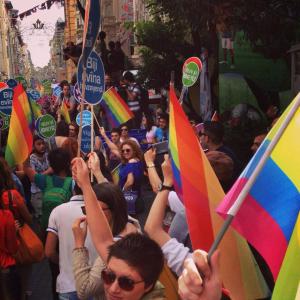
Istanbul Pride march on Istiklal Caddesi, June 2014
7. So while we are thinking about health and happiness, let’s turn to Saf and Dobra – the Siamese twin puppets who love-hate Turkey. Sighing and giggling, they approach me together, hand in hand. “Our favorite moment relates to the 7th heaven we saw many people experience during Istanbul Pride. We were proud to see M’Lady and M. join in that parade. We love the fact that such a large (100,000 people!) Pride parade happened in Istanbul but we hate the fact that things are still really NOT GREAT for many LGBT people in Turkey.” Well said, Saf and Dobra, we feel the same way. 6. Celebi, the modern lover puppet (a Kemalist for sure), goes the traditional route today. Instead of something modern – he celebrates something traditional – “My favorite moment involved viewing six versions of İmam bayıldı. M’Lady finally started to learn how to cook Turkish food this year (no, M’Lady, çay does not count) and perfected her approach to this classic Turkish stuffed eggplant dish!”
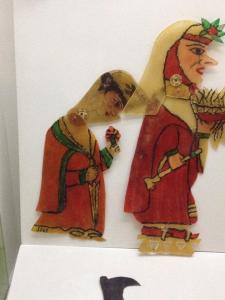
Two female puppets from the Karagöz puppet museum in Bursa – we visited there in June.
5. “And then,” Tiryaki, the addict puppet, says in between opium binges, “there was the time that M’Lady insisted on buying five celeriac roots for M. to make into an Ottoman-style celeriac dish. That was a serious celeriac bender, dude.” You can check out the recipe that came out of that experience here. “Of course, there was also that trippy time when M’Lady took the entire puppet troupe to the Bursa-based Karagöz Puppet Museum – that was wild to see ourselves in different camel-leather forms! 4. The little chorus of dancing lady puppets begins to sing from the handbag where they always reside – their own little harem of safety, I think. Humming, they explain their favorite moment related to the number 4 – “It involved the interpretive dance we did on the windowsill as we watched four quinces being split into eight pieces! It was the first time that M’Lady’s M. made Ayva Tatlısı!” You can recall that sweet moment (with recipe) here!
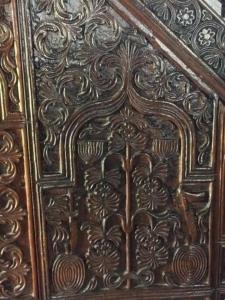
Detail from a wood panel in a tiny mosque on the Georgian border – this image depicts a menorah in honor of Judaism. (Image by Liz Cameron)
3. Yehuda Rebbe, the wise man puppet steps forward, his flowing robes following him in regal splendor. “My favorite moment relates to the number three – in this case three of the world’s largest religions – Islam, Christianity and Judaism. There we were, on the Georgian border in a tiny town with only one mosque. How surprised I was to meet the most passionate Imam ever, who gave us a tour of the amazing wood carvings in his mosque – which depicted important events and symbols from ALL THREE religions! In a mosque! This is a symbol of peace I will hold on to for years to come.” 2. Bebe Ruhi, the dwarfiest of the puppets steps up now – which is nice because we don’t hear from him a lot. “My favorite moment is a simple one, the moment that M’lady’s M. got over his Turkish snobbery long enough to realize that two SPECTACULAR items, chocolate and peanut butter, really do go well together indeed! It takes two to have a fıstıklı bromance!” 1. Karagöz has the last word – “of course my favorite moment of 2014 HAS to be the time we joined up with the Archers of Okçular and caused a ruckus upon finding the BLUE SLUG in the damp but fascinating town of Çamlıhemşin in the Black Sea region of Turkey! Hacivad Bey has to have the last word, of course, and he corrects Karagöz, saying, “actually, it was a Carpathian Blue Slug – Bielzia coerulans!” May 2015 bring twelve more such wonderful moments!
Please share if you like this!
 As the curls of cold make their way under the doors in through the window cracks, I curse the polar vortex.
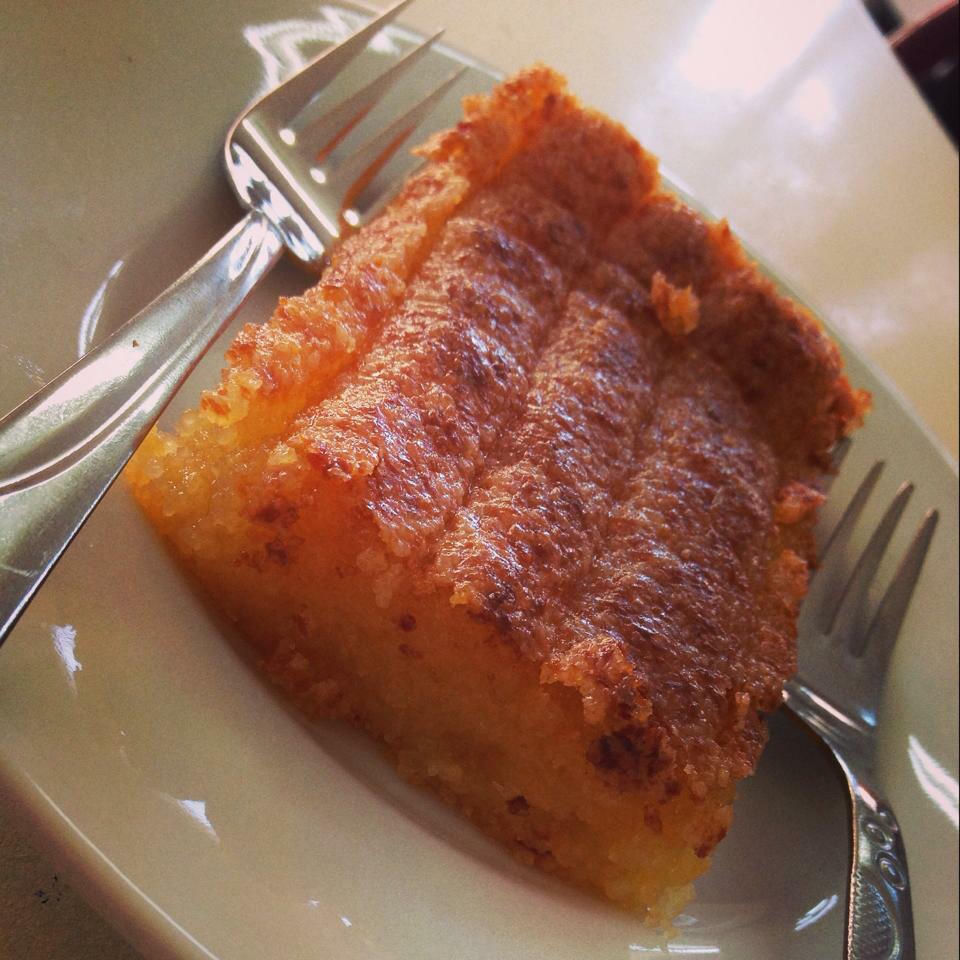
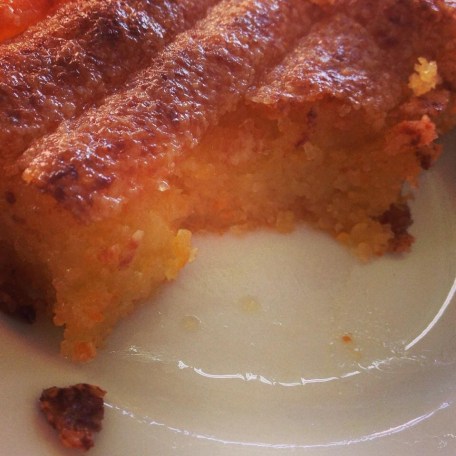 Mercan Bey reminds me that in all of his travels near and far, this unctuous and sweet treat is an artery clogger to be sure. As my Dad used to say, there are two kinds of really good food – “instant artery clogger” and “instant cavity.”


