
The Karagöz puppets howl at my ‘Turklish:’ “Ben yumurta yemek yiyorsun üstünde yatak’da?”


No, no revolutionary images or wan statements of solidarity with the Turkish people today – it’s a cute chick dominating a nice, fresh brown egg. Unlike what happened in my latest ‘Turklish‘ learning moment with M., which centered around talking about eating eggs whilst sitting on the bed. (Image from http://www.ces.ncsu.edu)

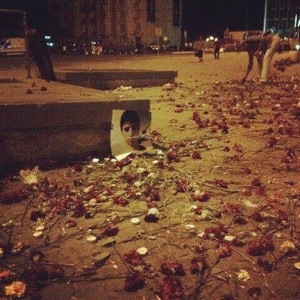
As we move on from horrific images of what followed the red carnation protest in Istanbul – and as we ignore reports of an horrific video of a swarm of police beating protesters hiding in a parking garage in Antalya – and as we are buoyed by wonderful photos of yesterday’s 10th annual Istanbul Pride march – today’s post turns to the banal when it comes to language learning in a Turkish American household.  Thus, the cute chick and egg photo.  We need an emotional break.

Nobody talks about the Turklish learning factor better than my e-friend over at the blog named, well, Turklish, but I thought I’d add my two cents on the topic as it relates to my business of relaying the nature of my cross-cultural marital roadtrip (with backseat-driving Karagöz puppets, of course).

As you may have gathered, my birthday present from M. this year was lessons one through three of Rosetta stone‘s Turkish language learning program. I have felt that it is an excellent immersion program, although because my vocabulary is excellent, I am scoring high while still not understanding the grammar very well. This is because the program uses images and words together, and I can spot the images to get the matching sentence and image correct.

Wishing for a list of the verbs and articles used in my lessons, I googled Rosetta Stone. Soon, I found a series of reviews of the lesson plan I am working on. The funniest of which was from a woman studying Turkish to be able to communicate with her husband’s Turkish relatives. She wrote how much she liked Rosetta Stone – and that now she could say things along the lines of “I am eating an egg on top of the bed.” “Whilst not necessarily very useful,” she wrote, “it does seem like progress.” I could totally relate.

Turning to M., I tried out the sentence in Turkish myself– it went something like this:

“Ben yumurta yiyorum üstünde yatak’da!”

He laughed at me. Excessively.  So did Karagöz.  He howled, there is no other word.  In the end, it turns out this is inexorably grammatically incorrect.  But I wasn’t seeing it.

“Am I not saying I am eating an egg on top of the bed?” I said, feeling somewhat taken aback after my confidence had been boosted by the program.

Canım benim (my dear), You don’t say it like that. What you need to say I am sitting on the bed eating an egg.”

Exasperated, I said “what’s the goddamn difference?” And repeated my gloriously and flagrantly incorrect Turkish sentence. Karagöz whooped and hollered and started to do somersaults all over the place – his way of upping the ante in a tense moment, even about something unimportant.

“In Turkish,” M. said trying to suppress a major smile, “what you said is not grammatically correct. You have to start with the bed, that you were sitting on top of the bed or it is devrik cümle – a particular writing style…but…it’s too hard to explain in English for me.”

Ready to tear my hair out, I managed the necessary marital politeness saying “but what difference does it make if you start with the BED or the EGG?” I sighed. “You’re telling me that there is a grammatical rule about beds before eggs?  I mean REALLY???”

“Yes,” he said stifling more giggles,”it does matter – you say it like this: “Ben yatakta yumurta yiyorum.”

I knew he was right, why couldn’t I back down?  Because he is my emotional punching bag when it comes to the frustrations of learning a language I am keen to learn.  And that, I know is not fair to him at all.  But I only know that in my best moments. Sitting up straighter, I retorted with “but why does it matter? In English it doesn’t matter?!

Karagöz Jumped into the conversation at this point, saying: “you need to ask yourself ‘Is this just my American essentialism?’ I mean just because in American English it’s okay, it should be okay in Turkish?” Blushing at my potential ugly American-ness, I ceased and desisted. “Sitting on the bed, eating an egg. Okay.”

So much of becoming fluent, so to speak, in the culture – not even the language – of Turkey, is accepting different ways of doing things, thinking about things. This is an old lesson for people who teach English as a second language or another language as a second language, but new to me.  Just another “Turklish” moment in our home. I am sure there will be many more.

As I slunk back to my computer to continue my lessons, I noticed that the puppets, who have been standing for six days now in support of the standing men and standing women of Turkey, were giving me a standing ovation for carrying on with the lessons. I suppose it would’ve been a sitting ovation if they were protesting, but it was clear they were pleased with me and my efforts to learn.

Teşekkür ederim Karagöz Oyunları – sometimes you keep me going!

Posted in Turkish-American Matters, Turklish Moments, Visits from the Karagöz puppets | Tagged , , , , , , | 10 Comments

Kırmızı karanfil in Taksim Square: The Karagöz puppets, wordless yet again


This is a (Source unknown)

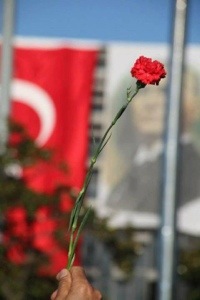
This is a Kırmızı karanfil (red carnation) – peaceful protesters gathered in Taksim Square this afternoon to commemorate those lost in recent protests – and brought these with them (Source unknown)

As is usual these days, I woke to the array of the puppets still standing, along with all the ‘standing men’ and ‘standing woman’ in Turkey and worldwide who are protesting the increasingly authoritarian practices and tactics of the AKP government. My puppets, they’ve been standing for five days now. But that’s nothing, compared to what people in Turkey are going through.

As the day went by, and I went about my business, I began to notice the puppets hovering around my Twitter feed (still the best source for news in Turkey, they wager).

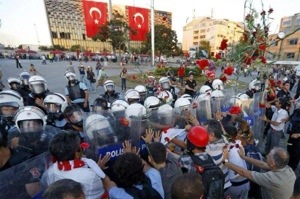
Soon, I saw wonderful images of peaceful protesters in Istanbul’s Taksim Square. My understanding is that a large group of peaceful protestors gathered to commemorate those lost during the police brutality witnessed during the #OccupyGezi protests.

Peaceful protest in Taksim Square (Image from Occupy Gezi's FB page)

Peaceful protest in Taksim Square (Image from Occupy Gezi’s FB page)

I watched live feed of the police asking the group to disperse for 30 minutes (although spoken as “friends, please leave”) before police began using the now-infamous TOMA water canons (with and without pepper spray) and tear gas to clear the square.

I watched as an old man stood with his arms up in a sign of submission begged the TOMA to have mercy on people who were literally running the other way and in no way a threat – the police asked him kindly to move, referring to him as “amca” (which means ‘uncle’ and is often used as a term of respect even when you do not know someone). I saw human chains with police shields chase chunks of people away from the square into the side streets. The people looked, literally, like sheep in a

(Image from Occupy Gezi's FB page)

(Image from Occupy Gezi’s FB page)

pen ready for slaughter. No, this is not hyperbole. Then I watched as police shot close-range tear gas canisters into that crowded street of peaceful people.

At one point, I saw video of two young men throwing things at the TOMA – and another ‘amca‘ begging the ‘cocuklar‘ (youth) to stop – and begging the police to stop – he turned back and forth saying the same thing before being lost in the fray.

(Image from Occupy Gezi's FB page)

(Image from Occupy Gezi’s FB page)

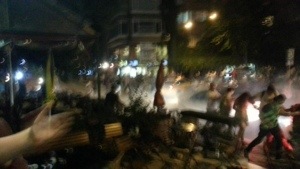
I then saw a small group of peaceful protesters stand in between the two rock-throwing youth and the TOMA begging them not to continue. I began to cry when I saw the police pepper spray a young woman caught on the sidewalk by what appeared to be her family’s shop – she fell, screaming at the pain of the pepper spray, her sister holding her in her arms. She had a light pink sweater on. Her screams were awful, and it appeared to me that her mother – or an aunt perhaps – behind her in the door of the store passed out.

(Image from Occupy Gezi's FB page)

(Image from Occupy Gezi’s FB page)

As the night goes on, we are hearing that this continues, that journalists are being attacked by police and/or refused entry to ‘hot spots’ for reporting.

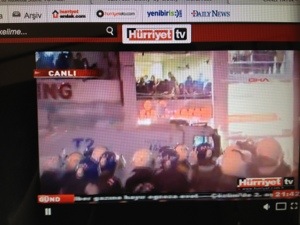
This shows police gassing people in and near the Simit Sarayi (Simit Palace, a sort of bagel-like shop) where M. and I usually stop for a snack before walking Istiklal Caddesi. (Image is screen capture by Liz Cameron)

This shows police gassing people in and near the Simit Sarayi (Simit Palace, a sort of bagel-like shop) where M. and I usually stop for a snack before walking Istiklal Caddesi. (Image is screen capture by Liz Cameron)

We also hear firsthand reports from Ankara that police are randomly throwing tear gas into residential homes and buildings – as well as lokantas where one person reported that as people choked on the gas, they raised their glasses of raki (anise-flavored liquor, national drink of Turkey).

(Image from Occupy Gezi's FB page)

(Image from Occupy Gezi’s FB page)

When M. arrived home, I began to show him, but it was too painful to watch for him. He prefers to read the news – a gentler impact. He is learning how to take care of his secondary traumatic stress.

Remember, folks, it is still legal to congregate for peaceful protest on the books in Turkey…so I’ll let the pictures tell the story now. I wish I could make this post have some sort of like puppet-fueled touch, but they, as I, am once again speechless at the behavior of the police. And to put “the icing on the cake” – a friend in Istanbul just wrote that she had dinner with her son in Istanbul’s Bebek neighborhood – and coincidentally, the President himself was attending a wedding in the same locale. Business as usual in Turkey, under Tayyip the Terrible and Gül the relatively silent?

As one tweep put it, “Most seem to think Tayyyip has mental health issues, and this continues, what to do?” Indeed.

(Image from Occupy Gezi's FB page)

(Image from Occupy Gezi’s FB page)


Posted in Turkish Art, Turkish Controversies, Visits from the Karagöz puppets | Tagged , , , , , , , | 8 Comments

#DuranKaragöz – Taking the best of his spirit into M’lady’s new year!


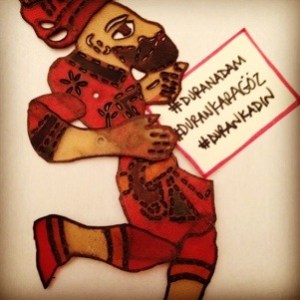
20130620-230555.jpgToday’s blog post is all about Karagöz, the shadow puppet from Turkey – and namesake of the famous “Karagöz Oyunları” or “Karagöz puppet troupe.” As you can see from the photograph to your left, he is standing today, joining the Turkish movement of standing men and standing women and well, standing people! All of these standing people (and the standing puppets in life of my mind) are protesting extreme police brutality, iron fisted control of Turkish media by the AKP government and increasingly authoritative behavior on the part of Turkey’s ruling party.

As it is my birthday today, and as I wish for the next year that I had some of this particular puppet’s energy as it relates to #OccupyGezi.

First, in general, if you read this blog much, you have likely caught on by now that he hs known to be a trickster and an agent provocateur – some might even say an agent provocateur extraordinaire according to the resident Ms. Manners.  And, you see, this little puppet character, he has been this way since Ottoman times when he was born in Bursa, along with his original companion & sparring partner, Hacivad.

Even though this agent provocateur puppet watched live DHA feeds along with us with just the glimpse of a tear as Turkey erupted into chaos over the last weeks – his tongue in cheek, sarcastic and sometimes caustic humor alienated some of the puppets in his puppet troupe (here in my mind).

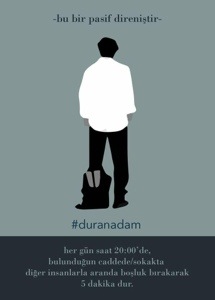
20130618-110825.jpgWhen Karagöz first heard about the standing man (#duranadam), for example, who stood for eight or so hours in Istanbul’s Taksim Square as a performance/protest against the police inflicted deaths during #OccupyGezi, that little puppet erupted in such chortles of laughter and splutters of glee and sarcasm you might think he would damage his camel’s hide-constructed self.

And the rest of the puppets made their displeasure known – more than usual – MUCH more than usual – and then, something different happened. Usually, Karagoz doesn’t care what anyone thinks. But the very best side of him came forward in the face of his peers. He apologized – did you hear that? Karagoz APOLOGIZED to his puppet troupe. And now, with very few agent provocateur interruptions (they are part of his nature, after all, he really can’t help it to some extent) he does his best to stand along with them as he is reallly upset about what is happening to his homeland as well, very, very upset indeed. The puppets are up to four days now, on the standing front.

20130618-110832.jpgSo, as I look toward the next year of my life, which I already know will include some major challenges, here is what I hope to take from the very best parts of Karagöz’ example in these tough times:

1) Cultivation of lots of energy channelled in positive ways (but no cartwheels for me).

2) His zest and passion for living life in the moment.

3) The honor to admit when he’s wrong – and to stand up and change even if (slightly) embarrassed.

4) Commitment to having more fun with his sparring partners – the other puppets and especially his beloved Hacivad. (Jolly Joker, that’s for you, canım benim).

5) Most importantly, drawing on his activist spirit to speak the truth to power when necessary…and perhaps especially when others are afraid to do so!

Viva #DuranKaragöz!

Posted in Turkish Controversies, Turkish-American Matters, Visits from the Karagöz puppets | Tagged , , , , , , , | 9 Comments