
On escaping the “emotion work” of everyday life in Istanbul


A man walking in Istanbul - image from the Reblog Phlog

A man walking in Istanbul – I wonder about the state of his emotion work with that wonderful and complicated city (Image from the Reblog Phlog)

On Sunday, I wrote that living in a Turkish-American marriage, you notice some cultural differences right away – and others slowly by slowly.

In thinking about cultural differences in this roadtrip called our marriage, work is a key piece when it comes to cultural difference – and as my theme of the month is “work,” due to my participation in Blogher’s NaBloPoMo, a discussion on “emotion work” as the sociologists call it, seems appropriate. “Emotion work” is defined as the management of one’s own feelings or as work done in a conscious effort to maintain the well being of a relationship – and in the case of this blog post – I am talking about the relationship between a person and their city, specifically, M. and Istanbul.
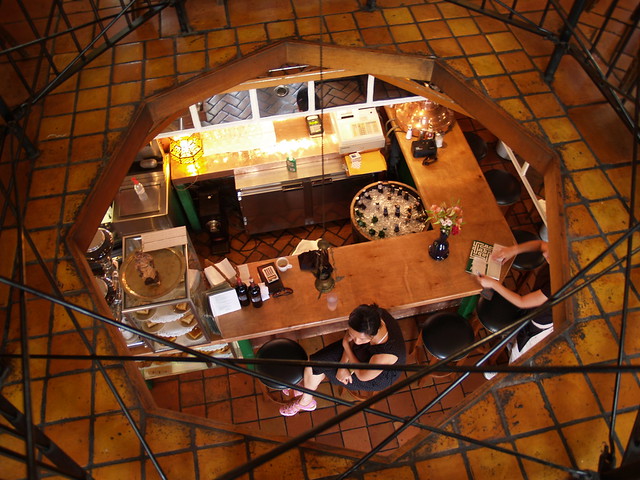
An image from the famous Cafe Algiers (Image by Neonlike at Flikr)

Let me go back some years, to the first date I had with my now husband. Sitting in the glow of warm light in Cafe Algiers, M. and I began the dance of getting to know one another. One of the first things I asked him related to the differences he noticed between his former life in Turkey and his present life in the United States.

“Oh,” he said, as if pained by an attack of acute gastritis (and eye rolling), “Turkey – Turkey – living there is just so much WORK. I was planning to move to a smaller city on the coast before I came here – Istanbul is just SO DIFFICULT.” I don’t recall the rest of that conversation – but I did wonder what the heck he meant, having never visited one of the second or third world’s mega-metropolis-cities at the time. I think my follow-up question was deflected elsewhere as we ordered a second cup of coffee before heading out for a walk along the Charles.

When M. did invite me to visit Turkey with him, to meet his family – and learn about that side of himself, I started to understand what he meant about the work of living in Istanbul – and it was indeed “emotion work” – just with a city this time. It didn’t take long,sitting in traffic, going in and out of markets, museums and watching M. trying to get a few bits of bureaucratic business done, I began to realize why living in Turkey might feel like so much WORK.

Istanbul traffic

Istanbul traffic (Photo credit: quicksilver_)

One day, sitting together in a cab without air conditioning, stuck in a a tangle of traffic like none I had ever seen, M. revisited the topic of the “work” of “just living” in Istanbul. Visibly frustrated – and a tinge sad if my eyes did not deceive me – he explained “This is why I left Istanbul, this is draining, like emotional work, just to get from one place to another.” He went on to describe the massive influx of immigrants from the eastern part of the country over the past 20-30 years that had changed his city of 7 million to one of 17 million seemingly in the blink of an eye. Of course, the city’s infrastructure could not smoothly absorb all of this – making day to day movement, well, work.

And then there were the queues – or rather – the lack thereof. Raised by very orderly people in a country in which queues are only slightly less relied upon than in Britain, I was shocked at the mad dash and super crush of humanity at the entrance to any particular venue – mosque, store, museum, move, restaurant, all of it. This image truly gets at the difference. And I learned too, that this, for my husband, had become intolerable “emotion work” as an Istanbullu, part of what eventually led him to live in this country. “Nothing,” he says with a frustrated sigh, “is easy, and over time that wears you down. When you want something – you have to battle with everyone to get to the front of the counter – there is no order, no peace.”

I believe that M’s dislike of the emotion work of living in Istanbul is a reflection of culture shift – from an eastern approach in which the present, comfort and balance were much closer at hand than in this globalized era. Now, this may also relate to his family’s class status – but I would argue we are a pretty good match in that department, so my bet is on cultural difference. And given his escape, I think that is why he is particularly happy with the boundaries around his professional work. And so how does this impact me? Well, it gives me a lot of food for thought.  The “emotion work” of living in our city is nothing compared to Istanbul – but given my recent workaholic collapse as a University professor and with my left shoulder injury to boot, I have a lot of time to re-consider my relationship with work – including the “emotion work” of academia.  But that, dear readers, is a post for another time.

And you – what about the “emotion work” in your life? I would love to hear your thoughts!

Posted in Cross-cultural learning moments, Family Challenges, Turkish-American Matters | Tagged , , , , , , , , | 10 Comments

Of east and west, work and rest in a Turkish-American marriage


We often view the role of work, and rest, in what I think are Eastern-informed and Western-informed lenses (Image by Jenny Lee Fowler)

We often view the role of work, and rest, in what I think are Eastern-informed and Western-informed lenses (Image by Jenny Lee Fowler)

Living in a Turkish-American marriage, there are some differences that are glaringly garish, more that subtle, a few that are barely perceptible and some that really creep up on you over time.  As my theme of the month is “work,” due to my participation in Blogher‘s NaBloPoMo, a discussion of how work is perceived in my own relationship seems appropriate to share.

As a couple thrown together from Eastern and Western traditions, work is often an area in which we clash.  M., who is much more of a bohemian and easygoing person than I, loves his work more than anything – and after 8 hours – comes home – and that’s that.  He is a curator in a museum that is a particularly healthy workplace, if you ask me.  The culture of work in that place, I believe, supports what M. knows about the value of balancing work and rest time – as his rest time is when his true work begins, as he is also a working artist.  Lately, he has been in the throes of recalibration – as he has perhaps adopted too much of a work ethic on the volunteer front – and needs to step back.  But unlike me, he knows it when he sees it.  Would that I were that way.

I, on the other hand, well, it’s not that easy.  It is likely that I make nothing easy on myself as I come from the Yankee work ethic tradition that has rushed vs. trickled down from generation to generation.  I feel guilty if I am not working or doing something useful.  This tendency has been cemented in my psyche by choosing to work first in social services for years (where workaholism is the only way to get impossible tasks even partway done) and then to choose academia.  Ah, academia, the land of no rest, knots in your stomach and a constant “somewhere else to be, something else to do,” type of feeling.  I know that my e-friend over at Turklish is wrestling with the same things (you should check out her blog here, she is marrying a Turkish man and moving to Turkey soon – while doing graduate work). With my need-to-prove-my-worth work ethic and my Yankee roots, I think I am doomed.

Hacivad Bey, the learned Sufi elder puppet who has been observing and facilitating this whole work meditation, steps in at this moment.  “This, m’lady,” he says softly, “is the reason you met and married M.  So different from you he is, you are bound to have to take another good look at yourself and decide what is, and what is not healthy.”

And then, without further ado, he unfurls a soft and worn scroll of parchment in front of my eyes, and it reads:

“Let the beauty of what you love be what you do” – Rumi  

Almost imperceptibly, he whispers this to me – “Figuring this out now, M’lady, is your task. It’s time to get well again” And it becomes clear to me that I have a lot to learn about the Eastern approach when it comes to balance – and determining what it is that I will do.


Posted in Academic hell, Cross-cultural learning moments, Family Challenges, Turkish-American Matters, Visits from the Karagöz puppets | Tagged , , , , , , , | 12 Comments

Hacivad Bey consults Rumi on the topic of work


20121209-162728.jpg

Words by Rumi, image by Liz Cameron

Silence reigns this Saturday as the majority of the Karagöz puppet troupe lounges, arms all akimbo, in and amongst the orchids that line the kitchen windows.

They enjoy the soft, green moss blankets we tuck the orchids in with and hope that it is not orchid-watering day – as that is the day we place a peace-shaped ice cube on top of each mossy blanket, to slowly melt and sink down to the roots.

Esma the hippie puppet, known in part for her green thumb when it comes to orchids, insists that the best way to water orchids is with peace-shaped ice cubes placed on top of their mossy blankets for slow melting nourishment. (Image by Liz Cameron)

Esma the hippie puppet, known in part for her green thumb when it comes to orchids, insists that the best way to water orchids is with peace-shaped ice cubes placed on top of their mossy blankets for slow melting nourishment. (Image by Liz Cameron)

Esma, the hippie puppet with the green thumb, tells us this is just the absolutely most respectful and effective manner of orchid-watering.  So far, the orchids seem very happy.

As I shuffle past the kitchen windows, Esma calls out to me, explaining “my work for the day is meditating, centering myself, finding inner peace, do you care to join me?” I can’t decide, and move on, leaving her atop the golden dotted-maroon blossoming orchid, way above the slowly dissipating peace-sign-shaped ice cubes below.

The chorus of little dancing ladies have made their own harem, replete with a eunuch or two, in the bottom of my big bucket purse – thanks to several of my missing silken scarves….

Forgoing the mossy softness, the little chorus of dancing lady puppets has retreated to their lair, the inside of my purse (their own self-imposed harem, a respite from the world), where they have dragged a set of particularly smooth and silky scarves in hues of amber and aqua which to recline, drink tea, and sleep.  They are pretty sure they will not be disturbed as I am not working these days, so the purse remains quiet, hanging on the back of the bedroom door.

Turning the corner into the foyer, I see Zenne, the shivery, quivery nervous nellie like a bowl of jelly being schooled in the work of stain removal by none other than herself, Kenne, the Queen of Manners, Etiquette and the Maven of Maintaining Ladylike Behavior.  “Cleanliness is next to Godliness, and this is our work, dear, even if all others are lounging and loafing like those chorus girls – ah – M’lady – care to join us in this spot-removal tutorial?”   I demure, lowering my head, and politely decline. Slipping past the duo thanks to the wax on the hardwood floors, I turn the corner into the living room just in time to ignore Kenne’s protest about my mismatched socks.  That stubborn, image-conscious lady refuses to accept that this is my signature look, even if it is usually hidden in my boots.

And it is then, that I notice Hacivad Bey, the learned elder, follower of Celaleddin Rumi, sitting atop my Great-grandfather’s wooden armchair, having a conversation with himself, or so it seems.  “Please join me, M’lady, I am just speaking with the spirit of Rumi himself – as he is in all of us who believe – I am speaking to him of your conundrum, about how to re-negociate your relationship with work so that you can feel healthier.”

Brought to tears by his kindness, all I can muster is, “thank you Hacivad Bey, you are so kind to help me think about this.  I feel lost in the woods, and don’t know exactly what the right thing to do is.”

“You won’t know, not until you do.  You need to rest and get well, and you need to look in your heart and consult those you love, and eventually, the way will become clear….” as Hacivad Bey’s voice trails off, he looks up to the heavens, as if receiving an interstitial telegram from far on some other side. Finally, he looks up, and tells me this:

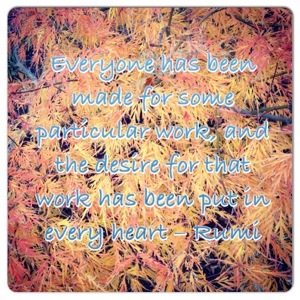
Rumi says this – and this you must meditate on – “Everyone has been made for some particular work, and the desire for that work has been put in every heart.”

And so I have been, and I will be, and I have faith that the way will become clear, even if all I hear from the majority of the puppets is surrendering to Saturday snoring.

Posted in Turkish Art, Visits from the Karagöz puppets | Tagged , , , , | 12 Comments