Searching for the red thread: On structuring a Turkish-American marital memoir (Part 1)


In search of my elusive red thread – the thing that will pull my memoir together…note that as in this photo, in which the spool is somewhat blurry, so too is my own conceptualization of the red thread that pulls this body of writing all together…

Today, I am going to talk about my elusive “red thread” as it relates to the writing of my Turkish-American marital memoir. My dear friend and soul sister K., also a professor type who edits students’ papers a lot, refers to the “necessary red thread” in any writing one does.  It is the theme that pulls it together, the point that acts like a magnet for all of the words included in any given bit of writing.

And it is this red thread that is elusive to me as I try to consider the revising of the first draft of my now 300 page memoir on my own Turkish-American marriage “road trip” as I like to call it.  Having completed the manuscript over a year ago, I can now see how crappy it really is – as it has a faulty red thread.  Now my M. read it and loved it, but, of course, he is a biased audience. I cringe when I look at it.  I especially cringe when I look at my first draft as I am so good at finding and elucidating red threads in my academic writing, but I really suck at it here.

I am sure my wonderful brother, would make some very fine bits of advice after a day full of cringeworthy reading.  I am too embarrassed to show it to him as he is an MFA who writes masterpieces full of thick red threads.  The thought of showing this work to him makes me even more stressed out and inspired to keep going, possibly with the help of the #38write movement developed by Kristin Bair O’Keefe over at Writerhead.  Sometimes, you just have to take the “butt in seat” approach, and write – and maybe that red thread will find you there.

Now, red threads also seem to have to do with what my friend, the Turkish-American playwrightSInan Ünel, has to say about the importance structure in writing (as well as in writing practice), and although he doesn’t know it, he has impacted me as I have listened to the few words he has said to me on the topic.  And that reminds me of what my e-friend Jack Scott once said about how he got his first book done (Perking the Pansies: Jack and Liam Move to Turkey), namely by remembering as a novice writer that “every story needs a beginning, a middle and an end.” Well, when it comes to marital road trips, I suppose learning to drive and driving – that could fit with either red threads – and beginnings, middles and ends, – but I am not so sure…

But I digress, because it is easier to talk about others than to talk about my own struggles.  Let me get back to my faulty red thread.  So, in the first draft of the memoir, I center my writing around the idea of our marriage as a“road trip” with “backseat-driving Karagöz puppets.” When I started this project, three years ago, I thought about relationships and marriages as being akin the process of learning to drive- and driving.  There are all sorts of parts of this process:
  • Taking a driver’s education course,
  • Getting a learner’s permit
  • Practicing driving with an overly-anxious parent
  • Finally obtaining the damned driver’s license
  • Getting into an accident
  • Experiencing road rage
  • Missing an exit on the highway
  • Switching lanes
  • Cars breaking down
  • Buying new cars
  • Trading in cars
  • Bargaining for cars
  • Perfecting the art of paralell parking
  • Learning new traffic rules in other countries (such as Turkey, where there are no rules)
  • Getting a traffic ticket…and the like

…And on the face of it, it seems to me, marriage (however you define marriage, legal or not, partnership or otherwise), is really quite akin to learning how to drive a two-handled moving machine of some sort, is it not?  But I was not convinced….here is the current chapter structure

Chapter 1: Being driven: Navigating cultures (This chapter talks about how I came to accept the idea of dating non-American guys, and the various things I encountered along the way – including the beginnings of maneuvering a Turkish-American relationship)

Chapter 2:  Driver’s education:  Serving tea, Episode I (This short chapter addresses the cross-cultural aspects of tea drinking in my British-influenced American household, and M.’s Turkish-American household)

Chapter 3:  Choosing an insurance policy: On veiling and the perfect nightgown (This chapter addresses my preparation for my first trip to Turkey, in which all of my personal stereotypes about what I would find there, along with my families, are laid out in the open)

Chapter 4: Stuck in traffic:  Hair color, wine tastings in a mosque and the call to prayer. (This chapter highlights the utter confusion I often felt in the first few years of my relationship with M. when faced with Turkish realities that did and did not fit the stereotypes I didn’t know I had about Turkey, men and Islam in general)

Chapter 5: Defensive driving:  Turkish love rats, wind farms and environmentalism, Turk-style. (This chapter documents my easing into the realities of what Turkey is and is not as our relationship progressed)

Chapter 6: Three point turn:  Serving Tea, Episode 2 (This short chapter addresses my first botched attempt to acculturate in the form of serving M. tea when his friend visited, and my husband’s dual comfot and discomfort with this action)

Chapter 7: Managing road rage:  On Turkish bureaucracy and the demise of beyaz peynir  (This chapter addresses our families’ views on our elopement, our attempts to be recognized as married in Turkey -and how we drove closer to defining our own Turkish-American cultural space within our relationship) 

Chapter 8: Learning to use the GPS:  Co-navigating the road to Canakkale with Melia (This chapter documents our continued path to understanding how we are percieved as a married couple in the U.S. and in Turkey – and the joys and challenges therein)

Chapter 9: Parallel parking:  Serving Tea, Episode 3 (This short chapter describes a perfect tea service, alla Turca, performed in my United States’ living room – and everything that it meant to me)
So, this is contender #1 for my memoir’s red thread – and although I am not sure it works, it might work. However, tomorrow, I will tell you about my other potential red thread, using a theory of migration often used in social work practice with immigrants in the United States. TO BE CONTINUED

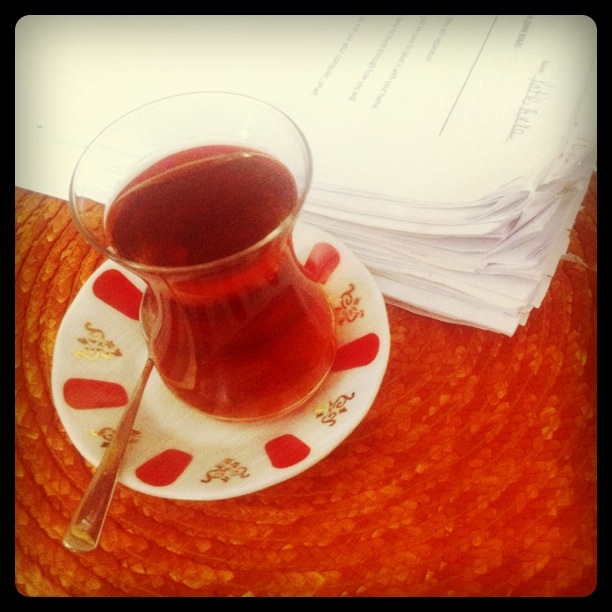
Papers to grade, tea to drink…life in a Turkish-American household revolves around the consumption of these tiny glasses of tea although we have shifted from the traditional sugar lumps to Agave nectar…(Image by Liz Cameron, it has been used before, as the papers I am grading today are electronic, and not those shown here – but the stack is equally large). The tea glass, however, remains the same!

Note: Hello dear readers, this is the first post that comes to you directly from my mouth to the computer screen, no hands involved.  Here’s to Dragon Naturally Speaking Software – it has its bugs, but it works pretty darn well! You can learn more about Dragon Naturally Speaking by clicking on this link.  This is a software program that you train to your voice, and use to speak into the computer’s microphone in order to have your words made into text on the computer screen.  They key, I find, is to speak slowly and pause after each word.  You have to add paragraph breaks on your own – and often it mis-hears names, so you may need to do a bit of editing, but I would say it is 90-95% accurate.  When M. tried it, however, the computer did not recognize many of his words due to his Turkish accent.  So far, we can’t figure out how to train it in Turkish, but luckily, he’s not the one with the shoulder injury! Unfortunately, Dragon doesn’t provide any red thread guidance, either, thank god that artificial intelligence has not yet gone too far.

Today’s post comes as I am failing trying to finish up my grading work before my medical leave begins in earnest.  So, I hope that my momentary procrastination has been interesting to you -perhaps if you too are struggling with your red thread, or how to structure some of your writing.

Posted in On writing about my life with the Karagöz puppets | Tagged , , , , , , , | 13 Comments

Guest Post #1: The Puppets Want to Talk About The Children


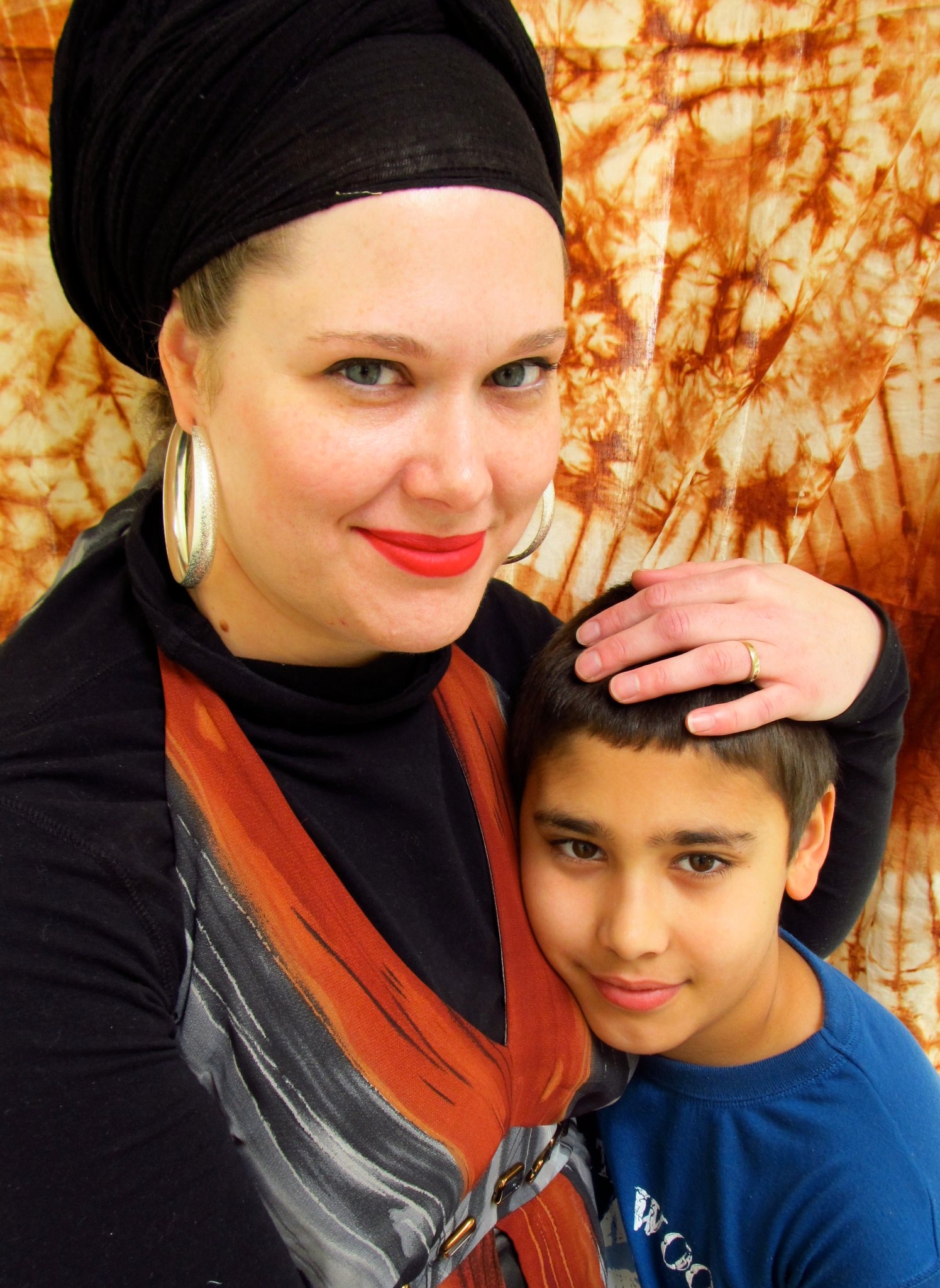
Deonna Kelli Sayed and her handsome son, Ibrahim. Deonna Kelli Sayed is an American-Muslim writer, author and cultural commentator.

Today, the Karagoz puppet troupe and I are so very honored to share an essay written by our e-friend, Deonna Kelli Sayed.  Deonna was kind enough to offer to write a guest post for me while my shoulder/writing capacity heals.  I am very moved by this act of kindness and sharing but even more moved by her incredibly thoughtful critical consideration of what it can mean to be a transcultural or cross-cultural child in the United States of America – and a bit about what it can be like to be the Mom of that child (or in her case, the Farsi Nanna).

I should mention that my M. (along with my internal puppet, Yehuda Rebbe, the wise man) was stopped in his tracks by her writing as I read it aloud to him last night – and immediately went to read more of her stuff.  She’s a powerful writer!  Although I have never met Deonna in person, I feel she is a kindred spirit and soul sister of some sort.  Thank you so much, Deonna!

Here is her bio: Deonna Kelli Sayed is an American-Muslim writer and author of Paranormal Obsession: America’s Fascination with Ghosts & Hauntings, Spooks & Spirits. She is also included in the New York Times featured anthology, Love, InshAllah: The Secret Love Lives of American-Muslim Women. Visit her at deonnakellisayed.com and her blog at deonnakellisayed.wordpress.com to learn more. She is also on Twitter @deonnakelli and Facebook at DeonnakSayed.

And without further ado, here is her essay, entitled “The Puppets Want to Talk About the Children”

___________________

I call on Yehuda Rebbe as my muse for this blog, for he is of the world and he is wise.

And, Yehuda Rebbe is appropriate because my son’s name is Ibrahim, as in Abraham-Prophet-of-Monotheistic-Faiths. Plus, it is important to reveal at this moment – if the puppets will allow me – that Ibrahim’s nickname is “Hebrew.” I cannot tell you how, why, or when this particular nickname started. Nor can I suggest that it is wise calling a little brown, multiraced Muslim child “Hebrew” in public. It is not meant to offend. What such a name suggests is how complex and global a child is when he arises from multiple cultures, and his mother named him in hopes he would embody the best of all faith traditions.

Odd little creatures emerge when spawned by and in-between the precious spaces of language, geography, and identity.

Yehuda Rebbe nods in approval regarding my son, Ibrahim, being Hebrew by name. He also approves of complicated, culturally complex offspring. His nose wrinkles a bit when he reminds me that such children are the future of America — and also of the world.

Ibrahim is an American-Afghan-Muslim boy aged ten years old.  According to the US Census, he is Asian-American of mixed race heritage. His mother is an effervescently white American-Muslim (christened Methodist, raised Southern Baptist, Muslim long before marriage) who has lived around the world. His father is light wheat-colored man from Afghanistan who currently lives in Sudan. Ibrahim was born in Baku, Azerbaijan in an elite women’s hospital where the toilet tissue was the shade and texture of soft sandpaper. By the time he was six, he had more passport stamps than George Bush, Jr did when he took office.

I mention skin hues not because they carry great philosophical importance, but because his mother, born and raised in racially segregated part of the rural South, has reared a boy who does not identify with America the same way she does.

This is a good thing. Many of us are assigned our race and cultural status at birth, even if we do not agree with such labels. It is rare that we jump ship. But some do circumvent such assignments, either through marriage, travel, or general life experience.  Then there are the children who are products of cross-cultural marriages. They get to write a whole new identity all for themselves; to discard that they don’t want, to keep what they do.

They get to make brand new puppets.

Ibrahim was four years old and attending a preschool in Bahrain when I first asked him what color he was.

“Brwown,” he said.

“Umm, you mean, you aren’t white?” I asked.

“No nanna, I’m brwown.”  (Yes, he calls his me nanna, because his father used to tell him to go find his nann-id, “your mother,” in Farsi. So my son essentially calls me what is equivalent to “granny” in some languages around the world). Of course he saw himself as brown. He went to school with Arab and Pakistan kids with names, foods, and a families that looked more like his own than those of his blond, British classmates.  His cultural experience wasn’t like the other white kids.

It was seven years ago that he decided to be brown. Not much has changed, although he has upgraded to “tan.”

Ibrahim knows that he is different.  “I’m a really complicated person,” is his 10-yr-old way of saying he is transcultured. He has lived and traveled around the world. He spent this past summer in Africa with his father.  The interesting thing about being a child conceived between multiple cultures (and I say between, because he is not a product solely of America or Afghanistan; he is a creation of many cultures) is that he understands that he is always bigger than the moment; that there are always another contexts to consider.

Some people will spend a lifetime before they learn that one, tiny little lesson.

Two years ago, I asked him to list all of his ethnicities, just to see how informed he was of his genetic and cultural profile. He held up both hands and starting counting on his fingers.

“I am Afghan and American. That is two. I am also Pashtun, so that is three. I am Azerbaijan, so that is four….”

“Honey,” I stop him, “American and Azerbaijan aren’t ethnicities. They are countries.”

“I know,” he says, “but they are in me.”

He continues, “And I’m part British, Irish, and Native American from your side, and I’m Red Neck from grandma…”

I interrupt him again, “Ibrahim, redneck isn’t an ethnicity or a race. What race are you?”

“But that is part of me!” He threw his hands down, overwhelmed by the task. “You know what? I’m just part of a human race. That is all.”

People from different cultures sometimes meet and fall in love. They often have children. Sometimes these children turn out to adopt the Jersey Shore parts of American culture just to rebel against the parents. Perhaps this aspect of America is easier to obtain that the other parts. But then, some of these offspring create a brand new cultural space; they redefine the very meaning of cultural identity in a global society

**

Ibrahim’s parents are no longer together. His father is abroad doing United Nations work; his mother is raising him as a single Muslim woman and trying to find her place in the world. What she misses most is the nicely shaped cross-cultural box that married provided.  Being married to someone from another culture and being Muslim made you Super Othered, and by some accounts, Super Cool. Now, the mother is just a globally-nuanced white woman working a low-wage day job with an interesting son who doesn’t see himself as part of white America.

The son knows that he has an Afghan father and a culturally complex American mother.  Who do you most identify with, the mother asks?  The son looks up at her with his big brown eyes, “Well, pader is from one culture, but you are from, like, many different cultures, so I see myself more like you,” he comments, before he returns doing his very American, very 10 year old Minecraft.

I can hear the puppets applauding now. Yehude Rebbe even speaks: “Score one for the white Muslim girl.”

—————-

Deonna Kelli Sayed is an American-Muslim writer and author of Paranormal Obsession: America’s Fascination with Ghosts & Hauntings, Spooks & Spirits. She is also included in the New York Times featured anthology, Love, InshAllah: The Secret Love Lives of American-Muslim Women. Visit her at deonnakellisayed.com and her blog at deonnakellisayed.wordpress.com to learn more. She is also on Twitter @deonnakelli and Facebook at DeonnakSayed.

Posted in Cross-cultural learning moments, Family Challenges, Guest posts, On Islam and Muslims, Visits from the Karagöz puppets | Tagged , , , , , , , | 15 Comments


We Karagöz puppets just learn of other puppet species – Muppet they call. We thinks they very deep thinker, but not this blue cookie man, he crazy. We puppet think we find Samuel Beckett book soon and show M’Lady, she need absurdist play, if interpret that way indeed we not sure.

Love,

the K. Puppets

KMRO's avatarLife of refinement

“Yeah, that’s deep, deep stuff.”

I like the idea of the Sesame Street folks carving out the time to produce such a segment.  Who pitches such an idea?
Who approves such an idea?  It is a nice illustration of the kind of abstract license that seemed to be available to Sesame Street at times.

I especially like the idea of not talking down to kids.  I guess there could be some perception of a mockery of Becket and philosophical/abstract plays.  But if your snide-upper-class-host-of-a-public television show is played by COOKIE MONSTER maybe you are the one being mocked.

How badass is it that the character who never arrives is the mass marketed Sesame Street super star Elmo?

View original post

Posted in Visits from the Karagöz puppets | 2 Comments