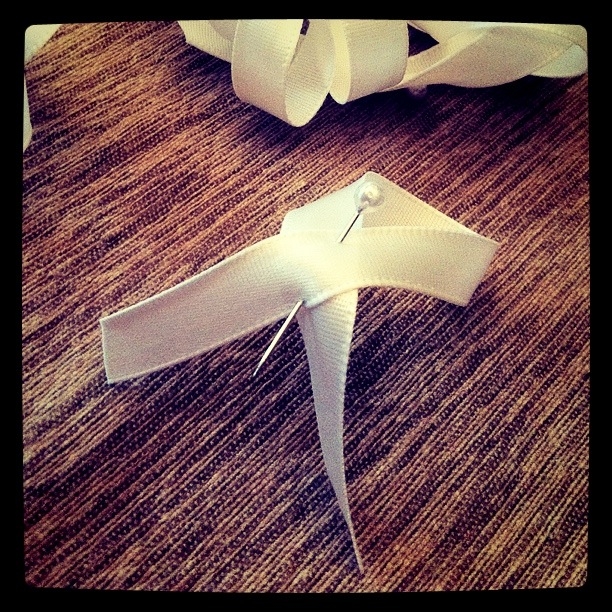

Beyaz kurdeleler: The puppets address violence against women in Turkey and the U.S.


One of the white ribbons the puppets made to honor the White Ribbon Campaign on March 1st, 2012. This campaign was started by men interested in preventing violence against women, including domestic violence/intimate partner violence and sexual assault. At my university, we go beyond the male focus...and the puppets have embraced this.

It’s the day after I have committed myself to applying for a Fulbright fellowship to Cyprus, and I am in the steep, warm ascent from deep-sleep to almost-awake sleep when I start to hear a slithery sliding sound. My eyes are still cloaked in warm red ember-colored glowing curtains (a.k.a. my inner eyelids) but I know that there is something that is traversing the space between reality outside of me and dreamland inside of me. I hear – sliding. I wish it would go away, as today will be a long day, and I have an important lecture to give. But soft wafts of silk seem to be caressing my face and after several tries, I am able to open my eyes to see what’s what I am met with beyaz kurdelelerinin (white ribbons) all over the place.

“Ah – she’s awake!” Esma the hippie puppet cries out – and I can see all of the ladies of the Karagöz puppet troupe lined up on the bookshelf at the other end of the room – watching me awake in between volumes of modern art tomes, feminist theory, travel memoirs, histories of World War I and Tin Tin books in French (somehow, this mix explains M. and I). “Why,” I think to myself, “are all the lady puppets over there – and what are all of these white ribbons doing hanging from the ceiling?”

Before I can locate the answer in the asleep part of my brain that remembers that I have had skeins of white ribbon in my house for weeks now, I realize that the male puppets are repelling down the ribbons onto my pillow. Hacivad Bey speaks for the group, saying “we have been watching you, m’lady, prepare your talk on intimate partner violence against women with disabilities for a special lecture during anti-violence week at your university, and we have learned about this thing called the White Ribbon Campaign and because we Ottoman shadow puppets are very interested in our life here in America, we are trying out something new for us, talking about the un-mentionable.”

Mercan Bey, the spice trader from the Arabian Penninsula was next to speak, wafts of cardamom swished around him as he made it to the bottom of his ribbon, and he said “we have learned that this campaign began after a terrible terrible day, at the École Polytechnique in Canada in1989, where 14 women were killed by an anti-feminist shooter. More specifically, we have learned that after this shooting, a men’s movement appeared in Canada, where men wearing the white ribbon were standing up against violence against women. The men of this troupe – even oppositional Karagöz who never likes to go with the flow of the whole – have decided to embrace the idea behind the White Ribbon Campaign. At first we men just watched the little chorus of dancing lady puppets make some of those pinned ribbons for you – remember that there is a whole batch ready on your dining room table, m’lady.”

Bebe Ruhi, the last to swish down his ribbon from the ceiling (man, these puppets really know how to make an entrance), stepped before Mercan Bey, but gave him a loving hug along the way before saying “BUT, after we saw M. pick up one of those ribbons and put it on his jacket to wear ALL WEEK, well, we were inspired. We know that violence against women is a major problem in modern-day Turkeysome say 50+ percent of all women experience intimate partner violence there. We know that there is a movement underway back home – and we know that there is even a Turkish all-female movie cast addressing this back home – but we want to do our part too. We want to be part of the solution, not part of the problem, so we have taken the White Ribbon Campaign pledge (see below) and we are spreading the word back all the way to Turkiye, through shadow puppet means, about the need for people to take a stand on this. We also think that it should be about everyone – not just violence against women – but we get why this focus is needed now, and it saddens us. We may be skeptical of all of these ribbons symbolizing all of these things – but that does not belie the importance of all this. We want you to ask your dear readers – will you take the pledge as well?”

Posted in Visits from the Karagöz puppets | Tagged , , , , , , | 20 Comments

The Karagöz puppets set their sights on Lefkoşa – and Nicosia


English: Map of the districts of Cyprus, named...

Image via Wikipedia

When I last left you, I was down in the dumps, perhaps a poor choice of metaphors given the topic at the time – the fact that a set of Qu’rans had been dumped in the garbage bin and burned…somehow this incident about which I have no unique connection hit me hard – and in some ways catapulted me to the bottom of the pit of post-tenure depression, which I now understand to be a documented phenomenon (you can read about that here). The response from readers was both faith re-instilling and heart-warming, but it took a few days to sink in.

Perhaps to perk me up in those few days and perhaps to get me to the task of finding a new academic raison d’être, the karagöz puppet troupe have been in high gear – jumping on the new iPad (gift from M., thank you!) whenever they have a free moment and even when they don’t. I just had a sense that they were REALLY up to something these last few days…and this morning I found out what it was. You see, those puppets, well, they have a new destination in mind.

“Wake up, m’lady, wake up!” Esma the hippie puppet said, as she fanned refreshing morning air towards me with her fresh rose petal fan.  “You need to get up to hear THE BIG ANNOUNCEMENT.”

Half-sandy-eyed, I sat up in the dizzy-movement way of a non-morning person who moves to quickly for her non-caffeinated body – and soul – to handle.  “Announcement?” I croaked, “big announcement?”  Looking around for the dog and the husband, I noted that those two early birds were already up and out of the house on their morning exploration of the nearby pond – and all of its resident canine charms (i.e. squirrel scents).  With nobody around to overhear me talking to the imaginary puppets, I realized I could speak – err – croak – freely. “What’s this about an announcement?” I questioned , begrudgingly exiting the comforting heated flannel sheets.

Karagöz zipped in from the kitchen at warp speed upon hearing this question.  He was so excited that I couldn’t understand a word he was saying for once.  Before long, the chorus of dancing ladies pulled him back with a cane – akin to old-time theatres in which a performer had over sung a song or overstayed his welcome on stage. Replacing the renegade Karagöz with an extra-large glass of tea loaded with sugar to get my brain going, the chorus of dancing ladies made way for the two elder statesmen Hacivad Bey and Yehuda Rebbe and, of course, the matriarch of the puppet troupe, my fairy godmother puppet, Perihan Hanım.

“We have come to announce,” Perihan Hanım began, “that we know the solution for you.  We know you are burned out – maybe some would even say burnt to a crisp with all the work you have put in at your university.  And this, m’lady, this is when you need to start planning for the next phase – and, m’lady, the next phase includes a S-A-B-B-A-T-I-C-A-L.” With a flourish of her sparkly green wand, Perihan Hanım stepped back and made way for Hacivad Bey, who said “we have seen you looking around at options for that year of yours – that magical year when you will do a project for your own professional development – and we have seen that you are either going to propose to write an academic book as part of a local fellowship OR that you are going to apply to take the year and teach in another country.”  Clearing his throat, Hacivad Bey continued.  “We see that you have looked at the Fulbright program – and that you are considering Hungary, Sri Lanka and Cyprus – as all might be interested in a social worker with some expertise in your specific research area. We were sad to see that Turkey was not calling for a person with your skills, but we have a solution.  We, you see, we the puppet troupe in your head, have decided what the best choice is for you.”

Yehuda Rebbe stepped in at this moment.  “M’lady, you have been wondering if it is the right choice, Cyprus, as M. and the dog are not so sure on Hungary and as it looks like Sri Lanka isn’t looking for  your exact specifications, as much as M. would like to go there again, and we know that you have been a bit nervous about the idea of Cyprus as you would likely have to reside on the Greek side, but, m’lady, we puppets have decided that if you are true to your word about being interested in the joys and challenges of cross-cultural life – what better place to go than the lovely capital of Nicosia – which – you see – is actually my birthplace!

“Nicosia?” Hacivad Bey said with surpise, “well, surely my learned friend, you are referring to the wonderful metropolis of Lefkoşa!”

“No, my equally learned friend, I am referring to Nicosia.”

“Lefkoşa!”

“Nicosia!”

“Lefkoşa!”

“Nicosia!”

“Lefkoşa!”

Absorbed by their debate – I realized that the central cross-cultural conflict that exists in Turkey – that set in motion in 1974 – was manifesting right here on my flannel bedcovers in the form of a Rabbi of Greek Cypriot origin (what are the odds?) and a learned Sufi of Turkish-Cypriot origin. Cyprus, an island off of the southern coast of Turkey, is half Turkish and half Greek – as well as the subject of much political strife.  What better place for cross-cultural consideration?

Waving her arm as if casting the debating friends aside, Perihan Hanım stepped in.  “It is decided,” she said with pomp and assuredness, “you are applying for a Fulbright Scholar position in Cyprus.  You will apply to teach on the Greek side and on the Turkish side.  You will learn all about the different brand of academic hell over there – and you will have fun doing it!  You will have to do some crossing of the infamous Green Line if they accept you, but what better place to continue your cross-cultural exploration of life than Cyprus?  We have been whispering into M’s ear at night for several nights -and he is ready to do this as well – for as much vacation time and leave time he can acquire of course – you will have to do some of this on your own.  As for the dog? Well, he doesn’t much like the idea of leaving home, but it will all work out in the end if it is meant to be.  He supports you in your efforts to do this.  Now, get up, and start writing letters of inquiry.  The future is yours if you will just try.”

Before I knew it, the iPad was in my hands, and I was composing notes to academics on both the Greek and the Turkish side of the island of Cyprus regarding letters of invitation – a requirement of the Fulbright Commission in that country.  So, dear readers, keep your fingers crossed that I may write to you, yavash yavash, from Nicosia a.k.a. Lefkoşa during academic year 2013-2014!

Typing away madly, I saw a flash of white out of the corner of my eye.  There they were, the whole puppet troupe, riding around on the dog, with a banner flowing out behind them, it read “Cyprus, or bust!”

Posted in A Karagöz puppet battle, Academic hell, Turkish Controversies, Visits from the Karagöz puppets | Tagged , , , , , , | 5 Comments

Bebe Ruhi sadly questions Americans and Qu’ran burnings


On Islamophobia (click photo for source, credits)

When I last left you, I wrote about my early exposure to Islam.  Specifically, I wrote about my parents’ interest in Persian rugs, and the carpet-weaving community’s practice of always leaving at least one mistake in their work as “only Allah is perfect.”  You can read more about all of that here.  While this was hardly an exhaustive introduction to the tenets of Islam, I do feel luck to have been raised by parents (one agnostic, one Christian) that was more than open to learning about other cultures and religions – as imperfect as those efforts may at times be and as imperfect as any human can be in their efforts to be respectful of, sensitive to and aware of different cultures and religions.

Efforts to open my mind continued in my high school – and in fact my first exposure to the idea of feminism was through the writing of Fatima Mernissi, who wrote about Islamic feminism (on how Islam and veiling in particular allow women to be treated as respected equals, more on this another time).  While in college, I lived as a non-Jewish person in my University’s residential Hillel House, where I learned about Judaism and keeping kosher.  Flung heart-first into the experience of religious intolerance, I experienced our Hillel House’s post-traumatic stress after members of the Aryan Nation senselessly broke into that house on a school break – intentionally defiling the house with feces, urine, spray-paint and meat on the dairy dishes.  It was confusing and heartbreaking – why would someone do this?  I wrestled with this question on gut and mind levels for a long time.  Even though I have answers, the whole thing still makes my stomach hurt.

Later, while practicing as a social worker in New York City, I worked with many Muslim immigrants, mostly from Yemen and various parts of Africa.  Tasked with investigating child abuse and/or neglect, my cross-cultural thinking was put to the test.  I often wrestled with the question “if it is right in one culture, should that be able to stand in a second culture of residence – and vice versa.”  While I disagreed in a very personal way with some of the ways the tenets of Islam were implemented in some of the families I worked with when it came to disciplining adolescents walking the cross-cultural tightrope of their new culture and their family culture, I did my best to be fair in my decision-making and to respect all I worked with to the best of my ability.

It is, perhaps, these facts of my upbringing as well as the fact of being married to a person from a Muslim majority country and the ways he is sometimes misunderstood or stereotyped that lead me to feel so upset about the most recent Qu’ran burnings in Afghanistan by U.S. armed forces and the reactions of some of those around me.  It is always painful to me, cringe-worthy even, when friends or family in Turkey work to make sure that I understand they do not associate themselves with the worst that call themselves Muslim, much as I distance myself from those soldiers that decided to burn religious books in a garbage purge.

It may sound cliché, but my extreme disappointment and upset over this incident so far away renews my commitment to making some kind of a difference in the lives of my students – a few of whom I overheard last night joking about this incident in Afghanistan.  My heart sank, my anger surged, and I said nothing.  Normally, I am fairly “out there” but I am trying to be more mindful of and attentive to the power of my role as a professor and the need to ask calm questions to encourage them softly to look at their statements and views in a way that might bring some learning and transformation.

Today, I am just left with Bebe Ruhi, the ever-questioning Karagoz puppet in my mind, who has tears running down his cheeks, and rocks back and forth, asking these questions over and over:

How can these kind and loving students who are training to be social workers be so mean in their comments? 

How can you get them over this hump of ignorance?

How could these American soldiers be so disrespectful?

I know people are ignorant and in pain about 9/11 and whatever they are experiencing on the ground, but how could they be so stupid and inflammatory?

I know soldiers get all worked up with what they are expected by their governments to do – and sometimes experience moral conflicts, but why does this keep happening?

How does this type of behavior square with the alleged religious tolerance the United States supposedly represents?

What is wrong with Newt Gingrich, that bombastic idiot, for questioning President Obama’s decision to apologize for this? What on earth is wrong with an apology?

M’lady, can you explain Americans to me?

None of these are new questions or particularly unique ones.  Many of them have many documented answers already.  Today, I am feeling down, and I just wish these questions would be less present in life as they are just so painful sometimes.  Must be a blue day.

Posted in America post 9-11, Early exposure to Islam, Visits from the Karagöz puppets | Tagged , , , , , , , , | 27 Comments