Global warming and diving ducks: Our “cultural iceberg” looms


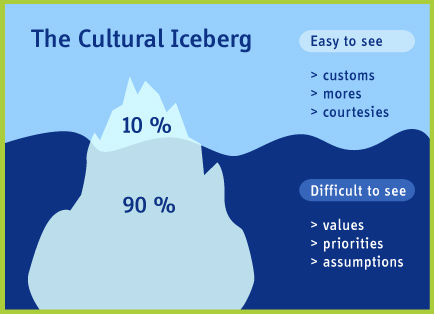
Image of the cultural iceberg thanks to cross-culture.de

Yesterday, icebergs were spotted off of the Northern Aegean coast on the Turkish side here at slowly-by-slowly.  The field of ice was so wide that it reached all the way to the craggy New England coast.

Karagöz was at the helm of my ship of life and called out – “land ho!” and then screeched in horror “not land – crap – iceberg ho! scramble the hatches and lift the boats and whatever else sailors do – I don’t even know their terms!”  It is rare to see Karagöz shaken up like that.  He is the agent provocateur, the mischief, the imp, that wax papery shadow puppet from Ottoman times who has come to reside in my head.

Now, mind you, the icebergs I am referring to are metaphorical icebergs.  You can see the image to the left – or you can read a bit more about it here.  So, this morning I awoke to the wise wan Yehuda Rebbe, who was studying the iceberg intently.  “You see, m’lady,” he intoned, “I am observing this iceberg as I myself and my countrymen have much to learn about our own Israeli-Palestinian cultural iceberg fields. You, however, have it a little easier.  Make the silver lining of the aqua ghost monsters worth it to you and M.  Be sure to explore it all.”

“Hmmm,” I thought as if old oil was clogged in the mechanics of my brain, “I am not sure what he means.”

Icebergs or no icebergs, I am not a morning person, but my life partner and husband M. is very much a morning person, so, icebergs spinning in my head, I got up to spend some time with him.  I tried to offer something nice, to drive him to work on a chilly day.  What better place, I now realize, to find icebergs, than on the road to work, in the morning, on a chilly day?  And of course, we drove right smack into one.

“You haven’t commented on the new puppets, Saf and Dobra, and their love-hate relationship with Turkey,” I said slyly, referring to my last blog post and wondering how M. would respond. “Ce to think of it, nobody else has either – I wonder if they are afraid to comment as I wrote the words “Armenian genocide” even though do not think I was being offensive to the Turkish state and/or at risk for being 301’d.”

“You know me, I am better with images than words,” M. countered, “I love your blog.” Shifting a bit in his chair, M. continued “and you can write whatever you want, but don’t be surprised if they track you down and it impacts your Turkish citizenship application.  But you need to follow your heart and not be afraid to write what you think.  Screw the Turkish citizenship, you know?  I mean, I don’t think you wrote anything offensive – you wrote about your mixed feelings about how the whole thing is addressed in Turkey by the government – and you are in the U.S. so that protects you some – but I have been out of the country for many years and people may take something differently than I would expect so I don’t know.”

My head began to pound.  I was caffeine-less and driving and in the morning, a tough tripartite oligarchy for the moment.  “What are you saying, M.?” my brow was furrowed, and my sharp stomach pains from what I guess is a pre-ulcerous condition as a result of my stressful professorship panged and pinged across my upper-duodenum (site you start to feel an ulcer).

“I don’t want to censor you,” he said strongly – his voice loud with conviction, “I will never do that.  I want you to speak your heart and mind no matter what.”

“Are you saying you think I have insulted the Turkish state?” I gasped out the words as I inched the car across the intersection.

“Well, here is what I can say, in Turkey, we have a saying….” M began.

[Cross-cultural interlude:  I always know we have hit an iceberg when M. starts a sentence this way.  I feel as though there is a to-my-ears obscure/opaque Turkish saying for EVERYTHING. This is part of how I first began to notice the icebergs on our cross-cultural roadtrip called Turkish-American marriage]

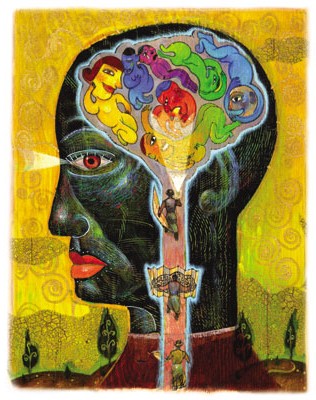
Ducks, in this Turkish proverb, are a symbol of being made a fool of when people take things the wrong way...it took me a bit of time to understand the Turkish logic/mores/values/customs behind this one (image from http://www.poetry-innerspace.com)

M. cleared his throat and began to narrate the story.  “The story starts like this…two friends are talking with each other.  One said: today the weather is bad and it is going to be rainy, looks like it anyway.  The other friend said: you mean to call me a ‘duck!’ Scrambling to clarify, the other one said ‘No I didn’t mean that, where did you get this idea?”

Cocking my head to the right, I said, very eloquently, “huh?”  I heard the iceberg scratch the car as I drove along.

“OK,” M. said, “let me try it in this replay way.  The friend said ‘when the weather is bad, it rains, what happens in a rainy day?’ Well, where the water accumulates in the pit, it consists of ponds, the ducks swim in the pond, so you called me a duck…’ do you understand now?”

The metaphorical scratching of my head in confusion was only blocked out noise-wise by the shardingly-steely (new word) screech of iceberg against steel and I thought about the Titanic sinking.  “M.,” I said, “what the hell are you talking about?”

It took a while, but M. explained that in Turkey, to call someone a duck is to call them stupid or ignorant. The proverb suggests that people can take seemingly innocent statements and misinterpret them…which links to how M. was warning me about what I wrote on my post the other day.  Specifically, he wondered if someone might take it the wrong way…

So, here we have it – M. and I in the car, in the morning, pre-caffeine, debating the far-reaching fingers of cool censorship and oppression and how it may or may not be infiltrating our life in New England.  So, that iceberg that the car was grating on as we drove through the city?  Refer to the above graphic which suggests that 10% alone is visible.  Today, my image of that iceberg was one that was bobbing up and down in the waters of our relationship in the context of the world.  So, cultural customs are showing (albeit unclear from the fog at times) and the need for cultural courtesies are abundantly clear (e.g. Turkish cultural mores in the current political environment there re: not insulting the Turkish state).  However, the glimpses I am catching of the underwater portion of hte iceberg are harder to identify, namely, the values, the priorities and the assumptions – they are down there swimming with the diving ducks in M.’s story, I suppose.  I wonder when one of those diving ducks may surface to show me sliver more about the iceberg matter underneath – values, priorities and assumptions as they relate to speaking my mind and how to handle that.

Posted in Cross-cultural learning moments, Visits from the Karagöz puppets | Tagged , , , , | 2 Comments

Icebergs in Türkiye


Iceberg

Iceberg (Photo credit: graceinhim)

Yesterday, I saw a number of icebergs in my dreams.  Hopefully they are not precursors to my own personal Titanic in some aspect of my life.  I should mention that I am meeting with the Provost at my University today (in 29 minutes, gulp) as the next stage of my tenure process – but it is considered to be “over the hump” at this point, my mentors tell me.

Perhaps all of the iceberg imagery was in relation to a bit of worry about yesterday’s post on the love-hate relationship we have with Turkey in this home (my view, M. has not weighed in on this) and whether 301 will be used against me if I speak out more…for those of you not in the know, “301” refers to Article 301 of the Turkish Penal Code which, according to Wikipedia “makes it illegal to insult Turkey, the Turkish ethnicity, or Turkish government institutions.”  I do not think I have done so, I was careful in how I framed my word, but who knows how my best intentions are interpreted.  Don’t get me wrong – I adore Türkiye but am aware that there are some challenge – as with my own country and as with any country.

Click on the image of the cultural iceberg for the link to the source of this image

So, leaving fear of 301-shaped icebergs behind for the moment, the icebergs I am going to refer to in this post are icebergs in Türkiye of a very different sort.  Thee are the icebergs that do a lot of melting while M. and I are in Turkey.  The graphic called “the cultural iceberg” should explain it all.

I’ll spend the next few days breaking down what has been floating above the line in my life – and where I think we are going re: figuring out what is below the line in our life (note my vs. our as it is a process).

What is especially interesting to me is that while we spend most of our year in the U.S., it is in Turkey where most of our iceberg melting goes on…in so many ways, M. feels to me to be super-acculturated to the ways of the U.S. and often feels out of step when he returns to the country of his birth…but as he said to me at the sink a few weeks ago while we were doing dishes together – “there must be those deep things in me from my Muslim root – just like with you and your Christian root – even if we do not practice religion at all or just a little, respectively.”

Keep it locked, as the radio station host say – and let us know how your icebergs work.  I’ll be back with my views on our icebergs tomorrow.

Posted in Academic hell, Cross-cultural learning moments, Visits from the Karagöz puppets | Tagged , , , , , , , | 3 Comments

Introducing Saf and Dobra: On a love-hate relationship with Türkiye


Sometimes I feel like this troupe of explorers when I am observing my husband struggle with his clearly conflicting emotions about his country of origin (image thanks to U Wisconsin Alumni at this link)

Today I met two new puppets, Saf and Dobra.  Saf is an idealist, myopic in her micro moment, focused on her love of her homeland.  Dobra, on the other hand, is more like Karagoz- an outspoken agent provocateur who stands up loudly and proudly when it comes to what her homeland can include and/or does horribly.  This is the story of why I think they showed up today.

“In Turkey, human life has no value.”

Of course, this is not a blanket statement, as I see it.  But, I have been hearing M. say this more and more recently.

And it alarms me.  It is not the only way he feels about Turkey, of course, but it alarms me.

It seems to come from some deep place.

Most recently, it has related to the deaths of young Kurdish smugglers and Turkish military conscripts alike – but has also related to what we believe is the indiscriminate use and/or testing of major psychotropic medications (and the concomitant major side effects that last forever) on young people without any regulation whatsoever.

But it is more than that too.  It relates to family expectations, cultural traditions and the dark (in the metaphorical sense) underbelly of Turkish ways that are about things more subtle and less obscene than what we often hear about or talk about here at slowly-by-slowly re: M.’s country of birth.  Those topics generally include culture-driven ways of relating, the incessant red tape of everyday life, the embrace of U.S. values and products that lead to a recherche du temps perdu and on a more positive note, more enduring cultural traditions that are not very controversial.

This is a different reality than what I will classify as the mixed feelings of malaise that some Turkish American expats (and indeed some Turks in Turkey) I know feel in response to what is widely viewed as the AKP (current ruling party) intentions to move from a Kemalist-style secularism towards a lifestyle such as that lived in the Islamic Republic of Iran.  Those other, deeper, darker and more terrible things, such as the fear about the end of true secularism, are generally grouped as follows, in no particular order:  decreasing identity of the nation as a secular state due to incrementalism on the part of the AKP, so called “honor killings” of young women in relation to sexual activity and/or sexual assault, debates about whether the Armenian genocide should be named as such or just what it was that leads people to debate the use of that term in the first place, debates about whether the treatment of Kurdish people can be classified as ethnic (and other) oppression or not and the prevalence of intimate partner violence – especially violence against women in Turkey.   Without getting more specific, as I am afraid the  Turkish censors will be after me and my readers will run like scared fish into a bait ball, suffice it to say that M. has mixed love-hate feelings about his country of origin as well as this, his country of choice.  It seems more than fair – and obvious – to say that we could make a quite similar list about the United States – and this is the subject of much discussion in our home. By now, Dobra is jumping up and down, yelling at me to make a post each about each of these things I have mentioned – just to watch my language so the censors don’t get me so that I can keep using my voice.

No large nation-place is ideal.  Sometimes I think that Saf is ingenue-puppet who longs for an idealized Turkish quiet life in Anatolia.  While I know more about reality than that ingenue-puppet, who came to introduce herself to me today (her name means naive, pure, clean, etc.), she is still a part of the puppet troupe that is helping me figure out this aspect of my cross-cultural roadtrip called this Turkish-American marriage.  She tells me, “take care, m’lady, not to write about these deep dark things, they will give people the wrong idea of Türkiye .”

English: Map of the number of Turkish people i...

All my life I have sought out a different type of life with what at times might be referred to as a vengeance.  I have tried to learn and grow my brain beyond the myopia that is rampant in the U.S. My career is central to this effort.  Now, here I am with a very different partner who is also a Turkish American – and I find that he has very strong negative feelings about his home country that range in the love-sad-hate-love spectrum depending on the topic.  This has challenged me a lot and made me more of a critical thinker.  I am not quite clear enough to write more on it, but wanted to plant these first seeds now, since Saf came to introduce herself, shyly, today and as Dobra blew in like a hurricane, to yell her introductions from across the room.

Today, they named themselves, at least, so that is a start.  So, while Saf will continue to wax lyrical about all things Türkiye that have come into her life, we’ll see how Dobra manages this.

Posted in Introducing the Karagöz puppets, On writing about my life with the Karagöz puppets, Turkish-American Matters | Tagged , , , , , , , , | 10 Comments