
Panoramic image of the Aegean Sea (Ege Deniz) at sunset from Clara S. via Flickr
It was an otherwise glorious scene, blue skies heading to sunset, hot sun fading towards evening, smooth teal Aegean sea with the beginning pink twinges towards twilight, a litter of white adobe houses taking on the pastel hues of nature as they lay splayed across the arid landscape covered in sweet-smelling herbs – and the blessed evening breeze. What could be wrong when the world around me looked just like this?
When I last left you, I was sitting on the terrace of M.’s brother X.’s summer home near Bodrum. X had just delivered what I am referring to as a “Sicilian message” about what would ideally happen to women who cheat his brother – and by his definition – the family. It was a jarring statement that took me completely off guard. The statement did not seem to fit right in this otherwise “modern” and from what I could see “western-oriented” home full of English and French speakers, all with master’s degrees from European universities.
 As the bead-laced door into the kitchen swirled with the exit of X., I sat, a bit dumbfounded. Silent. Part of me in shock and part of me so imbued in trying hard to accept the culture around me in this family that I almost did not register that X. had talked of “taking a (cheating) woman to the mountain to rape her a thousand times.” This was not some tribal village. This was not Eastern Turkey where stories of honor killings filtered out from in the media. This was not the 1800s, what the heck was going on?

The shoes Karagöz left in the purse once he commenced sliding across the tile floor
I soon learned that my shadow-puppet friend Karagöz was more than happy to fill me in on what was going on as I sat, log-like, confused, torpid even. Karagöz had at first emerged from the purse where all of the puppets had been hiding during my conversation with X. Instead of launching into a crazed, alliterative diatribe as was his usual wont, he commenced sliding across the tiled floor, row by row, at breakneck speed, screaming bloody murder at the top of his waxy-papered lungs. He was sliding in his socks, having left his fancy shoes back in the purse, I presume. Then, stopping at a dead halt, he turned to face me from the middle of the terrace floor, and he said this “Watch out for this guy. Yes, he’s acting crack-cocaine high. But he says this not on the fly. My oh my. You may be asking why. You’re only answer comes from drinking rye. Just let the conversation die.”
At this point, Hacivad crawled out of the purse. I watched him with almost blank eyes as he made his way across the floor, up the white canvas couch and on up my dress and onto my right shoulder. I turned to my left, leaning my head on my shoulder, remembering finding some comfort in my Granny’s house by the herb garden there, the scent of sage intermingling with mid-summer tanned-skin smell. “M’lady,” Hacivad prodded gently, “you just need to take space and time to understand this. You need to talk to M. about this. He will help you to understand. This is nonsense talk, unacceptable talk from X., but you need to understand it and where it comes from. Do not expect to understand today. Also, do not expect to be X.’s equal, which I think you did. You think of him as one of your age cohort, as one of your generation, but it is clearly different for him.”

Karagöz and Hacivad resembled a tumbleweed as they fought, their wax-papery selves getting shreded and intertwined in the process
Karagöz let out a screech. Back to his old mnemonic tricks, he exclaimed with more of a fevered pitch than usual “you need to kick his ass, tell him who’s the lass, no raising of the peace glass, tell him he must not be so crass!” Annoyed, Hacivad began to display a set of uncharacteristic behaviors and verbalizations. “You fool, do not encourage this! Serious business we have here and you must cease and desist! She does not know what she is up against here!” Before I could even imagine it, Hacivad had, in his uncharacteristic ire, leaped off of my shoulder and jumped full-force onto the jokerish Karagöz. The two were fighting, whirling in the process, flailing all over the cool tiles like a raggedy-edged tumbleweed gone wild.
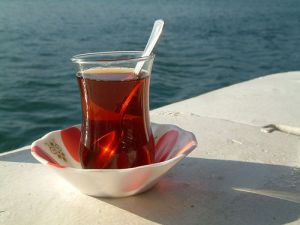
The chorus of shadow puppet dancing ladies began to emerge from the purse by the beaded door in huddles of two and three. “Oh!” they cried to a one, “oh, horrors, this is a terrible, terrible thing. Such things that men do. Such words that men say. So misguided they all are. Shame on them all.” The melee and audience continued as Kalinka arrived through the beads with a glass of strong black tea. She sat next to me for a moment after looking around furtively to make sure her boss was not about to come back and see her sitting with me, or at least that is what I imagined the look to be about. She began to talk to me in her own Moldovian (limba moldovenească or лимба молдовеняскэ) language which, of course, I understood nary a word of. She smoothed her hand up and down my back, clearly seeing some upset on my face.
 While my conversation with X. had been in English, and I know she could not have understood it, she had seen a bit of the affect involved in the interaction, and so she had a sense that something bad had gone down. Her soothing led to my tears letting down like breast milk responding to a baby’s cry. Kalinka wiped my tears away with a cold washcloth and got me back into a presentable state by starting to do whatever she could to get me to laugh. First, she amped about like X., imitating his movements to a t. Second, she just began dancing around in the goofiest manner possible. She had no idea that at one point, she stepped clearly and firmly on top of the tumbling testosterone duo comprised of Hacivad and Karagöz, who crumbled to dust under her foot whilst the little ladies sighed and fainted. I felt as though she must be employing the tactics used on a two year-old child to distract them from whatever the upset of the moment was. It worked.
All of a sudden, she stopped at the sound of a door shutting downstairs Turning to listen, we heard X. and M. walking up the stairs into the terrace-kitchen area. Kalinka winked at me and scuttled back into the kitchen. The laughter and joking felt clear and easy between them as futbol-related words emanated from their conversation into the part of my brain that understood some Turkish. As X. went to get his tea, M. jumped onto the sofa next to me, planting a big kiss on my cheek before saying “X. said you had a good conversation, really got to know each other, while I was asleep. That’s great!” I could tell beyond a reasonable doubt that he had no idea about the rape comment. I leaned towards him and stared out at the dimming light over the sea, wondering how such ugly words and mixed-up feelings could possibly be present in such a lovely place.
Related articles
- Of cigars, ironing and my very own “Sicilian message” (slowly-by-slowly.com)
- On managing stereotypes about Middle Eastern men (slowly-by-slowly.com)
- Tea at breakfast: Sweltering in my smile with Hacivad and Karagöz (slowly-by-slowly.com)