
How the Cape Cod Screen Porch and Mérida Courtyard Manage the Elements
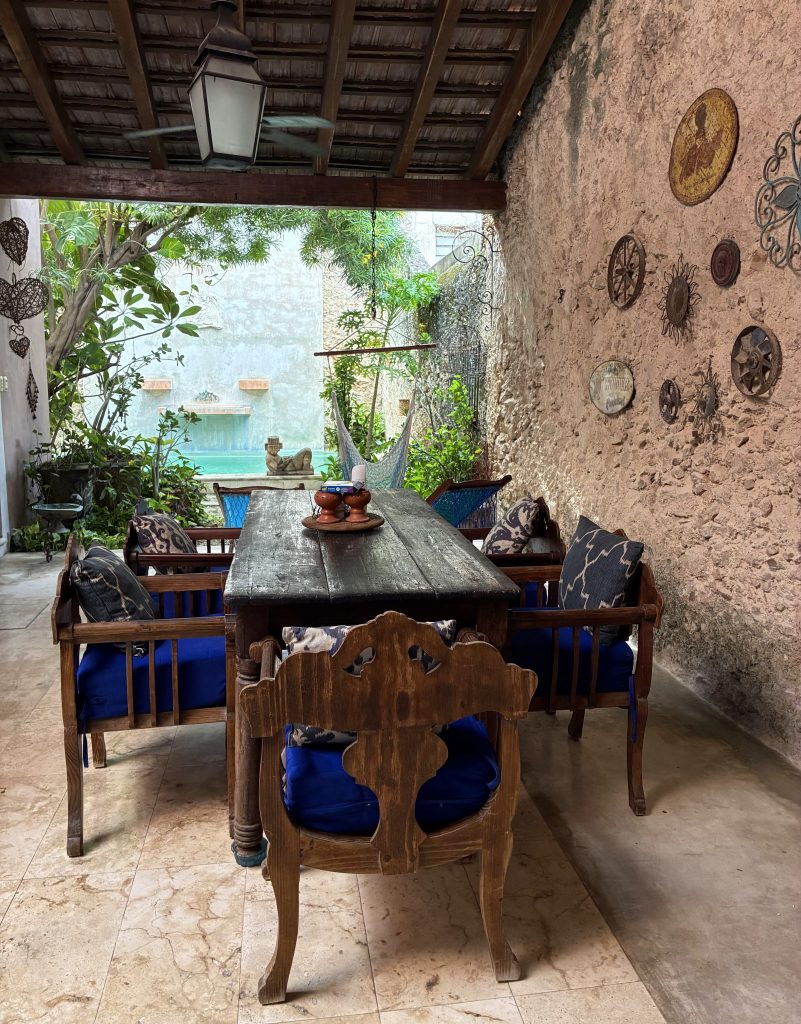
Mérida, Mexico is a place where many from the Outer Cape escape in winter, just like the Piping Plovers. As I sit here in July, 1,850 miles from home in Provincetown, MA as the crow flies, I wonder about the similarities and differences of these seasonally-driven places. July is the low season for Mérida, and I am here on business one again, missing the scent of the rosa rugosa, the thud and thump of tea dance and other joys of the Outer Cape’s high season. Stuck inside during the hottest hours of the day from 10 am to 4 pm, I am languid in the dark, limestone-walled courtyard of my rental apartment. I’m thinking of a friend’s screened-in porch in Truro, and how I’m missing seeing the bunnies hop across the clover-covered lawn.
And as I lie here on my laptop, and observe my surroundings, I’m thinking, architecture in general really includes a conversation about how much of the outside world we want to let in. What does this architectural dance look like Mérida and on the Outer Cape? In the harsh but beautiful climates of both the Outer Cape and the central Yucatán Peninsula, I can see that this conversation results in both ingenuity and compromise. We know that humans require shelter from the wild forces of nature, but we also languish without access to that very same nature. How do these two locales navigate this tango?
Let’s start by considering the classic Outer Cape screened-in porch. It is usually a timber-framed appendage tacked onto the back of a shingled saltbox-style house. I imagine that architecturally, it may be an afterthought that in fact becomes the center of our living space during the season. With walls a tight weave of wire mesh, its purpose is catching the fleeting breezes from Cape Cod Bay while simultaneously keeping the ferocious salt-marsh horseflies and mosquitoes at bay. I suppose that sitting in a screen porch is a bit like living in a liminal space. Perhaps you can hear the rustling honeysuckle bushes, perhaps you can smell the low tide and some of the remaining decaying squid, and you are aware of the fog unfurling from over the dunes on those kinds of days. And yet you are safe, with the screen as a sort of democratic barrier between you and the world, letting the air flow freely. We know that the New England summer is all too brief, and cannot be spent entirely behind glass. We do what we have to do with the screen porch, living with the sound of the creaky springs as the light, summer door slams shut, keeping the bugs out.
Now, shift the lens to where I am sitting in the urban grid of the colonial city of Mérida on Calle 59. Here, unlike Cape Cod’s screen porches, the architecture looks inward in a different sort of liminal space. I would say that here, the architecture adopts a defensive posture against the intensity of the heat. As I write at 2 pm on a Wednesday in June, it is 92F and quite humid with thick air abounding. Mérida offers a different kind of climate intensity than we have at home. From the street, the traditional colonial stone homes usually present as single-story monoliths with unyielding facades. Stone walls are pretty high, windows (covered in curly-cue bars) few, doors carved, wooden and heavy. All of these architectural elements guard private life from dust, noise, and of course the blistering heat of the sidewalk, even on the shady side of the street.
But step through that heavy door into the transitional space known as zaguán, and the house opens to the air, although often with a canvas or wooden lattice cover to block some of the light and heat. There are even dark-colored mesh shields called malla sombras you can buy to cover the bright light reflected on the walls here, to create sombras, or shadows. All of this is what comes with the Mérida patio. Every home I have ever stayed in here in the city center has one. You might say that the patio is the open-air stone heart of the home that has been designed to assist in managing this tropical clime beyond sitting diagonally on the ever-present hamaca (hammock) and letting the air swoon around you. Reading up on this topic, I learn that the presence of a central courtyard functions, in a way, as a thermal chimney. It is an understatement to say that the sun beats down on the ceramic tiles, and as the hot air rises, it draws cooler air out from the shaded, high-ceiling rooms around the courtyard. The torrential rains of summer also allow for the cooling of those tiles, and the filling of cisterns traditionally and in modern times, the ever-present “plunge pool.”
Both the Cape Cod screen porch and the Yucatecan patio are wonderful spatial solutions to a universal human challenge – how do we balance our simultaneous need for privacy and engagement with the climate with the raw force of the weather? I posit that the screen porch is like a net cast into the breeze and the stone patio is akin to a clay vessel for catching the moving sky. One filters and the other tames. In both types of spaces, we find people living joyfully, refusing to shut out the world completely


