The Karagöz puppets comment on recent legal changes in Turkey, my absence from the Internet & obtaining a “certificate of good citizenship”


20130905-181338.jpg

The Karagöz puppets have been nagging at me. “When are you going to write about us again on that Internet?” I usually say something along the lines of “be quiet, I’m studying Turkish on Rosetta Stone,” or at times I’ll just say “I am so tired and I don’t feel well, I have to put my health first, beyond puppets.” This does not go down well.

They are done being diplomatic and are now much more insistent. I hear them whispering as a group, saying things like “now that M’Lady is still sick, the cross cultural elements of their relationship are even more present in odd ways where perhaps he is not Turkish-seeming at all given how supportive he is! She should be writing! The potential for macho myth stereotype busting is off the charts and she’s ignoring it.

And then I hear the politically correct puppet named Esma say things like “just because he’s a Turkish man, we shouldn’t assume he can’t or won’t be happy to cook and clean.”

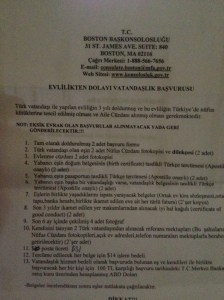
However, nothing got the puppets more riled up and giggly than seeing the instructions for our Turkish citizenship application for me. They thought the instructions were a perfect example of Turkish red tape bureaucracy. And indeed I do agree. The puppets were not, however, very helpful when it came to understanding how to implement the instructions.

The modern puppet, Celebi, was feeling a bit sarcastic and downtrodden when he commented on our attempt for me to gain Turkish citizenship. He reflected “why do you even want to think about getting Turkish citizenship when there are incremental moves being made by the AKP – such as this move to separate men and women from eating together in public universities. Or even the idea that police should be allowed to search and investigate co-ed private apartments near universities. Every day, there is something new that takes us farther towards traditional sharia-types of law.”

Regardless of our concerns about what is happening in Turkey, we are still exploring the citizenship option – mainly so I will have health care and expanded property rights for our time there.

So, today’s post is actually more of a question. As my application for Turkish citizenship (slowly) moves forward, my next task is to obtain a “certificate of good conduct.”

Oy vey. Allah, allah! How’s that for Islamo-Judaic mixing?

In addition to multiple other bureaucratic papers and photos, we need this in order for M. to apply for our “aile cüzdanı,” which by understand to be a “family card” listing all the members of his family. Of course, needless to say this is a patriarchal focus. Whatever, I’m over that.

Here’s what I’d like to know – how have others gathered this “certificate of good conduct?” Via a criminal record check in once State – in the United States? A letter from a trusted Turkish friend or relative? Any advice greatly appreciated!

And now I will return to Rosetta stone studying… A program which I love and highly recommend. I am speaking more Turkish than I ever have… Even if it makes the puppets cringe, wince and roll over to play dead at my at times grammatically horrible misstatements. More on that to come!

Hoş çakalın!
Posted in Turkish-American Matters, Visits from the Karagöz puppets | Tagged , , , , , , , , | 8 Comments

Quince mania: The ayva tatlısı that was 9 years in the making…


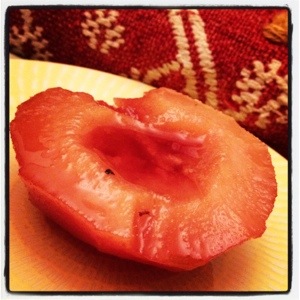
Ayva tatlısı or quince sweet a la M (Image by Liz Cameron)

Ayva tatlısı or quince sweet a la M.  He commented that his rendition of this traditional Turkish dish was “perfect” but he needed some kaymak (sort of like clotted cream) and walnut to make it “over the top.” (Image by Liz Cameron)

Last night, M. and I enjoyed the most luscious of Turkish desserts, Ayva tatlısı or quince sweet.  And it was a welcome change to our diet of take out food – none of which has included dessert.

Much to my surprise, the last few weeks have involved the consumption of takeout food. The Karagoz puppets, along with M’Lady, M. and the dog, have STILL been totally wiped out from the series of ongoing health challenges M’Lady is facing.

In the face of all the takeout boxes, Kenne, (the queen of etiquette and maintenance of ladylike behavior puppet) has even given up on encouraging me to cook, instead focusing on the etiquette of how to deal with delivery people.  She is basing her teachings on Miss Manner’s Guide to Saving Modern Civilization, an updated version of the original etiquette guide.

Champion quince

So, given all the focus on takeout and the eating of cereal, one might imagine my surprise when M. walked in the door with a bag of lemons, a box of sugar and four quinces. Quince, in case you don’t know, is “ayva” in Turkish, and looks like an odd-shaped, bumpy yellow pear.

I grew up with my Granny’s quince jelly on Cape Cod (a rendition of the Spanish version she grew up with in Murcia) and often buy the Turkish brand Tamek’s Ayva Receli (quince jam). It is a comfort food for me as it reminds me of Granny. The fact that M. and I share a love of Quinces is wonderful – a small way that our very different upbringings intersect.  Celebi, the Modernist puppet, remarks “See, M’Lady, there is always a way to connect in a cross-cultural marriage, even in the age of globalization, in this case, via the simple Quince!”

A basket of quince at the Portland Farmers Market.

A basket of quince at the Portland Farmers Market. (Photo credit: Wikipedia)

As M. barreled into the kitchen, he announced, with glee, that he was going to cook Ayva tatlısı.  While directly translated as something along the lines of “quince sweet,” this dish is really a poached, spiced quince.  For YEARS, M. has explained how much he loves this dish, dreamt of this dish in quince season and lamented not being in Turkey at the right time to consume as much Ayva tatlısı as possible.

Dropping the bag on the kitchen counter, M. began to work in a frenzy, opening drawers with abandon, like a confused whirling dervish unsure of his new surroundings. I followed along in shock.  Looking into the china drawer, he yelled “where’s the cinnamon, I need it!”  I suggested looking in the spice cabinet.  “What about a cooking spoon?”Giggling, I pointed to the utensil drawer.  And it went on like this for a bit.  Mercan Bey, the Arabian Spice Trader Puppet looked on in shock and a bit of woe, as he realized that M. did not know the kitchen so well.  “I have made such an effort,” Mercan Bey said glumly, “to stock this kitchen with every Turkish spice imagineable…and he doesn’t even know where they are” While an amazing cook during our courtship, M. rarely cooks now despite his significant skill.  To his credit, he does just about EVERYTHING else in the house, so who is to complain?  Nodding his head, Mercan Bey agreed.  It is rare to see a Turkish man vacuum, clean the bathroom and do the shopping…all of which he has done since I am sick.

After securing all of his ingredients in a precarious perch on the counter, he dashed to his desk, calling up a Turkish-language recipe for the dish he has threatened to make for the last nine years but never seem to find the time.  This is “the dish that got away” during our courtship.  Zenne, the Nervous Nellie like a Dish of Quince Jelly Puppet suggested with hands on her cheeks “Perhaps you are on to a new phase in your courtship?”  I smiled, as we are reaching the point of 10 years together.

Quince dessert with cream

Quince dessert with kaymak (clotted cream) (Photo credit: bbak)

As M. worked away in the kitchen, I rested in bed as the onset of lovely wafts of quince and cinnamon made their way across the breezes of the house. One of the best parts of the cloud of sickness and fatigue that has plagued this house as of late, is that we are stopping to smell the roses a bit more, as much as we can. Although the process of getting the Ayva tatlısı to the right color and consistency took longer than the recipe suggested, M. was in freestyling mode, and it came out just perfectly….here is M.’s “personal recipe.”

Ayva tatlısı or quince sweet a la M.

20131012-094219.jpg

You will need: 4 Quinces (peeled, halved and cored, with all seeds, peels and detritus reserved); 1 Cinnamon stick (preferably the soft and crumbly Cassia version); a few cloves; 1.5 drinking glasses of water; 2 drinking glasses of sugar.

As you peel and core each quince half, place them in lemon-infused cold water.  They may float, it’s ok.

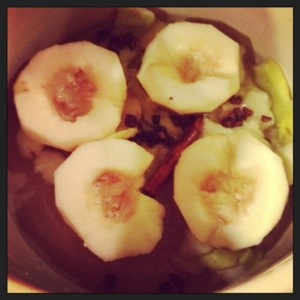
Place the quinces in the bottom of a large, thick-bottomed saucepan, such as a Le Creuset enamelled cast iron pot.  Cover them 3/4 of the way with the water.  Place the peels and detritus around the quince halves.  Separate the seeds and place them inside the hollow core of each quince half – this will give the dish its signature pink color. Place the cinnamon stick in the center of the quinces

20131012-102831.jpg

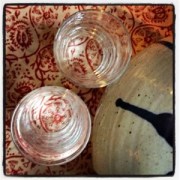
Two drinking glasses of white castor sugar (Image by Liz Cameron)

20131012-102820.jpg

1.5 drinking glasses of water (Image by Liz Cameron)

20131012-102811.jpg

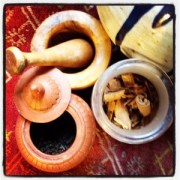
Cinamon, cloves and a spice-only mortar and pestle (Image by Liz Cameron)

Bring the pot to a boil on medium heat, then add sugar, and cook on low, for an hour and a half or more, until the quince halves begin to turn pink.

You must watch the stove the whole time.

Place on a dish with quince syrup from what is remaining in the pot – garnish with kaymak and crumbled toasted walnut and proclaim “AFIYET OLSUN!” (bon appetit) with glee!

Posted in Gendered moments, Turkish Food!, Visits from the Karagöz puppets | Tagged , , , , , , , | 13 Comments

Bachelors, dudes and dağı: On respecting your elders…and reality TV


20130220-124304.jpg

The Bachelor shows his potential wife’s Filipina Grandmother a sign of respect upon meeting her – cultural responsivity hits the mainstream (Image by Liz Cameron)

It may come as a surprise that M. and I watch a really trashy American reality television program each week.

Namely, I say blushing, we watch programs from “The Bachelor” TV franchise. In this reality series, one man (The Bachelor) or one woman (The Bachelorette) interacts with what can only be described as a pre-marriage harem of men or women for possible marriage potential.Of course, not surprisingly, this is a heterosexually biased show so far.

The watching of this program, however, does not seem to phase the Karagöz puppets. It is natural to them that marriage is preceded by parades of eligible, potential partners. They are still in shock, those puppets are, that we eloped in a love marriage, versus a traditional arranged marriage.

And, while it might sound old-fashioned to think that arranged marriage still exists in modern, Western Turkish cities such as Istanbul, this phenomenon has been coaxed along more informally through family networks, even in the circles we know. Wishing M. to be married, even his own Father and stepmother set up an introduction once.  Both M. and the woman he was set up with graciously got out of it as soon as they were out of the reach of their parents. M., you see, wanted nothing to do with this type of parental control. He is a free spirit, an independent thinker and values his independence with vigor.  And lucky me, I wouldn’t be with him, otherwise.

In any case, M. and and I are fascinated by the group dynamics that appear to emerge as a result of social isolation amongst the women or men vying for the Bachelor or Bachelorette depending on the season.  We are most interested in how “group think” combined with copious amounts of the alcohol we observe being consumed on the set play out. It brings out the worst in the contestants. But I make this sound as though it is an intellectual exercise, which it isn’t really. In any case what in the world does the bachelor and all of this have to do with respect? Or Turkey or cross-cultural relationships, for that matter?

“Well,” Hacivad Bey says, “you may well ask, because I’m asking!”

Showing respect to an elder (Image from Filipinofunfacts.com)

Last season’s “The Bachelor” was nearing the end and – with four potential brides left in the mix – aka during the “the hometown dates” in which the bachelor meets the families of his finalists.  M. and I were thrilled to see that this season’s bachelor took a cross-cultural cue from his Filipina-American girlfriend, who suggested that when he greeted her grandmother, he take her hand and put it to her for head. Apparently, this is a sign of respect in Filipino tradition.

Of course, Turkish readers or Turkish-American folk into vintage Turkish etiquette will recognize this sign of respect. I will never forget the first time I saw it. M. and I were at an art exhibition honoring the paintings his Uncle, now deceased. I watched our Teyze greet all of the young artists milling around her to talk about her husband’s art. Many of them took her hand, kissed it and then placed it on their own forehead. I did not know what was going on I had never seen such a thing – it seemed almost medieval to me.

Quickly, M. explained that this indicates a sign of respect for an elder, and that it means something along the lines of “May your wisdom come to my mind.” It is a lovely gesture and I feel honored to know now when to use it. In our private life, M. and I do this to one another in moments when we are feeling especially loving and respectful of one another – even though M. is hardly my elder and I am not his elder.

For example, once, we were walking along the street in Antakya, enjoying the French and Arab influences that abound in that small city.  A young man bumped M. by mistake on the narrow sidewalk and said “excuse me, dağı.” Now, dear reader, let me explain this word, dağı, as I understand it.  My young friend M.T. tells me that it has come to mean “dude” even though traditionally, it is a term reserved for addressing an elderly uncle. In a rare show of upset, M. grumbled loudly, saying “I’m no dağı, that punk, who is he calling dağı???!!!” I realized that M.’s years out of the country might mean that he was not aware of the evolution of the term towards the “dude” and of the spectrum from the “elder” side.  Or, perhaps the “punk” was a traditionalist – given M.’s grey hair. Wanting to return back to our happy, romantic stroll, I took his hand kiss it and put it to my four head we had a good laugh.

I am curious, dear readers, do other American partners of Turkish American marriages use this vintage etiquette? I believe it is still used commonly in on Anatolia, but perhaps not in the cities? What’s your experience?

Posted in Cross-cultural learning moments, Puppets on the move around the world, Turkish Art, Visits from the Karagöz puppets | Tagged , , , , , , , , , | 11 Comments