Mastering çay anxiety: Playing with gender stereotypes through tea service


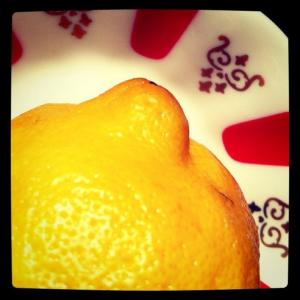
Lemon and traditional Turkish tea saucer (Image by Liz Cameron)

Lemon and traditional Turkish tea saucer (Image by Liz Cameron)

Perhaps it is the constant nausea and dizziness that are a plague to me this week, but I have spent much of my time with eyes closed, trying to remember bits and pieces of “before sick” to occupy my time.  Sometimes, these memories come forward in a kaleidescope-like jumbled introduction.  Today, I began by focusing on the view of the Austrian Alps outside of my best friend’s childhood home – and ended with the time I served a perfect çay service to M. and my brother in law.  After years of balking at gender expectations, I found myself “curiously into” the “playing out” of what I see as a traditional female gender role.  Let me tell you about my experience…

Placing my back to the window, I hoped to block out some of the chill that flutters through the walls at the front of our wintertime apartment.  I did not want my husband’s brother, Mr. X., to think ill of our new home – it was his first visit.  I couldn’t help myself from following his roving eye, as he took in every detail, rubbing his stomach after a large dinner out.  M. showed him around the house – but he spent much of his time in our dining room, looking at the old, hand-carved wooden details.

My observation of his assessment process was easy enough to do, as the conversation had reverted to a Turkish too fast and vernacular-ized for me to follow.  “Fair enough,” I thought, “it’s their language, they need to speak to one another as brothers who are trying to reconnect.”  The distant whirl of the washing machine spun in time with the fast-moving, slow-hummed string of words that I gathered bits of, one word here, one word there.

Before allowing myself to be lulled into the polite observation and the seemingly permanent placement of a gracious lipsticked smile I have practiced so well, I found myself speaking with the practiced languor of Turkish ladies, in order to offer tea to my guest.  “Pardon me…would you like some çay?” I asked with a surprisingly gracious ease – I was playing the role to the hilt.

“You have teabag?” Mr. X. said, with the corner of his mouth as his neck was now craned around looking at our dark wood dish rail in the dining room.

“No, real Turkish çay.  I am happy to make it.”

Taking in something unseen across the room, Mr. X.’s response was automatic, as if to Svetlana, his Istanbul servant.

“Normal,” he said casually, not really paying attention, “not too strong, not too light.” I noticed M.’s oppositional slump on the couch, and knew he was annoyed at my efforts to play this odd gender game.

Making his way through our home as if it was a museum, Mr. X. headed for the couch, where he assumed an unusual cross-legged position before striking up another conversation with M.  It was clear that I was dispatched for the moment, to the mütfak (kitchen). Oddly enthralled with it all, I found myself glowing with the exercise of a new role.  I had practiced this role many times with American visitors – and felt comfortable serving Turkish tea, but usually I felt uncomfortable and nervous serving REAL Turkish guests. I still have not resolved why this is.

That afternoon, before our dinner out with Mr. X., I knew what was coming down the pike, the playing of the gender role.  I had polished the silver tray, wiped the best çay glasses with a linen cloth just before we left – so that there would be no spots.  I had put aside the çay spoons from Pasabahçe that had been slightly ground up by the garbage disposal so that only the pristine ones remained – and even had lemon wedges of the perfect size under plastic wrap in a crystal dish of my Granny’s.

Ominous image of knife, lemon and traditional Turkish tea saucer (Image by Liz Cameron)

Ominous image of knife, lemon and traditional Turkish tea saucer (Image by Liz Cameron)

As I began the process that was now, after 9 years of practice, automatic for me, I prepared the tray with confidence.  As I waited for the first, and then second boil stages, I leaned against the wall of my kitchen to breathe deep, but I didn’t need to – the çay-anxiety that I usually felt with Turkish visitors was gone.  Instead, I reminded myself of my first teatime with Mr. X., in which he showed his true colors.  You can read about that here and here.  I’ll never forget it. Which makes my strong desire to serve him tea in a traditional manner even more strange.  What is even more strange, is that at times, Mr. X. has made an effort to welcome and respect me in some very traditional ways, such as offering me fish cheeks at the family dinner table. It’s all a cultural discombobulation, I decided, and checked the stove to see how the tea was coming along.

Ignoring all that, I was soon ready for the service. Walking in, I felt my non-presence on Mr. X.’s part – and M.’s protest.  M. refused the tea without looking at me, which upset me, although I knew the reason why.  The entire troupe of Karagöz puppets hovered on the windowsill above the living room, watching my every move, and I heard the silent clucks of approval from Kenne, the puppet known as the Queen of Manners and the Maintenance of Ladylike Behavior.

Mr. X.’s left hand reached out for his çay over his now confidently spread legs – he had uncrossed his legs to engage in some sort of quiet body language battle with M.  Mr. X. did not acknowledge me as I handed him his tea, nor the effort I had made to be “a good Turkish wife.”  “Why would he?” I thought, rather glumly.  I looked over to M.  He sat as spread out as possible – legs wider than his brothers, stance more macho – continuing his protest and their silent battle over who knows what subconscious matter that likely had nothing to do with me.  They were mirror images of one-another – but one a traditionalist and one a rebel.

Maybe, I thought, I am not performing well as a good Turkish wife, that is why Mr. X doesn’t say thanks, or comment that I am able to make “real” çay.

Maybe I am just too different to deserve a response.  A modern American woman serving her brother-in-law çay in the traditional manner? “I’m not sure what I expected,” I considered, “maybe, maybe this time he is treating me as women in his Turkish sphere are to be treated in most moments – as somewhat unimportant, to be managed, invisible?”

I listened to the two of them – my face plastered with a very convincing smile.  And then it hit me…This behavior of Mr. X.’s is a truth I did not want to accept for a long time, but here it is, settled like a walnut stored for winter by my heart’s very own squirrel.  This is how he is.  He is not going to change.  He will never treat me differently – and actually – I probably don’t care anyway. I could hear M. saying “it’s not worth the effort to care about this.”

With this resolution, I settled down with my little walnut of reality, and made a warm, soft place for it inside.  I sat perched on the finely hewn wooden chair that my great-Grandfather held court in – feigning interest in the tennis match of back and forth Turkish that was so familiar.  I’m glad – thrilled – that it was I who “got” the mirror image brother, who, by the way, washed up after Mr. X’s departure.

So, fellow non-Turkish brides, have you had a similar experience? Do you also get nervous serving tea to Turks – but not Americans? Do you enjoy observing gender role play in your cross-cultural marriage?

Posted in Cross-cultural learning moments, Gendered moments, Turkish Food!, Visits from the Karagöz puppets | Tagged , , , , , , , | 15 Comments

Karagöz, Kafka & Kaş: On radical acceptance of unexpected realities


Kaş

On the way to Kaş in my dream (image by Liz Cameron)

Still languishing in the in-between of not really REALLY sick anymore and not yet out of pain and fatigue at all, I am attempting to jump-start my brain.

It is so flacid, this womp of flesh in my head, that I am hoping not to lose my brain muscle.  It is as if my cross-cultural exploration passions and professional interests, analytical skills and puppet-listening prowess are covered by a thick film of grey sleep-inducing mesh curtain.

Today, however, I did my best to fight through the grey mesh of resistance, doing brain sit-ups in the form of free-writing a bit and trying to THINK.  Not much came of it, but I will continue – and softly, faintly, I can hear (and vaguely see) the puppets on the other side of the screen.  These are, as you may recall, or if you don’t know because you are new here, the ancient Ottoman-era Karagöz puppets who have taken up residence in my head in order to co-pilot my cross-cultural marital road-trip. And after watching their gesticulations for a time, I saw them pointing – and heard them saying “click on that old post, look at that – and think about ‘radical acceptance.'” And so I did.  And here is something I wrote last October…which still holds sway today. With love, m’lady

____

The puppets have been quiet these past few days, the pain from m’lady’s rotator cuff injury has drowned them out. So, I’m on leave from work & can only peck this out yavaş yavaş with my right hand. Grrrrrr. That’s where radical acceptance starts to come in. I need to accept inability to be immobile for a while, and to accept inability to type – well, fast, anyway.

This injury comes from, of all things I can figure, swimming over the summer, putting books into a bookshelf and waking up with my arms above my head (have done this since I was little).

It has been a *painful* time – mostly during the nights. And for much of the nighttime, I have had pain-induced insomnia. M. wakes up with me, and tells me stories about our first funny date to get my mind off things.

Sometimes the dog comes in between us and we all snuggle up warm, and I forget the weird electric eel that has taken up residence in my left arm, for a bit, that is. And eventually, I fall asleep for a bit.

Here’s the silver lining with this shoulder problem, the Karagöz puppets are showing up in my dreams, so although I don’t have much of those in this insomniac state, I enjoy what I get even more than usual.

I think pain must be good for dreams. I have refused to take any of the hard core stuff (e.g. Oxy Contin) as I am afraid of getting addicted to it not to mention the side effects. So, I can’t blame my dreams on opiates – much to Tiryaki’s dismay. Tiryaki, as you may recall, is my internal puppet with opium-addiction. Note that I used person-first language there, after scolding my students for doing otherwise (e.g. that opium addict vs. person with opium addiction), I have to do the right thing, eh?

Coke and jasmine in Kas, Turkiye

Coke and jasmine in Kas, Turkiye, but it wasn’t a dream – it was reality, the reality of globalization (Image by Elspeth Slayter)

So, my dreams have ranged from the standard anxiety dreams of packing with inadequate containers (e.g. paper bags for china and the like) to the more unusual conjuring of a University-days friend long receded into memory turning into a whale (along with his wife and twins) and commuting between New Zealand and the Provincetown coast.

By far my favorite, however, was waking up (in dream world, mind you), in Kaş, that elite but tiny town in South Western Turkey. Having only been there for one afternoon to visit a professional friend of M.’s this past summer (2012), I caught just the highlights of the place – and still swoon with the scent of jasmine in the hot sun below red ochre hills and long for the feel of well-woven and tastefully-colored linen peştemal between my fingers.

In my dream, I am walking along the marina, trying to find M. who is chasing after fisherman coming home for the night – wanting, of all things, buckets of sand from the bottom of the Ak Deniz (Mediterranean Sea) there.

Reddish hills on the way to Kaş (image by Liz Cameron)

Reddish hills on the way to Kaş (image by Liz Cameron)

As I hop from shaky boat to quaky boat on the hunt for my sand-seeking M., the puppets are trying to call out helpful hints for boat hopping (how do puppets learn those?), but are drowned out by Kenne, the puppet Queen of Manners, who suggests that I “work on M.” to make sure that he doesn’t act so extreme, so odd, so, well, agent-provocateur-ish. No radical acceptance for her.

In a mid-dream faux waking moment, I realize that this dream is in response to my horror M.’s tendency to say (and say loudly) the most unopportune things in the worst moments, such as “you have five children? You must be Irish!” to our new building contractor. Gulp.

I re-enter the dream as the sting of a Karagöz slap bubbles my cheek into dream consciousness. In a very uncharacteristically serious moment, Karagöz himself speaks quickly and sternly to me – telling me to remember the passion of the outlier, and the wisdom that lies with outliers as well.

“You must,” Karagöz reminds me, “support M. in his passion, this is the heart of his being, the pursuit of what is important to him – just as he supports you in this way with Slowly-by-Slowly in all of its madness! He left Turkey to be himself – and comes back on his own terms….support his terms, let the man roll around in deep-sea miniature mollusk sand mush if he must!”

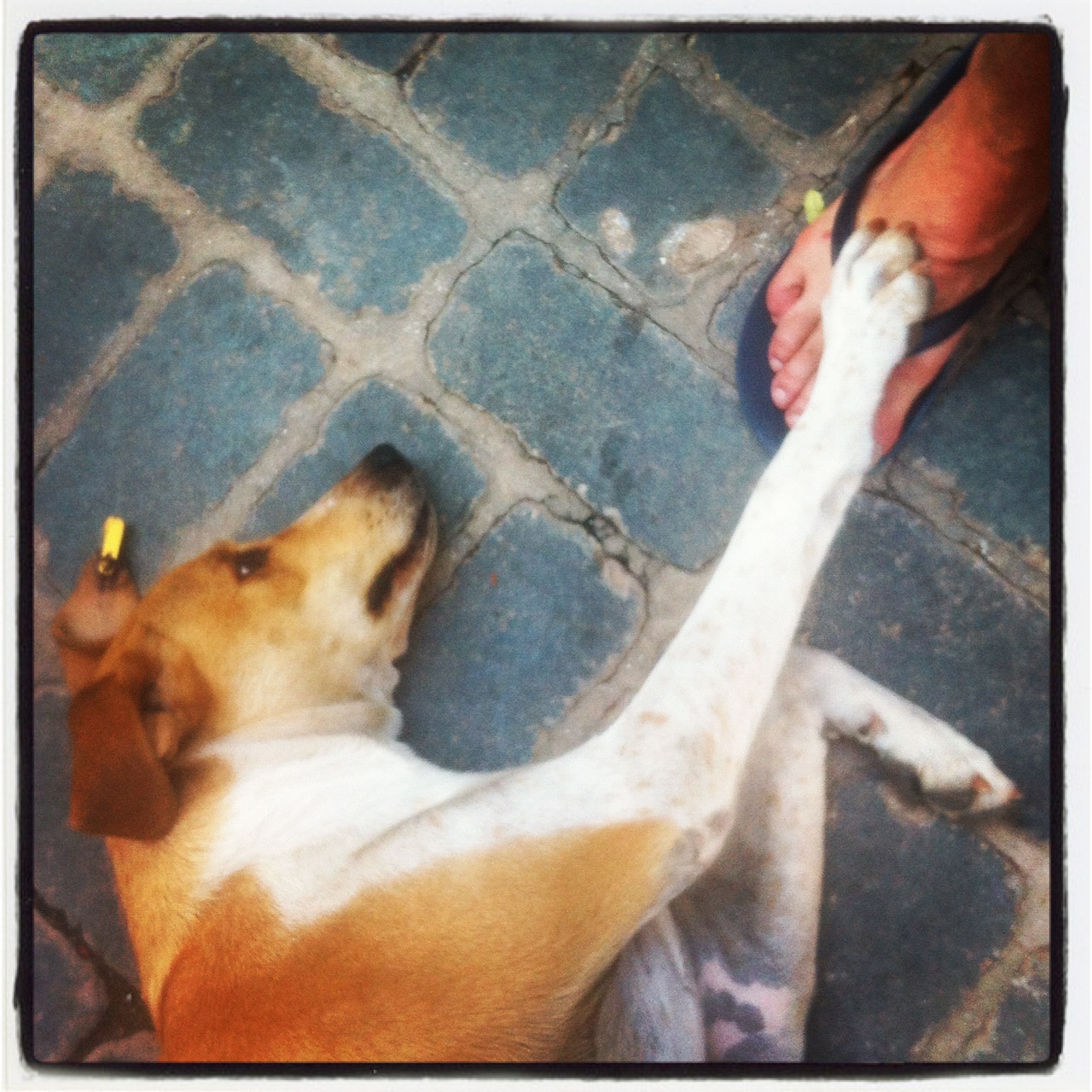
In Kaş, we found a dog that looked just like our own - and it made us homesick (image by Liz Cameron)

In the non-dream world Kaş, we found a dog that looked just like our own, who put his paw on M.’s foot just like our own dog and it made us homesick (image by Liz Cameron)

Feeling the sting of his puppet hand evolve into the prickly heat of an embarrassed blush, I notice that Karagöz is holding a book of Franz Kafka‘s in his hand, the wind across the sea wall is blowing the pages a bit, and before I know it, Karagöz is showing me his more learned side, quoting from memory the following:

“Don’t bend; don’t water it down; don’t try to make it logical; don’t edit your own soul according to the fashion. Rather, follow your most intense obsessions mercilessly.”

And there it is, Karagöz reading Kafka in Kaş, in my mental dreamworld, preaching radical acceptance. Got to listen to this lesson. Got to KEEP ON listening to this lesson.

Posted in Visits from the Karagöz puppets | Tagged , , , , , , | 8 Comments

Meet Mark and Esma: The Karagöz puppets howl with glee


Turkish accents, Arabic words and weird Gaelic names gang up on a customer service representative (Image from http://overseastonyc.files.wordpress.com)

We are standing in line waiting for a table at our favorite Mexican restaurant. We’ve been here many many times. M. Walks up to the hostess and asks for a table for two using his Turkish name.

“Can you tell me your name, sir?” she says with a big customer service smile on her face. He says his name, again. And then again once more when it is clear she does not understand him.

I understand his name. I look at the Karagöz puppets. They understand his name, tabi canım. I think of my family, they understand his name and can get past his accent as well. I go through this litany in my mind every time.

I know what’s coming. M.’s face begins to get a bit red with frustration, he’s all-too used to this. I look at the hostess,
who has that customer service smile really plastered on her face now.

Stepping towards him just slightly, she places her hand on his arm in what must be an attempt to mollify any potential future ill-humor. I am sure the touch of a young, gorgeous woman’s hand to a middle aged man’s arm usually results in 100% mollification. She has no idea who she is dealing with.

She says “Sir, what is your name, I said? I need your name.” Her tone is forceful through her plasticated demeanor. Taking my brain far away from the interaction for just a second, I reflect that it is likely only my own mother who uses terms like “plasticated” instead of plasticized. “Is it a Britishism?” I wonder, silently, before returning to the matter at hand.

“Just call me Mark,” M. says cuttingly. We are seated, immediately feted with homemade corn tortilla chips and freshly smashed guacamole.

20130828-191301.jpg

Delicious, organic frozen yogurt from Bliss, a store in Provincetown, MA (Image from Bliss’ FB page)

Later that night, I am at the front of the line, ready to place our order for soft, local and organic frozen yogurt. Tonight’s flavor is wild strawberry – all I can think of are the two times I have had the good fortune to harvest those tiny berries, densely packed with fruity sweet – in the Austrian Alps.

M. is outside sitting with our panting dog – I am taking care of the transaction in blue twilight. Our skin glowing blue green in that light, the gregarious woman behind the counter recognizes our faces.

“What’s your name, sweetheart?” She says heartily, “I think it’s time we were on a first name basis.”

And now it’s my turn to be surprised.

I repeat my odd old-fashioned English name several times. She tries each time and I feel compelled to try again to help her get it right. After all, I want to be on a first name basis with this nice lady. I live in this town, now, and I don’t want it to be awkward in the future if she is not saying my name correctly. I even spell out my name, to no avail.

She is getting flustered – and without thinking I engage in the art of the white lie. Shifting all of my weight onto my right foot, I muster “hey, my friends call me Esma, why don’t you call me that?”

“Oh!” She utters with great relief, “Esma! What a lovely name!” I can feel the Karagöz puppet troupe rolling around my shoulders and laughing with unfettered glee. In fact, there is so much glee going on that some of my hair is getting pulled out of place and into my face.

Popping down off of my shoulder and onto the bleached wooden counter, Esma the hippie puppet questions me on my choice of names, after all, I have chosen a Turkish name.”M’Lady, isn’t this the name you gave to Turks in Turkey when they cannot say your name? Why not just tell them Liz, or Elizabeth, like you normally do?” I can see, however, that she is not at all lacking pride in the fact that I have chosen her name to represent myself.

Shrugging my shoulders as I leave the establishment one friend richer, I lick the wild strawberry droplets starting down the code. “Whatever works,” I whispered to her impishly, “who would think a Turkish name would trump an English one?”

20130828-191301.jpg

Posted in Turkish-American Matters, Turklish Moments, Visits from the Karagöz puppets | Tagged , , , , , , | 6 Comments