
“Hayır!” and “No!”: The Karagöz puppets protest November


20121130-221111.jpg

Image taken by accident by Liz Cameron, and approved by M. as an interesting composition. It seems appropriate for the lack of light that New Englanders experience in the end of November. The puppets crave the light and warmth of south western Turkey in the summer – not this raw blue stuff. They are a bit homesick, you see.

“Hayır!” and “No!” These were the first words I heard this morning.  One in English and one in Turkish.  In choosing to speak both languages, the puppets were embracing their cross-cultural status.  You see, it has been almost a decade that they have been on leave from the Ottoman court and in residence in my head here in Provincetown, Massachusetts.  And today, those puppets were all about the negative.

“We have,” Yehuda Rebbe said, speaking for the group, “had it with November in New England.  We want NO more of it. No more cold. No more raw, damp air.  No more rain that turns to snow. No more brussel sprouts.  No more chilly fingers. No more November. Hayır!” His proclamation met with so many “Huzzahs” that I thought we might have awoken in a Charles Dickens novel, but soon realized it was not the case when I looked up at the top of the window wall across from my bed.  There, in the pre-dawn blue light, I saw a news ticker, words slipping and sliding across the digital cradle in a manner that created mini strobe-lights in the darkened room.

November

November (Photo credit: Cape Cod Cyclist)

As all the puppets clumped together on the windowsills, shivering with the breeze coming in through those ancient windows, Hacivad Bey made his own statement:

“M’lady, much as we love your love of the autumn, we side with the little-known poet, Thomas Hood, in his revolt against November.  We have installed it here in order to celebrate the LAST day of this dratted month in New England.  Perhaps this coming month will be a new leaf for you.”

I could have almost cried for the care and attention from the puppets this morning, as I, too, felt the No! of November, one of the toughest months of my life. And here is what the puppets had programmed into that ticker machine – lord knows where they found that out here at the end of the world!

No!

A poem by Thomas Hood

No sun–no moon!
No morn–no noon!
No dawn–no dusk–no proper time of day–
No sky–no earthly view–
No distance looking blue–
No road–no street–no “t’other side this way”–
No end to any Row–
No indications where the Crescents go–
No top to any steeple–
No recognitions of familiar people–
No courtesies for showing ’em–
No knowing ’em!
No traveling at all–no locomotion–
No inkling of the way–no notion–
“No go” by land or ocean–
No mail–no post–
No news from any foreign coast–
No Park, no Ring, no afternoon gentility–
No company–no nobility–
No warmth, no cheerfulness, no healthful ease,
No comfortable feel in any member–
No shade, no shine, no butterflies, no bees,
No fruits, no flowers, no leaves, no birds–
November!

As my eyes grew used to the sparking digital display, I remembered the poem that my Mother used to read to us every November 30th, and realized the puppets must have found that crevice of my brain, and retrieved the poem.  We always celebrated the end of the dreary – and the start of the festive season, full of love, friendship and hope towards the new year.  Many thanks to my puppets for this end-of-November treat.

Posted in Visits from the Karagöz puppets | Tagged , , , | 7 Comments

Vişne reçeli in my cookie: A “Turklish” twist on Thanksgiving


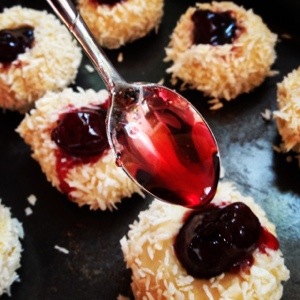
Adding sour cherry jam to thumbrint cookies for Thanksgiving, Turklish-style

A few days ago, my dear friend J. took me (and my mental Karagöz puppets) over for my twice-weekly physical therapy torture for what Emsa ths hippie puppet calls “my damaged wing,” and the very proper Kenne, Queen of Manners Puppet calls “my rotator cuff.”

By the way, this voice recognition software hears “Karagöz: as “Cairo guys,” and while I thought that the software was off, Hacivad Bey, the Sufi elder puppet, reminded me that Cairo was indeed part of the Ottoman empire from which these puppets come – so I guess the software is more intelligent than I could have realized.

But in any case, there we were, me and the “Cairo guys” puppets, doing all sorts of gentle stretches and weight lifting at the rehabılıtatıon center. And while the “Cairo guys” were curious about the medicine balls, yoga twists and silent war Veterans with tears in their eyes at the pain of their exercises, they were most interested in the conversation that I had with the woman that is my physical therapist.

She is a young American woman, who is really lovely and smart. As I went through my repetitions of weight lifting, we started to talk about my husband as well as her wife, and we started to talk about Thanksgiving traditions. She is cooking her first Thanksgiving this year I think she is newly married and nervous about cooking the turkey for the family first time. And I can relate to that very much.

At this point, one of the “Cairo guys” said “Why is she nervous – do they think Turkey is going to invade United States of America? And of course, I said no, “Cairo guys”they’re talking about the bird, “not the big yellow one,” I explained reminding the puppets about the Robama debate, “the one you roast. And as all of this was going on in my head, the physical therapist turned her head ever so slightly as she asked the question I get at least once per Thanksgiving season:

So, how do people in Turkey celebrate Thanksgiving?”

Drum roll please. Silence. I didn’t expect that from someone so smart and nice. Here’s how the puppets reacted in the moment:

Karagöz himself swirled and jumped while squealing with laughter and said “another dumb American!”

Esma the hippie puppet, well, she just sighed, putting her hand on my shoulder, and said “this is just one of those moments were going to have to kindly explain to someone that they said something really stupid.”

Kenne the Queen of Manners and Maintenance of Ladylike Behavior agreed with that.

Safiye Rakkase, the vainglorious dancing girl puppet was too busy dancing to the music in the boombox there in the physical therapy room to pay attention.

Yehuda Rebbe, the wise Jewish elder puppet looked down put his hands on his religious book and begin to pray.

So, left to my own devices as the puppets waited and watched, I very gently told her that “well, we don’t celebrate Thanksgiving in Turkey as it is an American tradition,” with a hopefully kind smile on my face of course. As she blushed, I ransacked my mental pantry in order to fill the gaffe gap, and told her quickly about all of the Turkish flavor traditions we have woven into our American Thanksgiving. And this is something that many immigrants or immigrant-infused families do, tabı canım.

For us, our “Turklish” approach to the holiday usually involves a bit of sun-dried kekik (thyme) in the stuffing, or pul biber (red Aleppo pepper) rubbed into the butter that goes on the bird, but this year, it was the addition of visne recelı (sour cherry jam), in thumbprint cookies. These ones have coconut on them – and M. says they would be more “Turklish” if it were nuts, but for this year, it’s a blend, just like every other day of our life!

And before I get to that Turklishified recipe, please check out the fascinating blog from which this (new to me) word has sprung – TURKLISH!!!

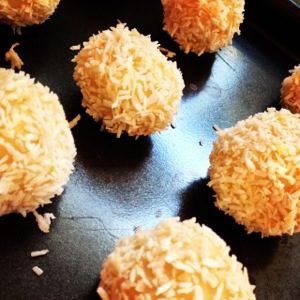
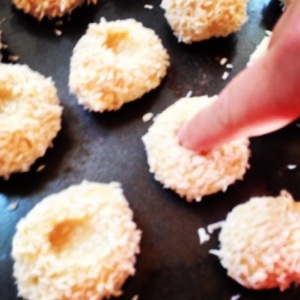
This is what the final product looks like – we have eaten ours all up, so I only have the pre-baking photos from our batch….

Ina Garten’s Thumbprint Jam Cookies – alla Turca

Ingredients:

3/4 pound (3 sticks) unsalted butter, at room temperature
1 cup sugar
1 teaspoon pure vanilla extract
3 1/2 cups all-purpose flour
1/4 teaspoon kosher salt
1 egg beaten with 1 tablespoon water, for egg wash
7 ounces sweetened flaked coconut (or nuts, crushed)
Raspberry and/or apricot jam (I used visne receli)

Directions:

Preheat the oven to 350 degrees F.

In an electric mixer fitted with the paddle attachment, cream together the butter and sugar until they are just combined and then add the vanilla. Separately, sift together the flour and salt. With the mixer on low speed, add the flour mixture to the creamed butter and sugar. Mix until the dough starts to come together. Dump on a floured board and roll together into a flat disk. Wrap in plastic and chill for 30 minutes.

Roll the dough into 1 1/4-inch balls. (If you have a scale they should each weigh 1 ounce.) Dip each ball into the egg wash and then roll it in coconut. Place the balls on an ungreased cookie sheet and press a light indentation into the top of each with your finger. Drop 1/4 teaspoon of jam into each indentation. Bake for 20 to 25 minutes, until the coconut is a golden brown. Cool and serve.

20121122-114045.jpg

20121122-114051.jpg

20121122-114057.jpg

Posted in Turkish Food!, Turkish-American Matters, Visits from the Karagöz puppets | Tagged , , , , , , , , , | 15 Comments

Migration as a cross-cultural marital metaphor? On structuring a Turkish-American memoir (Part 2)


Today, I am going to continue my musing about that elusive “red thread” I wrote about yesterday.  In case you missed it, this relates to the writing of my Turkish-American marital memoir.

And in case you don’t know what in the heck a red thread is, a dear friend of mine who is a great writer and editor refers to the “necessary red thread” in any writing one does.  As I said yesterday, and I quite like the metaphor, it is the theme that pulls it together, the point that acts like a magnet for all of the words included in any given bit of writing.  And it is this red thread that is elusive at the moment while revising of the first draft of my now 300 page work.

Yesterday, I explained that I had started writing this memoir by using the metaphor of driving – as I think of the marriage as a road trip.  However, now that I think about it, although I identified that as a red thread yesterday, it actually may be more of a structure, such as the one my friend Sinan spoke of. So, whether it is a red thread or a structure or whatever it may be – let tell you how I got to this place (“as if there were a choice!,” Karagöz, the sarcastic trickster puppet points out.)
So, a couple of years ago, I read Travelling with Pomegranates: A Mother-Daughter Journey to the Sacred Places of Greece, Turkey and France, which is a double memoir written by Sue Monk Kidd and her daughter Ann Kidd Taylor.  Structured into three sections inspired by the Demeter/Persephone myth: LOSS, SEARCH and RETURN, the memoir’s red thread emanates vibrantly – it is about growing up and growing old – and the relationships between mothers and daughters.  Clear as a bell, it had structure, and a glowing red thread, it was glowing so much, it was really almost neon, if you ask me.
Upon reading the book for a second time this summer, I sat up in my chair and thought “I need a structure like that – forget the whole driving thing – that’s too confusing – and surely a simple structure will create an infrastructure for my red thread.”  And then my mind went blank, totally blank, for months that felt like sandpaper.  And then, this fall, while re-reading an academic paper I had written that related to immigration, it hit me – there it was – a conceptual model for migration often used in social work practice with immigrants in the United States – and in many ways – our marriage is in constant migration.
Reflecting further, I thought, we do travel between worlds both while in Turkey and while in the United States.  M. always says he feels more American in Turkey now.  I am often thinking about Turkey while engaging in normative American behaviors – or Turkish-American behaviors.  We often talk about Turkey.  We eat Turkish food every day.  We drink Turkish tea all the time – and on and on.  And given that idea, that we travel between worlds on a constant basis at both the micro and a macro levels, what does a conceptual framework for migration do for structuring this memoir – or for finding my red thread?
So the conceptual model of migration I found goes like this:  When working with immigrants to a new country, there are three phases they may be in.  And, as a social worker, one should assess for which phase that person is in so that you can put yourself in their shoes some.  Those three phases are: Pre-migration; Transition and Re-settlement.  Now, as a student of the impact of globalization and transnational migration patterns, I know full well that this conceptual model is flawed – as many people only migrate on a temporary basis, with the intention of returning “home” someday.  With globalization we are exposed to cultures and subcultures constantly, able to rotate between places and homes and cultures very easily, if the penny permits, we are not isolated – and we are dealing with it all, all at once. So, this started to make sense vis-a-vis how I experience my cross-cultural marriage.  There was something there I felt I could work with.
So, I began to think about migration. Now, I have not migrated anywhere permanently, except perhaps in my own mind.  And I am hardly an expatriate at this point, although that is the group of folks I feel most akin to.  And that is why the workshops conducted by those super-smart and interesting ladies over at Global Niche are calling me like a siren song – as they can relate to the confusion of place, culture and identity in the cross-hairs of in-between. M. is with me in those cross-hairs, and I think that somehow our time both in the United States and in our extended stays in Turkey has caused me to migrate my mind and perhaps my thinking and some day-to-day practices of life. As for M., he migrated from Turkey to the United States in part as a way out of tradition and customs that did not feel right to him, akin to rubbing a dog’s hair the wrong way, constantly.  And perhaps that is why life in another culture comes easily to him, I don’t know.
Migration is also a comfortable concept to me – my Grandmother and Grandfather emigrated to New York City from Spain and Scotland, respectively, and never quite found themselves here or there.  My other Grandmother emigrated from Quebec province as a baby, and the spectre of other-ness haunted her for a time.  My stepmother and stepsiblings grew up in Kenya and East Pakistan (now Bangladesh) and migrated an international fiber into the fabric of our blende family. My good friend Trisha Thomas is a cross-cultural mother – an American living in Italy for many years now – and she thinks on these issues all the time over at her blog, Mozzarella Mamma
So, yes, I grew up with a well-steeped and stewed sense of other-ness, and mixed-ness vis-a-vis my family’s cultural elements and the migration patterns that led to that.  And as a result of all that, here is the structure I have today – option #2 – and who knows where it will go from here… 
Section 1: Pre-migration: This section of the book will be a series of chapters about my early exposure to Islam, Muslims and countries in the Middle East.  It would also address my youthful obsession with being different – and exploring different cultures.  It will end with a chapter on meeting M. and the beginnings of my foray into a cross-cultural relationship.

Section II: Transition: This section of the book will address what started to happen as M. and I began to get serious and move towards marriage.  In these chapters, I will address the challenges we faced as families in both countries were met – and as cross-cultural booby traps began to explode.

Section III: Resettlement: This section of the book is where the true learning and comfort-creation began to emerge.  I began see beyond the mystery and glam of being married to a foreigner and we began to make our own way with which traditions we did and did not want to keep in our married life.

And now, as I come back to read this before posting it today, I remember my friend Deonna’s wise and thoughtful words to me in response to yesterday’s post.  Deonna is also writing a memoir – and she said “I will tell you something simple, but even I can’t follow it: don’t over think it.”  I’m in your club, Deonna, and now I am even more confused!  However, I am very certain that the way will become clear! 

Posted in On writing about my life with the Karagöz puppets, Turkish-American Matters | Tagged , , , , , , , , , , | 8 Comments