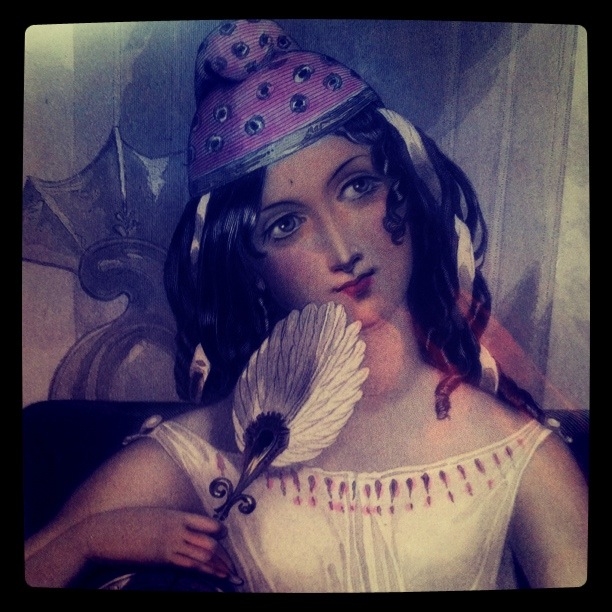
Was Scheherezade wired on Turkish tea, American coffee, Nepali chai or red bull during those 1,001 nights? Who knows? (Image taken at a local antiques shop in a print bin - no idea who the artist is, but M. and I found her fetching and I knew right away she was my Scheherezade).
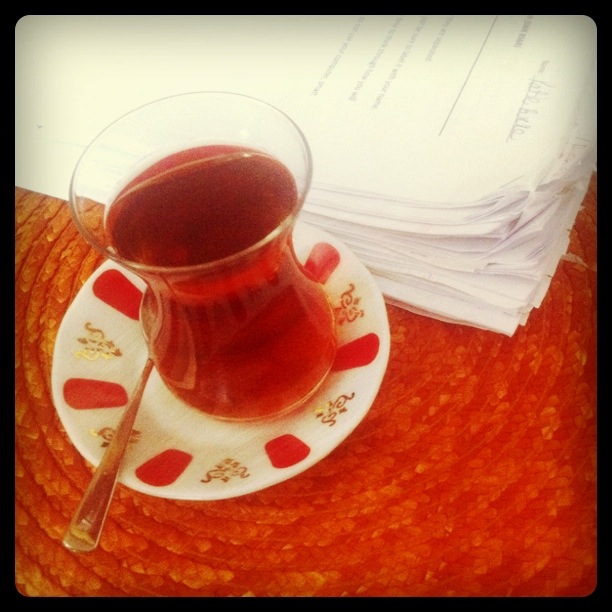
When I last left you, dear readers, I was wired out of my mind on Turkish tea in an effort to keep myself going on a stack of statistics exams. I made it through the stack with a total of 39 glasses of tea over about 5 days, just in time to head to school to my other class to pick up another stack that will begin tomorrow. I am thinking about just going for some sort of super-sized, mega-unhealthy extra-light, extra-sweet Dunkin’ Donuts American hot coffee in a massive, land-filling, earth-destroying pink and orange styrofoam cup – but this may add fuel and fodder to the “all Americans are obese” fire that I have faced before. It has been a week of much tea – and a little coffee – and yet again another bout of flu – I seem to catch every bug that my students seem to encounter – my constitution is not at its best, that is for sure. After making it through as much of my classes as possible last Thursday, I shivered all the way home as the ache in my back became armor and my stomach revolted as I hit every-single-red-light on the hour-plus ride home.
Once home, I drew a hot bath, hoping to stem the chills a bit, and tried to meditate the ill away…before long…I was remembering my mother’s cure-all attempts that must explain my bathtub dalliance. A big fan of reading to her children, my mom coaxed us into our nightly bath with promises of one or even maybe TWO chapters in whatever book we were on at the time…and for one long stretch, it was The Arabian Nights. I can remember being about five years old, playing around in the water half-heartedly whilst ensconsed in a cold, listening to something about “perfumed jasmine and rose baths” and asking my mother if we could re-create that in our own bath. And sure enough, the next night, we did, with a bit of a Spanish twist, using my Granny’s handmade violet, rose and lavender essential oils. It was heaven. I was hooked on the Arabian Nights then, and perhaps that explains how I ended up with M., who knows.
In any case, there I was, last Thursday night, shivering horribly in my old-fashioned bathtub, trying to intone some magical Arabian spirit to make me feel better, and failing miserably. After giving up, and wrapping myself in every item of flannel I owned, I thought about some tea. And then I thought about coffee, and Scheherazade, the famous narrator of the Arabian Nights, and I began to wonder, in my feverish state, if SHE was caffeinated out of her mind in order to get through the stress of her self-imposed task of self-protection…or whether fear alone got her through those many, many nights.
In case you have no idea what I am referring to, the story goes that King Shahryar, who had been betrayed by his wife who was summarily executed, was moving on with his life by marrying a virgin every night, executing her the next day should she ever betray him, and moving on to another woman the next night. Horrific, no? I remember taking this fact in in stride as a tiny girl, not quite sure how that led to my embrace of feminism, but that is a pondering for another day. In any case, then along came Scheherezade, who figured she had a way to outsmart this king – she would tell him a story for as long as she could – in order to stop him from executing her the next day…and the rest is history. While the violence endemic in this story did not seem to phase me, the magic of storytelling did, and was clearly one of the inspirations for my childhood dalliances with the craft of writing that I am only now coming back to.
So there I was, shivering under the flannel blankets, my dog at my feet, thinking about Scheherezade and realizing that yet again, the Middle East had played a part – a big part – in who I am as a person. Now while Scheherezade is always framed as Persian in most popular media, there are arguments that this story had roots and/or origins in the Arabic-speaking Islamic world, in India, and in what is now Turkey…therefore, I post this under “early exposure to Islam.”
So what led my mother to read to us from the Arabian nights in the bathtub? Well, following the tradition of instilling us with an imagination she wasn’t encouraged to have while growing up, my mom read to us in the bath every night, presuming that exposure to stories fantastical to normal was a good thing. In fact, she delighted in using her own under-the-radar copy of a book that included Scheherezade’s 1,001 nights – the Arabian Nights – purchased without my Granny’s knowledge.
 Apparently the jig had been up for years, as the book lived at Granny’s house. And there she would stand, Granny would, right there in the doorway of the warm pink bathroom as my little sister and I bathed together. Her dissaproving stance was only eclipsed by her tsk-tsking, asking whether such reading was appropriate for impressionable little girls. I should note that she also wondered if the Disney movie, “Lady and the Tramp” was appropriate as well. Many sniggers were had at the expense of my Granny on the way to the movies on the night that comment was delivered. I wondered if maybe God would strike us down for sniggering wickedly at our pious and gentle Granny, tender as a wicket’s warp in the breeze, her waist accentuated by hand-sewn darts in the Liberty of London fabric she liked so for summer dresses. She was a lady, just-so at all times. She was not sure that the tawdry sex-subtext of the Arabian Nights was OK. You didn’t talk about that. Perhaps my mother left any X-rated parts out, I’m not sure!
But hear the tales we did – sometimes more in a night than one. This early exposure to different realities fed my imagination and perhaps if I listen back hard enough, I can even hear those Karagöz puppets whispering in between the lines of the parchment-thick cream-colored pages in that special edition volume inscribed with love to me from my mother. What was it about the Arabian Nights that enraptured her so?

Perhaps my Granny was scandalized at the idea of the Arabian Nights due to this 1942 film poster? (Photo credit: Wikipedia)
I suppose it was her hatred of the hum-drum, as she might have put it. Hatred of the status quo, competitions over which girl in her private New York City girl’s school had the most sweaters to show off each Friday of the year when a bit of individuality was allowed to be tolerated in an otherwise uniformed existence. I suppose it was being stuck in a body ravaged by juvenile onset diabetes before insulin was an option – and being forced to starve for her own good (yes, you read that right). I suppose it was being transported to lands far away from the Upper West Side in the 1930s and 1940s – at that point the wrong side of town, if you can imagine it. Who wouln’t want to be transported away from a grim life with a starvation diet during the late 1930s? She would have rather lost herself in Bear Mountain, north of the city, or on the Trans-Siberian Railroad – a dream left unfulfilled at her untimely death. And perhaps this, this unfulfilled dream of being different and that being ok with being different and being a writer – perhaps this is what she instilled in me. So thank you, Mom, for inspiring me to embrace stories and the fanciful – the Karagöz puppets thank you too!
Related articles
- Of Turkish tea – and t-tests (slowly-by-slowly.com)
- Genies, Viziers, and Thieves, Oh My! ‘The Arabian Nights’ (Review) (popmatters.com)
- An American suburb in Palestine? Leave it to Beaver meets the Arabian Nights (inquisitr.com)
- Haunted Arabian Nights (thedailybeast.com)