Of oxen, calves and paper tigers: Öküz altında buzağı aramak


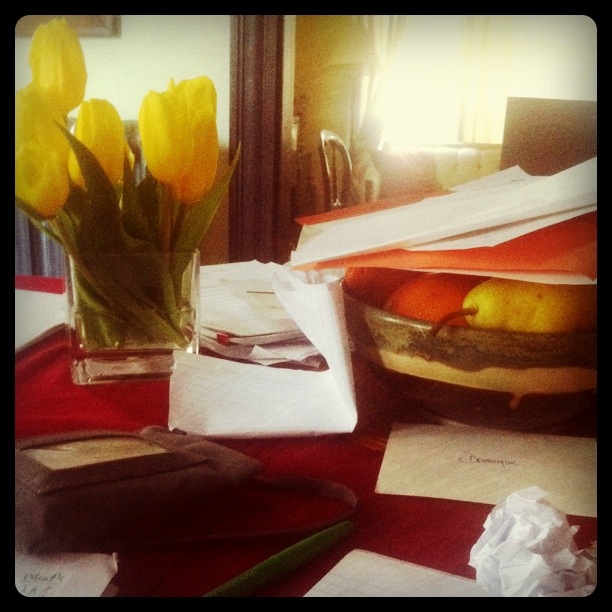
The "paper tiger" takes over my fruit bowl as I try to get organized...

All day, the impish Karagöz has been lounging around the dining room table, giggling and rolling about.  Every once in a while, when I come in from my spot on the back porch, where I am grading yesterday’s tests, he lets out a long, crooning cry of a sentence in Turkish – knowing that I can’t understand it.  As he does this, he flips more of the papers I am trying to organize around, spurring on the “paper tiger” I have created on the dining table.

Knowing he is taunting me, and that eventually those other puppets will emerge from the back porch (where they are sunning themselves for all their worth) and explain it to me, I decide not to sweat it too much (hard for me).  But they are not rushing in on this sun-infused day.  They really don’t have much to say, which leaves the Write-a-Matrix to do her thing – you know – crack the whip and try to get me to do academic work.

She’s cracking the whip a lot today, you see, as every time I come in from grading one paper (an attempt at operant conditioning), I get caught up on starting another project – and let me tell you – there are many.  She’s mad as hell, that Write-a-matrix, and none of the puppets are even trying to do battle with her today, although Karagöz is watching her with lackadaisical interest in between narcoleptic sleep-a-thons.  Many work projects, many home projects, many friendships to keep, self-care rituals to adhere to.  I haven’t had a haircut in 3 months.  It is almost 80 degrees out, but my feet are a sight for ogres and I am too ashamed to leave the house without a full foot-care pedicure in the immediate house-exiting future.  I wonder what M.’s mother would think about that, if she were alive.  She always looks so put-together in all of her photographs – she looks just lovely.  I am also afraid to see one of my students who lives in the neighborhood, as I have not graded her paper yet and don’t want to have to explain that.  Hacıyatmaz keys in on this point, rocking harder back and forth, reminding me that there is life beyond academia and that I need to tend to other aspects of life as well.  As you may recall, he is the relentless supporter of my personal writing – and my personal life – and he is constantly rocking and rolling in the background these days.

I decided to see which vegetables were at risk of peril in the fridge, and chopped up all the carrots and celery and onions to make a nice mirepoix with Bozcaada-sunned kekik (thyme) preserved in a hand-blown glass jar.  Seeing a bottle of pinot grigio one-third full and on the way to vinegar, I decided it was the day to make a red lentil stew, and added the wine dregs to the mirepoix before picking through the lentils to eliminate tiny stones.  One more paper was graded and then it was over to the car insurance bill, organizing the towel closet and making the bed. It went on like this for a while.

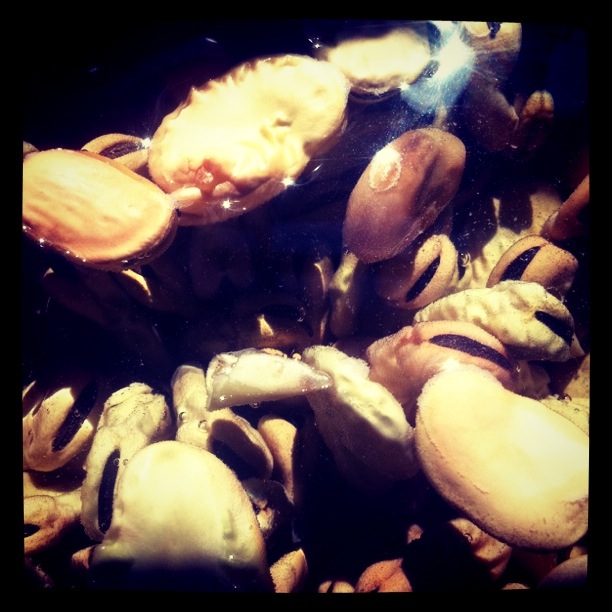
I mean really, don't these fava beans (bakla) look ominous to you too?

As the sun neared the top of the sky, peeking out in sharp darts through the hemlock tree in the backyard, one more paper was graded when I decided to learn what I could do with the dried fava beans I picked up the other day because I remembered M. talking about eating them as a kid.  I commenced soaking them after googling around for a while using both Turkish and English search terms.  After dropping what some in Turkish world refer to as fava fasulye and some refer to as bakla into a soaking bath, I ended up deciding that the floating fava beans look more than ominous, with many of their wide, black eyes eerily looking up at me from their vertical soaking stance, I go back to grading.  What self-respecting bean soaks vertically? Surely, I think, they are possessed.  Merging myself back into paper-grading mode, I let the sun beat down on the side of my face.  One more paper was graded and a friend stopped by, and after expressing interest in my double tea pot, I taught her how to make Turkish çay.  One long hiatus led to the eventual completion of one more paper before I noticed that the Write-a-matrix had stopped cracking her whip…there she was in the corner, and here is what she said..

“I hate to admit that that idiot Karagöz is right, but it is true, she sighed,Öküz altında buzağı aramak.”  I’ve had it today, I’ll let her drown in her paper tiger today – and will commence attempting to draw water from a stone tomorrow morning.”

Esma, the hippie puppet saunters in from her sunbath just then, and tells me “looks like the Write-a-matrix is getting a little soft, she just said “don’t look for a calf under an ox.”  With a big smile, I turned inward, thinking that I am likely on the path to a healthier place.  We’ll see how long this can last.  Hacıyatmaz just grins, and wobbles on.

Posted in Academic hell, Turkish Food!, Visits from the Karagöz puppets | Tagged , , , , , , | 3 Comments

Farazi Kozmos’ modern-day take on Karagoz (in Turkish)


Craig Jacobrown puppet troupe presents a child...

So, it has been months and months of me writing about the Karagöz puppets – and you know that these little paper people are metaphorical inventions that play out the voices in my head. You probably have also gathered that I am not, contrary to what it may seem, suffering from auditory hallucinations. Some of you think that the puppets torture me somehow – but actually this is not the case, they are just a way to “process” the in-many-ways subtle cross-cultural reality in which I live. However, what you have not seen a lot of is how the Karagöz puppets are presented in a more traditional – or even modern – light. Always focused on playing up cultural stereotypes (as well as personality types, perhaps), the Karagöz puppets are famous in Turkey – although these days, they primarily have a child audience. While many Karagöz puppeteers do their shows in the traditional manner, this does not stop the budding animators from taking on this traditional art form. So, in case you are curious about what the modern-day might look like for Karagöz and company, check out this video – in very modern animation. Enjoy!

Posted in Introducing the Karagöz puppets, On writing about my life with the Karagöz puppets | Tagged , , , , | 2 Comments

Moros y cristianos, siyah ve beyaz and being “black and white”


English: A black and white view of Istanbul. T...

English: A black and white view of Istanbul from Wikipedia

Recently, after posting my review of the new book, The Globalization of Love, M. and I were doing the dishes, and talking about the book, which is about cross-cultural relationships.

“It’s not a really BIG difference,” M. said, “I mean that author, her husband is from Austria and she is from Canada, I mean they are both western countries.” Karagöz and the rest of the puppets turned from looking at M. to see what I would have to say – as if once again they were watching a tennis match from the orchid-covered windowsills where they were perched.

“Hmmm, well, we can’t be the judge of that – who knows what their reality is? Western countries can be very, very different from one another!” Handing me the bowl to dry, M. continued, “Subconsciously, you know, you are Unitarian, right? You grew up in that Christian church. And you don’t go to church now, you feel that you are agnostic, but subconsciously Christianity is somehow just IN you, like fluoride is in the water here, and no matter how much you can be not going to church, you are still Christian and that impacts who you are and how you think and how you relate to the world. ”

“So that makes you Muslim?” I said, feeling a bit taken aback. Karagöz, the agent provocateur, spun a mighty spin on my shoulder, yelling at me to pick a fight.

“No, I just gave an example, you know, I am being black and white, as you say” M. said, with a wicked wink, as he turned to scrubbing the bean pot. Oddly enough, we were cleaning up from a dinner of “moros y cristianos” – which is a Spanish dish my Granny made, consisting of black beans (the Moors) and yellow rice (the non-Moorish Spaniards). Hacivad Bey, the Sufi peacemaker, encouraged me to breathe.

As I dried the bowl, I thought about what I often do, that I have a pretty westernized, anti-macho (car negotiations aside, as you will recall from this recent experience) Turkish man for a husband. He is, after all, standing next to me, washing the dishes of his own accord. In fact, he had to cajole me to get me to dry them as I was slacking off with a book. Placing the bowl on the shelf, I turned back to M.

“Man, we’ve been dealing with black and white for years now in this relationship, haven’t we?” I asked, curious about what he would say, and he did not disappoint, responding with “yes, canım (chah-num, dear) sweetheart, I am very black and white. I will never be in the grey with you – for very long that is!”

Later as I sat down to grade some papers, I reflected back on what it is I know about the idea of black and white thinking. As I googled around – a great way to avoid the horror of grading – I found a description of black and white thinking that perfectly sums it up from my own cultural standpoint. The website said the following:

“Always” and “never,” polar opposite words, tend to characterize the vocabulary of black and white thinkers. Black and white thinking means seeing the world only in terms of extremes. If things aren’t “perfect,” then they must be “horrible.” If your child isn’t “brilliant” then he must be “stupid.” If you’re not “fascinating” then you must be “boring.” Yikes! What a tough way to live! In real-life, situations are almost always shades of gray, not black or white. Falling victim to black and white thinking tends to exacerbate depression, marital conflict, anxiety, and a host of other everyday problems. Give yourself and the ones you love a break and discover the beauty of shades of gray. When small children are learning to use words and organize their thoughts, it is normal and expected for them to see and express their world in very black and white terms. When a young child feels they are not loved, they feel they must be hated. When a child feels his or her parents don’t pay enough attention to them, that child will say, “You never pay attention to me.” Developmental psychologists call this primitive thinking. Unfortunately, under duress, adults often regress to primitive thinking. Adults are most prone to regressing to primitive thinking when they are having a hard time and feel overwhelmed by their own emotions. A regression, in psychoanalytic parlance, is a backsliding from mature functioning and thinking to immature ways of functioning and thinking. For that one moment, when the adult starts relying on the words “always” or “never,” and seeing the world in black and white terms, they are slipping back to the way they saw the world as a child.”

Reading phrases such as “primitive thinking” and “Unfortunately, under duress, adults often regress to primitive thinking,” I began to despair. “Maybe,” I thought to myself as I bit my lip, “American views on Turks would have them all be ‘primitive thinkers.'” Sighing, I shifted in my seat, looking at the other dreaded words. “Even worse,” I thought, “does this mean that M. feels under duress – does the very existence of our cross-cultural marriage CAUSE this cross-cultural thinking, perhaps? Or is this Turkish? Can you really say that about a whole culture? I should think not, but???” The ruminations went on and on. How much is personality and how much is culture is akin to the old debate about who came first, the Chicken or the Egg…we’ll never know.

So, Turkish-American couples out there, do you experience the black and white – and grey? How does it manifest for you? Or is this a nationality-free gendered reality of some sort? Or just a personality one, if I may remove myself from potential heterosexist bias. Let me know your thoughts!

Posted in Cross-cultural learning moments, Gendered moments | Tagged , , | 8 Comments