Esma and M. mourn the Sivas Alevi massacre case verdict


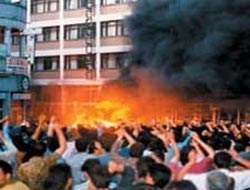
Honoring the (mostly) Alevi people who died in the Sivas massacre on July 2, 1993. (Image thanks to this link)

“Have you heard the news?” M. asked quietly over the crackly phone line as I dashed out to the porch in search of better reception. “Have you read the Turkish papers yet today?” he asked, with intent. “There was a big riot in protest of the Sivas massacre case being dropped as a result of a statute of limitations. It is just awful, just terrible. This is one reason why I fear for the nation of my birth.”

In his comments, M. is referencing the Sivas massacre (in which 33 Alevi intellectuals were murdered in 1993). M has spoken about this massacre many times in the course of our years together. You can see the news he is reacting to here and here and you can read more about the massacre here.

According to bianet.com, “The trials would have continued if the Sivas Massacre would have been accepted as a crime against humanity….at the hearing on 6 December 2011, (the) Prosecutor…put forward that after 15 years the statute of limitation had been reached…The plaintiff lawyers had demanded to handle the Sivas Massacre as a crime against humanity…the statute of limitations could not be applied to the case in the scope of a crime against humanity…Lawyer Mehdi Bektaş reiterated the same demand with regard to Article 7 of the European Convention on Human Rights. Lawyer Kazım Genç reminded verdicts given related to crimes against humanity and that it was a requirement of the jurisprudence to take these rulings into consideration. Lawyer Süleyman Ateş introduced himself as the nephew of Sehergül Ateş who died at the Madımak hotel in the course of the massacre. He urged the court, “Dismiss the request for the statute of limitation for the sake of the relief of the heart of sensitive people who have lost a relative and have been waiting for justice for 19 years”….Many people gathered in front of the courthouse upon the call of the Pır Sultan Culture and Solidarity Association. They were outraged about the court decision. Members of political parties, non-governmental organizations and trade unions carried photographs of the victims of the Sivas massacre and a banner reading “We did not make the massacre be forgotten and we will not forget”. The group chanted slogans like “No to statute of limitation, we want justice” and “The light of Sivas will not go out. ”

According to most reports, the Alevi who died had gathered for a cultural festival in honor of Alevi poet Pir Sultan Abdal (who you can read more about here, a fascinating person), two hotel employees and two members of the twenty-thousand-strong group of Sun’ni Islamists that allegedly set/celebrated the fire. It was a horrible instance of the dangerous and evil power of group think, if you ask me…

Occurring about a year before M. left Turkey for the U.S., this incident has clearly left its mark on my husband’s psyche. Clearly,the persecution of the Alevi as well as limitations on living as an atheist in Turkey had an indelible impact on his life. For example, once, when our niece asked him why he prefers the U.S. t0 Turkey, this massacre was the first thing he listed – stating that at least the civil rights movement has some power in this country. Although M. is not an Alevi, he is an ardent supporter of both the freedom of religion and freedom of expression – and worries at the increasing limitations on both he sees in Turkey over the decades – sometimes in the name of liberal to left causes. But that is a topic for another time.

Part of the reasoning behind the firesetting at the Sivas massacre, as I understand it, was the idea that one of the Alevi authors at the cultural celebration was allegedly promoting atheism. And this, in part, may be behind M.’s longstanding feelings about the Sivas massacre. Let me tell you a story about that. Once, M. tells me, as a young and naive 15 year-old student, he and his dear friend decided to take a stance with respect to their right to proclaim themselves as atheists in secular Turkey. They were, you see, essentially protesting the default listing of religion on their national identity cards. And the default listing was Sun’ni Muslim. In recounting the tale, M. channels the teenaged version of himself, who proclaimed “Why not test the secular-ness of our country, by changing our identity cards?”

Now before I go on, let me say that M. does come from Sun’ni roots, he was raised in a primarily secular family (his Bosnian grandmother was the only one who prayed 5 times a day while he was growing up), but explains with some sadness that while he desperately wanted to “feel God” the way others he knew did, God just never came to him. Coming into his adolescence in the 1970s, M. lived through news reports from Iran – and became fearful of the potentially negative power of religion. It seems that the Sivas massacre was the straw that broke the camel’s back for him.

Once he and his friend were in the belediye(that’s akin to a city hall, folks) requesting that their identity cards be changed, a generous and wise soul took pity on them. As M. tells it, the kindly amca (gentleman, uncle) at the identity card window encouraged them to reconsider their request. “Yes it is true,” he said, “you have the right to do this – but do you really think this is a wise decision? You will need to go to court for this. What would happen if you were stopped by the cops and they saw that you were atheists? Do you really want to test this out? Is it really worth it to you? There are times that standing on principle is not worth it, I ask you to consider this.” Uncharacteristically, my protest-oriented odd duck of a husband thought better of the move to test the limits of what is supposed to be a secular state – and left the Sun’ni Muslim marker on his identity card.

As I write this, Esma, the tiny hippie puppet, is sighing through a blue-grey funk. She is dejected today, not even able to continue her celebration of our win of the Liebster award I wrote about yesterday. Instead of her usual buoyant flitting about the house, she sits by the window, looking out at the rain on the water in Provincetown bay. Without even turning to face me, the words slip sadly out of her mouth, “it is a sad day when it comes to this Sivas massacre verdict, and I feel M.’s pain left over for years – the pain that made him let go of his right to proclaim his lack of religion” she says, her words are accompanied by sad, wilty white gladiolas, a traditional funeral flower in the United States. Esma, you see, emits flowers from her mouth and ears depending on her mood. If she is in a wicked mood, it’s usually the sharp-edged but boldly-colored ginger flower or birds-of-pardise whereas if she is joyful and light it is often soft and airy jasmine and rose petals. But today, it is those aforementioned wilty, white gladiolas, their soft plopping sound hitting the floor with a maudlin regularity.

“It is grey indeed today. It feels as though the sun is nowhere in the world,” Esma continues, sighing deeply, “and I remember all of the pain of July 2, 1993. What I have never told you, m’lady, is that my interest in Sufism is actually an offshoot of being raised as an Alevi. As you may know, Alevis are a minority group in Turkey, who have roots in Shi’ia Islam with a twinge of Sufism. We are a group of critical thinkers, who reject gender oppression and embrace social change. You can read more about us here

An horrific image of the seemingly celebratory protests outside of the hotel as 37 people died during the Sivas massacre. (Image thanks to this website) The wife in me worries that this image will bias views about all Turks in ways that will impact M. more than stereotypes already do.

“Allah, hallah,” Esma continued, using Turkish slang to indicate a big emotional sigh of surprise or intensity, “if I let myself think about it, I would think about the Sivas massacre and the Maraş massacre and so many others all the time – but although Wikipedia has a page devoted to “massacres in Turkey” this is not the spiritual or moral core of the majority of the home country I know…and I fear that people will not see that. I wish for peace on this matter, and resolution – and a more tolerant Turkiye.”

Posted in Turkish Controversies, Visits from the Karagöz puppets | Tagged , , , , , , , , , | 11 Comments

The Karagöz puppets revel in blog love around the world


Late last night, the Karagöz shadow puppets burst out into a cheer.  I was brushing my teeth at the time, and couldn’t come right out, but I knew they were jumping all over the iPad, and figured their futbol (soccer) team (Galatasaray, of course) had done something good.  When I emerged into the dark of the hallway, there they were, dancing in a raptured state, the luminous blue light of  the technology age rendering them like starchy jellyfish glowing in the dark at the bottom of the ocean.

“M’lady!” Esma, the hippie puppet, cried as she swung her arms about in slow motion, “come dance with us – you have won something wonderful – it is called “The Liebster Award!” Feeling a bit timid, I walked into the living room and soon was propelled by pure love of these puppet brain inhabitants to swirl around the living room in my nightgown like Isadora Duncan on LSD.  It might not have looked quite as grand as that, but it felt good.  M. came in and danced with me too with all the goofiness of a galumphing elephant in a delicate ballet posture.  We made a fine sight for the neighbors, that’s for sure.

In any case, the Liebster Award is for “the best kept secret” blogs with less than 200 followers. I can see that it is a smart way for people to find new blogs and to help other bloggers get discovered.  So many thanks to you, Madhu, f0r choosing me for this award.  I think that the best thing about blogging is the connections one makes to like-minded souls in far flung spots – and in some cases – not so far flung!  Best of all is being acknowledged by a smart and interesting woman blogger who has built a bridge with me – isn’t that what social networking is all about after all?  Please check out Madhu’s gorgeous blog, called “The Urge To Wander” and her lovely photographs (I am especially enamored of her Nubian landscapes, taken in or near Aswan, Egypt).  I especially love her devotion to participating in weekly photography challenges (see her entries here), and she may have just tipped my scales in the direction of doing the same!

So, in order to accept the award, I have several tasks to complete:

  • Thank the person that nominated you on your blog and link back to them (see above!)
  • Nominate up to 5 other blogs with less than 200 subscribed followers for the award (see below)
  • Let them know via comment on their blog (on the way as soon as this is posted!)
  • Post the award on your blog (done!)

So here are my 5 “Hidden Secrets” to whom the Liebster has been passed on.  I have attempted to stick with the focus of this blog in awarding these Liebsters – these blogs either address Turkey or cross-cultural relationships in some way, shape or form.  May they be as wonderful to you as they are to me! The puppets are all a-flutter over which blog to visit first…

1) Senior Dogs Abroad:  Check out Mark and Jolee’s adventures in Istanbul and beyond.  Their observations of their so-far three years in Turkey are detailed, thought-provoking, critical in the best sense of the word and just plain fascinating.  Most recently, they have been in Beirut, Lebanon, the “Paris of the Middle East” (click here to read about it) where they successfully negotiated a red-tape limbo-land that would send even the most of intrepid trekkers into a worry zone, if you ask me.  They are my inspiration.

2) Amargi Istanbul BlogWritten by the Amargi Feminist Collective based in Istanbul – I find it to be a wonderful English-language resource on feminism in Turkey.  The women at Amargi address their personal constructions of feminism, the challenges that feminism faces in Turkey and about the gaps that exist between some feminists groups in the country.  Keep going, Amargi!

3) Culture Every DayI hope you will enjoy Justine’s musings on all aspects of culture from an anthropologist and world traveler who is also on a Turkish-American marital roadtrip (to  use my own parlance!).  Right now, my favorite post is one that addresses common questions she gets about her experiences visiting Turkish family in Turkey (click here to check it out!). She’s been on hiatus as of late, but I miss her blog, and hope that this Liebster will encourage her to come back soon!

4) Mozzarella Mamma: Deadlines, Diapers and the Dolce Vita:  About an American journalist-Mamma living in Roma (full disclosure – she’s my sister).  I love all of her blog posts – but as she knows – those with the strongest “red thread” ;) are my fave – especially “Mozzarella Mamma vs. Tiger Mamma” or her more recent posing on Mediterranean Men in which a t-shirt proclaiming “Viva La Mamma” figures prominently. Check her out!

5) Keepin’ My Head Above Water:  Check out my friend and colleague, MamiNgwa, who blogs on her life as a mother-wife-professor-community member.  As one half of a Cameroonian-American marriage, I see MamiNgwa as doing her part for the documentation of modern day women’s social history in the United States.  May her blog someday be resident in the famous Schlesinger Library’s women’s social history collection (they have a fabulous collection of cookbooks through the ages that have been used to understand more about women’s lives).  I loved her post about the Million Moms Challenge – and her critique/embrace of International Women’s Day.  MamiNgwa is also in process on an important study about womens’ experiences with ectopic pregnancies – and is actively looking for study participants (click here to read more about that or take the survey located here).

____________

Also, I see from some googling around that people also post 5 unexpected things about themselves…in order not to compete with my reflections from winning the Versatile Blogger Award (thanks again to Perking the Pansies and Walking Papers), here you go:

1) I worked as a social worker in a public defender office (public criminal lawyers) in the South Bronx – and the experience never left me.  It informs every aspect of my academic scholarship and teaching graduate-level public sector social workers.  You can read more about The Bronx Defenders here.

2) In high school, I signed up for a hiking trip in place of being tortured in required gym courses (e.g. aerobics for this very discombobulated self),  As part of our training for a 7-day hike in the White Mountains of New Hampshire, I won a prize for being the first to make a fire in the pouring rain.  My Dad’s northern Maine training school worked wonders each summer!  The trick was to find dry kindling underneath the wet leaves in the forest, and start small, building it bigger as I went.

3) I can find my way around the Kapalı Çarşı (Grand Bazaar) in Istanbul better than my Istanbullu husband (per his report) due to what he terms my “internal GPS.”  This is also likely due to the northern Maine training sessions in which my Dad would lead me (and my little sister) blindfolded into the woods and let us go with nothing but a compass and the task to “get home.” It wasn’t until years later that he told me he was about 20 yards away, following us to make sure we did not get lost. That’s love, on both counts.

4) On and off during high school and college, I cleaned people’s houses and worked as a bucket-scrubber/flower prepper in a local florist.  Once, my Unitarian-Congregationalist minister hired me to help with cleaning a local woman’s home.  This woman suffered from a major mental illness and kept all of her animals in the house  along with her husband and children.  Although I did not revel in the weekly mess I had before me in that house, I give thanks to my early exposure to this woman’s reality.  Because of this, I wasn’t so afraid about the idea of working with people with serious and persistent mental illnesses in my later career as a forensic social worker.  We are all humans, after all.
5) As a committed scholar in the area of disability services research and disability studies, I am eager to learn more about disability-related matters in Turkey.  I would love to meet and talk with Şafak Pavey, who has recently been bestowed with the International Women of Courage Award.  To me, she embodies the social model of disability in the most straightforward way.
So, may these little nuggets of truth about me inform you in some way that explains how I got to the writing of this blog – or some of what you see in it!
Posted in Visits from the Karagöz puppets | Tagged , , , , , | 10 Comments

Of foxes and fur shops: Karagöz negates Ataturk’s brilliant negociating lesson


Ataturk Mosaic

A mosaic image of Mustafa Kemal Ataturk himself – clearly in military macho stance – not negotiating car prices (Image via Wikipedia)

When I last left you, M. and I were sitting in a frigid car dealership in the process of buying a new car.  M. was in the throes of channeling his great Uncle M., the silent and deadly Montenegran refugee who killed 36 people (body count has gone up, you may note) while protecting the family during the journey to Istanbul during the Balkan Wars at the turn of the 20th century.  M. did major battle that evening under the green-orange light of fluorescent cost efficiency – and while he agreed that in the end, the salesman usually gets the better of you – we did do some damage in our favor that day.

Before we had walked into the dealership that day, we had done our homework, googled the heck out of Hondas, and prepared ourselves for battle.  It was during this google-thon on duelling laptops, that the shadow puppets put on a fashion show.  It’s been quite a while since I’ve seen that before – the last time they hit the fashionista button was during their first trip to our Provincetown place (you can read about that here).  However, there we were, trying to be serious adults about making good decisions about gas mileage and safety features, and those damned puppets were parading across the piano window in – uniform…and not just any uniforms – WWI Turkish uniforms such as the one Ataturk is wearing in the mosaic image placed to the left of these words….covered in drapes of fox-fur.

As if reading what I was seeing in the puppet fashion show, M. piped up.  “OK, I will do the negotiation – I will put on my uniform!”  Pleased with himself, M. did a twirl that was halfway Karagöz and halfway the Fonz from the old Happy Days television show, his fingers pointed in the air much as John Travolta might have in a super-dancy moment in Saturday Night Fever.  “Are you channeling your disco days, canım?” I asked, my eyebrows akimbo with wry skepticism. At this point, the puppets all hopped down off of the piano window and away from the waning light splayed out around the colored glass, and onto the floor around M. where they formed a circle of back-and-forth dancing a la the 1970s at their best.  “Go M! Go M! Go M!” they chanted, knowing he could not hear them in anything but a subliminal way.

M. was feeling feisty – perhaps picking up the verve-ridden atmosphere the puppets were spinning around him invisibly – “you know, Ataturk left a negotiation once when he was displeased with the demands.  He asked to be excused for 5 minutes.  He came back, this time decked out in full military gear – and the message was clear.  They’d have to go to war to get that from him. And so, dear Liz, that’s what I am going to do today, put on my uniform!”

I wasn’t sure how I felt about M. embracing Ataturk’s vim and vigor for negotiation, this is, you see, the Ataturk who famously told his soldiers the following at the battle of Gelibolu (Gallipoli, a bonding topic for M. and I early in our relationship) “I am not ordering you to fight, I am ordering you to die!”

The puppets didn’t care, though, the ROARED their delight at this proclamation and set to sewing an invisible uniform onto M.’s massive frame – which was, of course, invisible to all but me.  They just barely finished the final details as we walked out of the door – I’m telling you, they were faster than a swarm of pyrrhanas when it came to sewing that thing together.  I had no idea there was so much olive drab fabric lurking in this house.

So you know the end of the story – we did well in the negotiation.  What of the puppets, you may ask? How did they help in the negotiation?  Uncharacteristically, they were pretty silent during the whole negotiation – watching the words tumble from the salesman’s mouth with increasing anxiety – and looking back and forth to M., as if watching a tennis match.

Kenne, the Queen of Manners and the Maintenance of Ladylike Behavior, was for once, very pleased with me.  I was, you see, shutting my mouth and letting the man do all the work.  Esma the hippie puppet is arguing that it was work not to open my mouth – and much like housewifery – that is work as well.  It is yin to his yang and all that jazz.  Mostly, the puppets just wanted to see what would happen.

As for Karagöz, well, the puppets had in their inimitable knowing-ness roped him up. Karagöz, that impish loudmouth, is known for making scenes that are sometimes counterproductive.  Rope and a bandage in his mouth were employed with care so that he would not create a stir during the process.  Every once in a while, I would hear muffled cries and attempts to do a back flip out of the slithery pocket lining of my black cashmere coat where he was marooned. Clearly, Karagöz was desperate to tell me something.

As we stood up to leave the “options salesman” about $900 lighter in the wallet vicinity (e.g. Lojack in case the car is stolen and rubberized floor mats to protect from beach sand and spring mud, but not much else), Karagöz finally broke free of his bonds.  Clambering up through the hole in my jacket pocket, he ignored the fight of the slippery lining and poked his head out just as I removed my hand to shake the salesman’s hand as M. began muttering under his breath – “so much for our savings…it begins to erode!  It’s inevitable.”

Trying to ignore him, my brain couldn’t resist the effort to interpret his murmured mumbles from the bandana he couldn’t quite un-tie.  It was covering his mouth, and this made him hoppy jumpy with rage.  A bit like hot peppers dancing on an oily skillet over a roaring fire when a bit of water has been left on them inadvertently.  It’s hot stuff flying everywhere.

“Foxes…..fur” Karagöz squeezed out – the words getting muffled along the way made him more frustrated.  I didn’t realize that shadow puppets could blush, but creeping crimson berries spotted themselves across his face and amongst the salt-and-pepper badge of his beard.  “FOXES! FUR!” Karagöz tried again, to no avail.  Why, I wondered, is Karagöz talking about a fox?  Spitting out the words in between sucking in air through the bandana, Karagöz finally got the message across – although it was in Turkish.  “Tilkinin dönüp dolaşıp geleceği yer kürkçü dükkanıdır!”

Not catching it all, I finally stuck him back in my pocket so I could loosen his bandana so I had a fighting chance of understanding what he was so adamant about sharing.  After almost bending my fingernail backwards with one-handed effort of untying that knot, it finally loosened – and Karagöz was able to yell at his loudest “A fox goes anywhere he wishes but he ends up his journey in a fur store!”  It’s true, there is always an inevitable end that deflates the poofy pride of starched up negotiating uniforms, but it was fun while it lasted!

Posted in Cross-cultural learning moments, Visits from the Karagöz puppets | Tagged , , , , , , , | 12 Comments