Karagöz hoots at the statement “I’ve been better”


Karagöz is literally dancing and rolling around the living room. He is hooting and hollering with gut-splitting guffaws the likes I have never seen before.

And I am mad as hell. Karagöz has been listening in on a phone call between me and M., and it has him in a giggle fit to end all giggle fits. I am not sure anyone else would think it was funny, but for some reason, well, Karagöz does.

Daily life with M. involves a lot of small miscommunication moments in which we miss each other’s meaning. I often speak in English language “phrases” that do not necessarily translate when interpreted verbatim. I am sure I would be totally lost in Turkish as the English translations M. regales me with re: Turkish sayings often leave me scratching my head.

This is really the essence of difference re: frames of references. I have learned that I need to be less frustrated about these moments. This is something that is central to the experience of a life in a partnership in which language differences exist.

Let me give you an explanation about all of this.

So, there I was, sitting in my chair, when M. called. I was feeling grumpy and overwhelmed by the gargantuan set of tasks before me for the day. Impossible for any one human to finish. M. had called to check in and send some love, always a welcome call, and asked me how I was. My response was – “I’ve been better.”

Canım sweetheart,” M. sang out over the phone, “I am so glad to hear it.”

Sighing, I breathed in my grump, and breathed out the following “No, it means I am not having a good day.”

“But you said you have been better today!” M. said, ardently.

“It is a manner of speaking, it means that you have been better than you are right now.”

“Oh, I see, so,” M. was confused, “so you mean that you want to be better, that you are not good. Why don’t you just say you are not good? That you don’t feel good. I am sorry you do not feel good, canım.”

These moments of clarification are many in our life…and they are so numerous, in fact, that I am not really sure why they bother me so much. I guess I just presume that my relationship is my sanctuary from my difficulties in life. I guess I wish for it to be free from the drama and difficulty of interactions with all of the other people in my life – but this is rarely the case.

This, of course, is part of relationship having. Lately, as I have tried harder to “hold a candle” for M. in these moments, I realize that he does this for me, shows kindness when I make a mockery of Turkish. He is always patient and calm in his corrective teaching. I have a lot to learn. In this way, I’ve been a better person to my students learning statistics than I am to my husband who is achieving the last vestiges of English fluency – aphorisms and odd turns of phrase. I can do better.

Related articles

Posted in Cross-cultural learning moments, Visits from the Karagöz puppets | Tagged , , , , | 6 Comments

Our globalized dinner date: Turkish soap operas in an Eriteran social club in New England


The other day, I got a form letter from the Provost about my tenure application.  It was just the next phase in what I hope will be a series of “rubber stamp” automatic approvals up the chain of command.  However, as I filed the letter away, I remembered M.’s carefully-planned tenure celebration with me.  Let me tell you a bit about it, as it was indeed a globalized night.

It was a chilly January evening in New England as M. beamed a jubilant smile my way.  I had made it through the major tenure application hurdle that morning – the grilling by the tenure committee.  “I will take you some place special to celebrate – is it ok that it is not fancy? Yes? You really don’t mind? That’s great, OK, do you trust me?”  M said, bouncing on his toes with excitement, pointing both of his index fingers in the air with the unrestrained glee and goofiness he is known for.

Pulling my fingertips closer into the bright orange woolen gloves, I thought about all of the sacrifices M. and my extended family have made over the past 7 years while I lived “on the tenure track.” And I mean ALL. Might as well call it the tenure gerbil wheel as far as I am concerned.  “Sure, canim,” I said with a confidence that belied my anxiety at what M. might have up his sleeve – he’s always into something new.

“We are going to the movies – and then” M. could hardly contain himself, “then we are going for supper at the Eritrean Social Club near my art studio!”  His smile was wider than the Bosphorus strait and his eyes had double the sparkle of that same body of water on the most perfect of sunny summer days.

I felt butterflies in the pit of my stomach. I knew I shouldn’t say it, but the etiquette-driven girl in me responded the way my Granny would have liked after all of those Sunday afternoon etiquette classes “Um, isn’t that a private social club, I mean, are we allowed to go in there?”  I thought of all of the Eritrean folks, in their social club, a refuge from the world outside that is likely to often be unfriendly and/or racist…

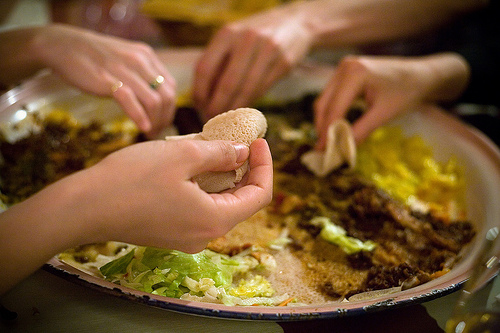
“No, no, it is fine!  I went in there, the lady was there cooking food – the whole place smelled sour like sourdough – it was that injeera bread – the pancakey one with all of the bubbles in it  – you know – injeera – she was cooking it and I asked her if we could come for dinner, if that would be alright, or if this was a private club.”

“Well,” I said, kicking myself as the words came out of my mouth, “that didn’t leave her much of an option, did it?”

“If you don’t want to go,” M. said as his energy and happiness deflated, “that’s ok, we can go anywhere you like.”

Feeling the blush of shame on my cheeks, I finally came to my sense.  Reaching out to hold his hand, I kissed M. and said “I trust you – let’s go – it will be fun! I love Eritrean food, what a treat!”  This seemed to do the trick – and although I still felt nervous about this impending cross-cultural moment, where I did not know what to expect, I knew it was important to show M. how much I loved him and trusted him – and I also knew that no matter what – we would grow from even this tiny experience.

As we walked in, a warm billow of spice and butter-scented air greeted us.  Turning to my left, I saw a young girl, who without missing a beat called out the following:

“Look! White people came in!”

There is nothing quite like the equalizer of a small child who is not afraid to name the moment.  And it softened us up completely. We laughed at this – perhaps with more comfort than the Eritreans shushing her and hustling her to the back of the pool table she sat next to.  “Yup,” M. said, giggling, “that’s us, white people!”

Before long, we were seated in front of the blasting television, joined by that very same little girl aged 7, and her younger brother, aged 3.  We played hand puppet games and answered their questions and just had a lot of fun.  It wasn’t until we were well-tucked-in to our delicious meal of super-spicy food that I realized I was hearing Turkish.  Looking around to make sure that it wasn’t the puppets lapsing into their native tongue, I finally turned up to the television screen.  Sure enough, it was a Turkish soap opera with Amharic subtitles. M. realized this at the same moment – whipping around to check it out – and proceeded to explain to me who the actors were – who was famous, and why.  I had no idea that my husband was so “up” on Turkish soap operas which, by the way, have gained international notoriety for tackling tough social issues – see, for example, this article in the New York Times.

What are the odds of a Turkish-American couple heading out to an Eritrean social club in Boston, Massachusetts only to watch a Turkish soap opera during dinner?  No idea, but it was a heck of a lot of fun.  Best date ever – and all because I allowed myself to trust in my M. and not worry quite so much about the rules of etiquette or being in my comfort zone.

Here’s to many more out-of-my-comfort-zone dates with M. Thank you for making me a better person.

Posted in Academic hell, Cross-cultural learning moments, Visits from the Karagöz puppets | Tagged , , , , , , , , | 5 Comments

Peynirli Poğaça: Karagöz urges me to get baking and forget academia


Those puppets, well, they are at it again. They are always nattering on and on, sometimes up to no good, sometimes up to good, scheming with the best of intentions and the worst at times – and discussing things that are going on in my life.  And while I am sure it is all for the greater good, sometimes I do tire of them despite the fact that I am secretly in love with them and the way that they allow me to see more clearly how I am thinking and feeling about the life I am steeped in.

Karagöz came to warn me about what the little chorus of dancing ladies (one of whom traditionally always starts up a Karagöz play) were up to as I was furiously following the Write-a-matrix’s demands to finish at least ONE of my manuscripts for publication while I was in seclusion down in Provincetown. The Write-a-matrix, as you may recall, is my internal whip-cracker, who only wants me to do academic writing – not my personal writing that I am getting back to after a hiatus of many years.

The Write-a-matrix does NOT care that I am not feeling well, nor that I am overwhelmed by my job’s demands to the extreme, or by the fact that I sometimes worry I am losing my mind as a result of this job.  She doesn’t care at all.  She is the pure academic writer who wants me to produce IMPORTANT commentary on IMPORTANT topics about the populations who “fall between the cracks” of the U.S. disability services and other systems.  She is true to that personal commitment that I made when I left direct care social work. “Never forget!” she screams, cracking her whip on the table to the left of my keyboard, “Never forget what you saw!” and I hurry back to writing even though I know that not many people will ever read my work and that it probably won’t make much of a difference anyway.

The dull ache in my stomach re-knots itself, a bit tighter this time, resulting in the internal version of a sharp whip crack, and I know that my endometriosis is coming back in full force – it has been a couple of years without this pain.  Perhaps it is my upset at this realization that indeed I’ll need to head for surgery again.  Perhaps spurred on by my response to the pain in my side, I shoot out some angry words her way, saying “Write-a-matrix – damn you – isn’t this really all for naught? And seriously, I took that ‘never forget’ oath before I had family responsibilities and a job like I do now. I mean, seriously, how am I supposed to balance all of this – much less balance this while I am not feeling well? I wish you would leave me alone. I wish everyone would just leave me alone.”  Ignoring my rant, that Write-a-matrix, she just kept cracking the whip – never breaking eye contact with her hypnotic stare.

Somewhat oblivious to all of this, Karagöz sauntered up just about then, full of his usual vim and vigor and oppositional behavior.  He was as drunk as a sailor on land leave for the first time in months. On the way over to visit me (from one end of the table to the other), he pushed the Write-a-matrix off of the desk in the midst of a sloppy dipping curtsy.  Seeing that the Write-a-matrix’s leather whip lay in wait, I wondered how long I had until the puppet battle really began in earnest.

“You see!” Karagöz said, pointing his swooning finger high into the sky above me, “those dancing ladies, they are on a mission (hiccup)- a mission I tell you!”  Turning my head to him at the completion of a sentence in my manuscript I was frantically trying to finish, I looked at him as if to say “make it snappy, I have no time for this.” Taking one sludgy step further, Karagöz smirked at me, saying “and that is just the problem, m’lady, you need to make time for more than this, that is what those little lady puppets are arguing, you need to make time to be a good wife – and a good Turkish wife at that and you know what that (hiccup) means, don’t you?”  Raising my eyebrows to indicate “no” in Turkish body language parlance, I just pursed my lips, tapped my keyboard, and waited for my drunken puppet friend to continue his inevitable rant, thinking “just what is this “Turkish wife” stuff, anyway?”

“Well, it means, you see, that you need to BAKE.” Standing tall with conviction, Karagöz exclaimed “you need to bake some Turkish pastries to show your husband that you love him and that you love his culture – if you are really so serious about cross-cultural life. Look at you, here you are on spring break from the university, slaving away, away from your husband, working at all hours of day and night on your academic papers. That Write-a-matrix be damned, you need to go home to the city and bake something good – and I vote for Peynirli Poğaça (pay-near-lee/ poh-ah-chah).

Pronouncing the ps in the Turkish name of the cheese-filled pastry with the ultimate alliterative allure, Karagöz fell over with the power of his own words. From his splayed-out position, Karagöz continued his rant even further ” in case your less-than-rudimentary Turkish fails you (and you NEED to get to studying that m’lady, now that you have tenure) – that means those feta and herb-filled savory buns that C. Teyze always serves when you come for tea.”  The pain in my stomach twisted a bit tighter, joining the mental pain of my guilt about all of the above.

Sighing at the tawdriness of Karagöz’s raw emotion oozing out as a result of being three-sheets-to-the-wind drunk, I heard the grumblings of a truly enraged Write-a-matrix as she climbed up the table leg, refusing to leave her job unfinished. I did feel guilty about being away from home and M. It is made somewhat easier by the fact that M. is fine with this – eating his organic chili from a can that he heats on the stove – something he cannot do when I am around. You can read more about that here – see the photo at the end of the article. Soon, Karagöz was dodging the Write-a-Matrix’s whip and the two were locked in mortal combat – yet another puppet battle in my life.

As the melee ensued, I thought about M., who was happy at home with his canned chili.  I thought about how he was 200% supportive of my academic career – although he does often say he wishes I was not so tired and overwhelmed by it.  I thought about how he was fine with me being away – as a couple married later in life – this has never been an issue for either of us.  And then I thought about my new e-friend Rosamond.  Raised in England, she is married to a man with Pakistani origins – and moved by the spirit, she converted to Islam when she married him. We have e-met and bonded recently through this blog – and I am ever grateful for her support and insightful comments.

I thought about all of her delicious-looking cooking posted on her blog entitled Food Glorious Food from Rosamond’s Kitchen.  I thought about my stepmom’s good advice about sometimes the best balm to heal an argument rift in a relationship is a good, home-cooked meal.  I thought about how nice it is to sit across from M. and have dinner together at the dining table.  I thought “I need to go home, and try out some of Rosamond’s recipes.”  The endometriosis-infused twinges in my stomach still continued, but the mental ones eased up a bit.  Taking the bull by the horns, I began to pack my bags for the trip home.

As I prepared for the trip, I just put Karagöz and the Write-a-matrix on mute and instead, I thought about Rosamond.  In truth, I feel as though this trail-blazer in the cross-cultural marriage club (40 years of marriage and counting) is in my corner – she has given me great advice and she inspires me about not letting anything get in the way of loving my M.  This is the best of what the blogosphere has to offer, this kind of e-camaraderie.  In any case, Rosamond popped into my mind for a reason – and Karagöz knew this – in addition to being the fabulous woman and wife she is, she has embraced the joys of cooking dishes from around the world – and hosts an interesting blog that is the very epitome of the best that globalization in situ has to offer.

Several weeks ago, Rosamond shared her recipe for peynirli poğaça – but she often has treats from many origins – from Polish cheesecake in honor of her father’s roots, shami kebabs from Pakistani or English almond pastry mince pies and beyond. I am grateful to her for these English-language recipes – and for the fact that she puts out recipes that she herself has tested! Please check out her blog for some no-nonsense, clear and super-yummy recipes!  So, while I am in process on balancing my personal life and my professional one, I think I might just have time to try Rosamond’s recipe! I’ll report back on that – but for now – check out this Turkish guy making peynirli poğaça with his kids!

Rosamond’s recipe for Peynirli Poğaça

There are many different types and shapes of this popular bread,bun or pastry as its called.This is very popular in Turkey for breakfast but it can be seved any time of the day. When my husband and i had our holiday home in turkey my neighbour used to send them round to us some mornings. I liked them so much i translated her recipie which i have included in my book.

Ingredients

  • 237ml   whole milk
  • 2 eggs, whites and yolks separated
  • 1 tbsp cooking oil
  • 4 tbsps granulated sugar
  • 1 tsp salt 800g plain flour
  • 2 tsps dry yeast
  • Cheese filling:
  • 225g     feta cheese crumbled
  • 4 tbsps  finely chopped parsley
  • For decoration: 3tsp  black sesame seeds

Procedure

  • 1 Add 2 tbsps of sugar in milk and stir to combine. Heat the milk in microwave for a minute or so. 2 Sprinkle dry yeast over milk and put the bowl in a warm place for 30 minutes. I usually leave it in microwave.
  • 3 After it has risen add 2 egg whites, the remaining sugar (2 tablespoons), oil, salt and gradually add flour while you are kneading the dough.
  • 4 Knead it until combined. Leave dough in a warm place to rise. It usually takes an hour to double in size.
  • 5 When it rises, take some dough the size of a golf ball and make it flat and round in your palm. 6 Put 1tsp cheese filling in it and close the edges of dough and make sure they stick to each other, it must look like letter “D”.
  • 7 Prepare an egg wash with 2 egg yolks and brush one side of each “pogoca” and sprinkle some black sesame seeds.
  • 8 Place them egg washed side up onto the greased baking tray/grease proofed sheets and pop them into the 180 C pre-heated oven and bake for about 20-25 minutes or until golden brown. 9 Serve warm with tea or any drink you like

Oven Temperature: 350f/180 C/Gas 4/5

Recipe Tips · You could also use 8oz cooked mince, salt and pepper, spices according to your taste instead of feta cheese.

Posted in A Karagöz puppet battle, Academic hell, Turkish Food!, Visits from the Karagöz puppets | Tagged , , , , , , , , , , , | 9 Comments