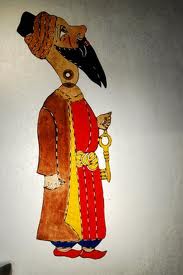
Yehuda Rebbe, image thanks to the Asian Shadow Theatre Exhibition's Flikr photostream
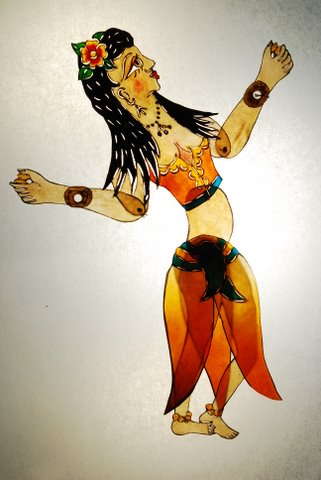
So, today we are meeting Yehuda Rebbe, the Jewish wise man. This is a far cry on the spectrum from ridiculous to sublime if you consider that yesterday we met Safiye Rakkase, the vainglorious dancing girl. She ignores Yehuda Rebbe when he comes around, and he respectfully steers clear of her.
Yehuda Rebbe is a learned and pious man who just happens to be of the Jewish faith. While the traditional use of Jewish figures in Karagöz puppetry involved significant stereotypes, my brain does not buy into this. In fact, Yehuda Rebbe is a wandering rebbe, who seeks truth much as the wandering dervishes did. As of late he wanders in and out of the area of my mind, and in the general vicinity around it. He carries a great big brass key, as he has become the guardian of the fountain of youth that all the puppets living in my head have drunk from. I am not sure who appointed him as the Holder of the Key, but he must have been deemed to have his head squarely on his shoulders to receive such an honor and responsibility, I mean, can you imagine if Karagöz himself had that job? Whew.
But, on a more serious note, Yehuda Rebbe loves to read, loves to observe and loves to debate. He has gotten himself up to speed on the modern day Israel-Palestine conflict, supported the Mavi Marmaris mission the first time, and has decried the oppression experienced by Palestinians. He feels that the entire conflict is a losing battle, though, and that the post-colonialistic influence of the UK in setting up the 1963 agreement was a bad seed planted. He says, however, that it goes on and on, round and round way back before that. He gets very worked up about all this.
Yehuda Rebbe is also a big fan of the resurgence of Ladino music in Turkey, and speaks Ladino with a flourish. Ladino is a language that is also called Judeo-Spanish. As I understand it, it is both the spoken and written Hispanic language of Jewish people of Spanish origin (I guess meaning those that did not head to Latin America). This was not a language until after the expulsion of Jewish people from Spain in 1492. So here is what I understand – when the Jews were expelled from Spain, the development of their (Castilian) Spanish was cut off from the rest of the Spanish-speaking world. However, they kept on speaking the language in their own communities and over time, their own grammar and volcabulary were sort of stuck back in the 1400s and 1500s…Yehuda Rebbe will tell you all you wanted to know and more on this topic…
Mostly, though he seeks to besmirch the stereotypical image of himself, which is described here by Emin Senyer, the English-language web expert on Karagoz puppetry, as far as I can see: “the haggling Jew is a familiar character and is either seen as a money lender, a second hand dealer or a peddler. He tries out many obscene puns on Karagöz and, using his ungrammatical, broken Turkish as an excuse, he maliciously changes Karagöz’s name to give it a bad meaning and a result, Karagöz becomes angry and wants to beat him. He is a malicious and vulgar type. He wears black salvar, a loose linen robe open in the front called cubbe, and a keveza, a black hat with a blue turban. There is a sack on his back. When Karagoz pretends to go at him, or even only to suggest that he intends to do so, the Jew begins to shout and scream as though he were actually being severally hurt. When Karagöz makes the motion of tickling him, even while till at a distance, the Jew begins to laugh. While he is complaining in a loud voice he nevertheless always finds time to revile Karagöz. He is a miser and haggler. Even after he agrees on a price, he complains that it is too high and he can not pay. He is also a coward and when all the other characters in the neighborhood decide to attack the drunkard, the Jew does not join them but runs away.”
Phew, what images. In the characters of my mind, Yehuda Rebbe never runs away, but always stays to enjoy a debate, or a little sparring. He also will not have one bit of interaction with currency, fearing a stereotyped image, he prefers to barter. He often barters his own melodious voice reading the sacred stories and learnings of the Torah and Talmud for what he may need. Turns out, Karagöz puppets occasionally need meals of olive oil (to keep their inner and outer workings supple, as they are made of cow and sheep hides, after all).
I have a sense that the puppets, including Yehuda Rebbe, may have known (YEARS ahead of me) that I would end up with M. and become in need of their Karagoz puppet services (well, they think that, and, um, I guess I do too). I say this, because I have heard stirrings of Yehuda Rebbe (and of course the others, each in their own way) for years. I think it was Yahuda Rebbe who encouraged me to take up my college friends’ offer to join them in living in our college’s Hillel House – since a crazy lawsuit required “de-segregation” of the house and the placement of at least three non-Jewish people in that house. Well, that was me. I learned how to cook in a kosher kitchen, how to deal with the aftermath of an aryan attack (for real, the meat was brought to the dairy parts of the kitchen, and human feces were spread everywhere before they tried to burn our house down) and a few basic blessings in Hebrew. For a Unitarian (lefty intellectual wing of the Protestant world), this posed no problem, and it has opened my eyes in more ways than one.
I am sure, now that I write this, that Yehuda Rebbe was behind this, silently whispering in my ear all the way through the application process, interview and move-in day. Like Mercan Bey, the spice trader from the Arabian penninsula, Yehuda Rebbe is responsible for always encouraging me to open not only my eyes, ears and mind – but also my heart to people who do things differently than me. Yehuda Rebbe is telling me that his special mission in my head is to focus especially on conducting damage control when M.’s heartfelt but truly ignorant in the dictionary-sense-of-the-word questions about religion rub people in the family the wrong way. As I write this, Hacivad Bey has chosen to show himself now, as has Yehuda Rebbe. We often see them together, talking into the wee hours of the night, much like Shams of Tabriz and the Mevlana himself. They are standing here on top of the laptop screen, looking at one another, and silently, they quote in unison something that means a lot to them – from Rumi:
“Since the object of praise is one,
from this point of view,
all religions are but one religion.
Know that all praise belongs to the Light of God
and is only lent to created forms and beings.
Should people praise anyone but the One
who alone deserves to be praised?
But they go astray in useless fantasy.
The Light of God in relation to phenomena
is like light shining upon a wall—
the wall is but a focus for these splendors.”
Finishing these words, the two puppets nod their heads in agreement and bow with respect to one another – only to be interrupted by the modern-thinking Celebi. Throwing himself in between, Celebi screams about religion being the opiate of the masses, and generally wreaks enough havoc for all the Karagöz puppets to run up onto the laptop wh430t21[035t0\1243@#$%F3P….WHEW! They all started jumping on the keys there, sorry. OK, we are in the middle of a full-blown argument on religion and spirituality now, I will have to get back to you another time – no space to type!
Related articles
- The Twelve Days of Christmas: Karagöz puppet-style (slowly-by-slowly.com)
- On the 9th day of Christmas: Meet Safiye Rakkase, the vainglorious dancing girl (slowly-by-slowly.com)
- On the 8th day of Christmas: Meet Mercan, the spice trader from Arabia (slowly-by-slowKly.com)
- On the 2nd day of Christmas: Meet Bebe Ruhi, a Karagöz puppet with Dwarfism and a whole lotta goof (slowly-by-slowly.com)
- Karagöz is up to his tricks, this time with a “ghost post:” The puppet troupe responds (slowly-by-slowly.com)
- On the 7th day of Christmas: Meet Zenne, nervous nellie like a bowl of jelly (slowly-by-slowly.com)
- On the 6th day of Christmas: Meet Tiryaki the opium addict with narcolepsy (slowly-by-slowly.com)
- Karagöz: Consider this a formal introduction to himself (slowly-by-slowly.com)