On the 7th day of Christmas: Meet Zenne, nervous nellie like a bowl of jelly


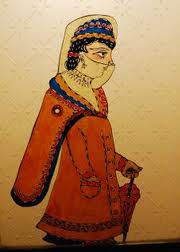
The shy and reserved Zenne, image from the Asian Shadow Theatre Exhibition's photostream at Flikr

Today, it is time to meet Zenne, the Karagoz puppet that I refer to as “the nervous nellie like a bowl of jelly.”  I realized that this moniker was befitting of her when I passed by Nervous Nellie’s Shop – in Deer Island, Maine.  They have some delicious, albeit wobbly and shaky jelly.  Zenne was so nervous about trying this new jelly, that she shivered and shook and worried that she might stain her silken veil with the wild blueberry jelly I was encouraging her to try, and the nickname was born.

So, Zenne, she is a very sweet and well-meaning lady, but very timid.  She wants to make a good impression.  She wants to do “the right thing.”  As Tiryaki Bey is addicted to opium – she is addicted to the worry about “doing the right thing” even if it is something that leads to her undoing.  So, how did Zenne come to be the way she is? And why is she here in my mind?  Rumor has it that her first words as a child were “Mummy, I wowwy about dat” but that is the extent of what we know about her origins other than that she was brought into Sultan Selim I‘s court as a Çengi from the Aegean region after being noticed in the village market by the entourage.  She worried about whether she would be chosen, whether she should go back to her family after being chosen and about whether she would please the Sultan since being chosen.  So, since that toddler-infused sentence was uttered, she basically has not stopped since then with the worrying, it is just part of who she is.  She does her best to put her worry to good use – reframed as an analytical mind on steroids, thinking multiplicatively about all possible options on any given matter.  She really drives people nuts, but there is a sheer genius to her brain sometimes – like juggling with concepts.  Her worry, though, can devolve into dysfunctional in a hot minute.  Generally, the other puppets are tender with her – except for the merciless Karagöz, who taunts her without end.

In the depiction of Zenne above left, we see a rather proper-looking lady with a veil – no?  Sniffing disdainfully as she throws her chin towards the chorus of little dancing ladies, (Çengi) , Kenne interrupts me here, “she is most certainly a proper lady, unlike that other lot!”  Zenne was also a Çengi for many years – due to her nervousness, she was usually the puppet that would start the pre-puppet-show on screen, which always starts with a scantily clad dancing girl – she had to start, because she was too nervous to wait.  But she gave this all up, as just before she drank from the fountain of youth with Khadijah, she had converted to Islam, and to a life of pious service to others.  This led to her use of the veil in the stereotypical sense we think of today – the veil as a guardian of female modesty.

While in reality, this image above may likely be a 19th-century re-imagination of the women of the Karagöz puppet troupe, we like to keep her this way over here at slowly-by-slowly.  So, let’s talk about that.  Now, the stereotype about the women amongst the traditional Karagöz puppet troupe is that they are temptresses extraordinaire, always being “unabashed flirts” and “setting snares for men,” at least so says Dror Zeʼevi, whose 2006 book, entitled Producing desire: Changing sexual discourse in the Ottoman Middle East, 1500-1900 covers all sorts of unexpected topics, as described here at this link.

A close up of a rose geranium flower from Zenne's summer garden

Zenne stays with her human relentlessly, she worries about her A LOT.  It’s just part of the territory with her, 99% of the time.  The only place she finds some solace is in her summertime scented garden – full of fragrant herbs, the most abundant of which is rose geranium – there is nothing more calming, she tells me, and it even makes a fantasically romantic jelly, the recipe for which she provides us here:
“Cut off all spots and decayed places on the apples. Do not core or peel them. Use abut 8 dozen apples. Fill the preserving pan and cover the fruit with spring water, cook until pulpy. Pour the fruit into a cotton bag and let them strain all night. Do not squeeze the bag too hard or you will get cloudy jelly. Next day add 1 pound sugar for every pint of juice; put in several plum fresh rose geranium leaves. Let this mixture boil 20 minutes. Take out and discard the geranium leaves. Skim it well. Put either into shapes or pots, cover it the next day. It ought to be quite stiff and clear.”  We see, sadly, that Cooks.com copies this recipe without any attribution to the little shadow puppet lady herself.  😦
Posted in Introducing the Karagöz puppets, On writing about my life with the Karagöz puppets, Visits from the Karagöz puppets | Tagged , , , , , , | 16 Comments

Karagöz is up to his tricks, this time with a “ghost post:” The puppet troupe responds


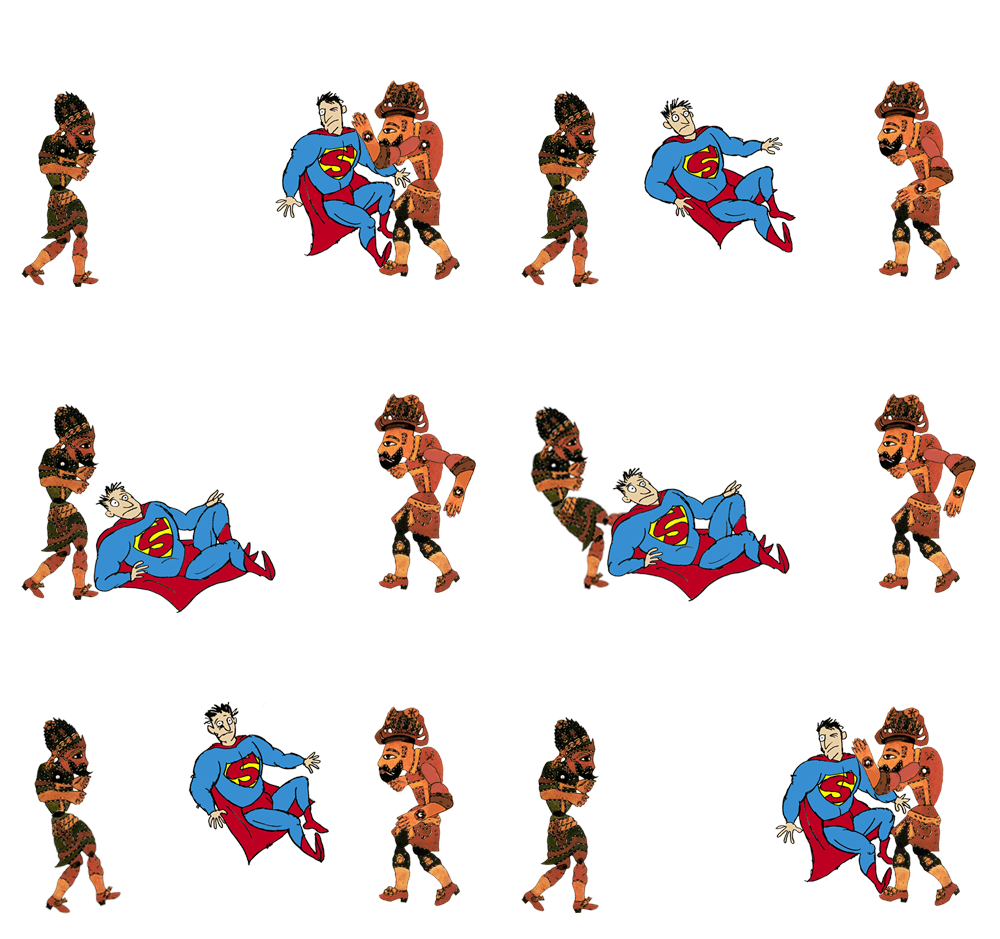
Well, woe is me.  Karagöz is up to his tricks, this time with a “ghost post.”  These puppets are so anxious to get ahead on posting for the new year, that they accidentally hit “publish” instead of “schedule” for a post they just inspired their human, me, the one who types, to write.

Karagoz the trickster is at it again - this time he is after the man in the superman costume - or else he really has some kryptonite. Thanks to this link for this little moving image! http://www.karagozcu.byethost13.com/images/intikam.gif

Kenne, the etiquette maven you learned about a few days ago, is red-faced and horrified, already seeking guidance from Emily Post on how to handle this situation.

Tiryaki, the opium addict, just took another toke and nodded out as a way to get through the embarrassment.

Celebi suggested that we just face the music, front and center, and throw a party for everyone – preferably with some Mahler symphonies, or maybe Bartok.

Khadijah just shrugged her shoulders, and kept going on the laundry.

Zenne, well, true to form, she is even more of a nervous nellie, shaking like jelly that someone will be upset, or even un-friend us on Facebook, de-tweet us on Twitter or stop following us on email.

The chorus of dancing ladies, well, they just grumble and mumble from their usual spot in my purse as Bebe Ruhi asks me, over and over and over, “why do you do this? Why do you do this writing? What is the meaning of this writing? What do you think subconsciously led you to hit “publish” and why?”

Esma, the little hippie puppet, she looked at me – and just instructed me to assume the position, the lotus position, that is.  Namely, it is time to meditate and consider this addiction to writing that has befallen me – and made me lose my senses.

At the mention of addiciton, Tiryaki stirs from his opium-laced sleep, opens one eye, surveys the tense situation, and falls immediately back to sleep.

And what do I say to the little hippie lady practically beating me with a lotus flower? “It’s a hell of a lot more fun than grading papers.”  She has no argument.

And then Hacivad Bey shows  up, and as usual, he has a quote from Rumi that leaves me ready to move on:

Mistakes can also lead you to the Truth. Ask, the answer will be given.”

Posted in Visits from the Karagöz puppets | 5 Comments

On the 6th day of Christmas: Meet Tiryaki the opium addict with narcolepsy


Kanbur TiryakiToday, we meet one of the more shadowy figures in my head – and in the history of Karagöz shadow puppetry in Turkey, Tiryaki Bey, who is addicted to opium and nods off on a regular basis – sometimes due to narcolepsy and sometimes due to, well, just nodding off from all of that opium. Like any other person who becomes addicted to substances, Tiryaki started out as a sweet-faced child, enamored of fairy tales, holding on to his mother’s apron strings and following his father’s trade visits through the Koza Han (or silk market) in his hometown of Bursa and visiting his grandparents’ chestnut farm on the outskirts of town – chestnuts (kestane) for which the region is most famous).

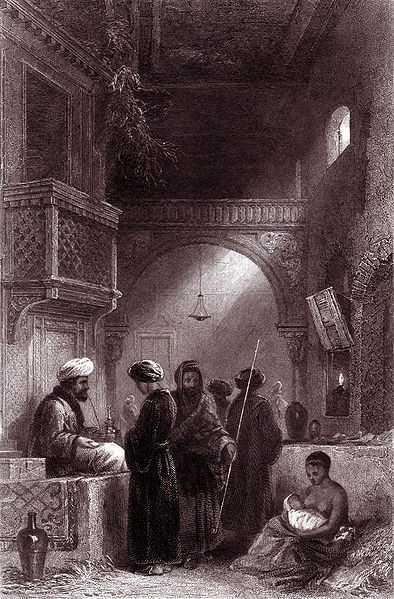
We can imagine a scene in the Ottoman court from looking at this image - this is a scan from the original engraving by F. W. Topham (London: E. Bell, c. 1850) via Wikicommons.

We can piece together the history of what happened to him – with a bit of the flourish of fairy tale fantasy thrown in – by looking at what we know about opium during Ottoman times….we know, for example from Wikipedia thatŞerafeddin Sabuncuoğlu used opium in the fourteenth century Ottoman Empire to treat migraine headaches, sciatica, and other painful ailments”  This was the time in which the puppets got their start – in the 1300s in Bursa.  We know that opium became something that was popular for recreation amongst the well-to-do.  Perhaps Tiryaki felt the tyranny of living up to his status as the firstborn son – and spent too much time hanging out in the Sultan’s court, as a member of the up and coming class of adolescent children of the  monied class…and perhaps he became exposed to opium…and perhaps, well, perhaps the rest is history? Opium did become a major export from the Ottoman Empire to Europe – but is reported by many to be well-used in Constantinople…one letter from 1573, for instance, documented that a “Venetian visitor to the Ottoman Empire observed that many of the Turkish natives of Constantinople regularly drink a ‘certain black water made with opium” that makes them feel good, but to which they become so addicted that if they try to go without they will ‘quickly die.'”

As I write this, Tiryaki Bey is nodding at me, with half-lidded eyes, in a cool man fashion, laughing through his Opium high haze enough to gaze out in my direction with a suave, nodding, cool acknowledgement that all I say here is true.  I remember this look that I thought was so cool when I was caught up in doing drugs et alia during my punk-hippie phase.  I guess I was a just a good kid doing bad things, reacting against some things in my life in a stupid way.  It was “cool” to do drugs, to be different, to rebel against the status quo of suburbia.  This is what I thought at the time – if you can call it thinking.  I did a bunch of different stuff – but I only smoked opium once (that I know of – pot is often laced with things that smokers are not aware of), and it resulted in a disastrous experience I would rather forget.  Suffice it to say, I am lucky to have made it out of that phase without significant and lasting trauma, brain damage, disease or criminal justice involvement.

I think that Tiryaki the puppet stays in the shadows of the corners of my mind as a reminder of how easy it is to get caught up in things that may seem alluring, different and interesting – but can be very damaging.  I see him nodding at me when I approach choices in my life that are not so good for me  – say – the decision to take on yet another research project because it is so tantalizingly interesting – despite the fact that I am already over-committed.  Tiryaki is the one that gets me to stop for McFatness (our niece’s word for McDonald’s) meals when I am starving at 10 at night after 12 hours at work instead of waiting for food at home.  Tiryaki is the one who draws me in to watch 3 hours at a time of E! entertainment TV when the Kardashian clan are on and I really need to be grading papers but am totally brain dead from a week’s worth of workaholism. Tiryaki is the one that is addicted to protesting during faculty meetings – when I really should be engaging in what is often referred to as “STFU” behavior in The Chronicle of Higher Education’s tenure track blogs (you can google that acronym, I don’t want the censors on my trail here).  Tiryaki is the one who opens the curtains wide when depression is peeking in the window of my life…and encourages me to sleep long, deep hours when depression is too much.  He is a mixed fellow, someone who wants to be a reminder of what is the wrong road – but too often takes that wrong road when he knows better.

So, Tiryaki is still addicted to opium, and as he has sipped from the fountain of youth (ok, he used it in his opium bong), he will be forever…and his goal is to forever be my reminder of bad choices – and if possible – the maker of bad choices.  It is my hope that my nieces and nephews will never experience this and that they will be a lot smarter than me in this regard and not need to recede into avoidance of the world around me when it was too difficult to stay, and to difficult to resist the allure of doing something “on the dark side.”  Thank goodness it all turned out ok – or – maybe this is part of why I am as weird and tortured as I am.

At this point in the narrative, Kenne standing right in my line of vision, in the middle of the laptop bed, glaring at me as she is wringing her hands at the horror of me admitting all of this.  She is interrupting my thoughts to shoot me this message in her shrill, uptight voice “a discussion of this nature, m’lady, it is most certainly not in the etiquette book, please do cease and desist.”  Karagöz is grinning from ear to ear about the fact that Kenne has her knickers in a knot, as the Brits like to say.  However, this post is not about Kenne, we learned all about her yesterday, and today is Tiryaki’s day in the limelight.  Every character – or puppet troupe of characters – has a dark side, and this is mine.

So, for a moment, let’s go to what Ermin Senyer has to say about this stock character in the world of Karagoz shadow puppets in Turkey:

“Tiryaki, the opium addict, spends all his time smoking opium and sleeping in the neighbourhood coffee house. He can easily be identified by his pipe, his fan and a huge humped shoulder. He is a flippant type but always tries to look serious. He speaks like Hacivat but has a bad habit of frequently going to sleep in the middle of a conversation and snoring loudly. He is inclined to make mountains out of molehills.”

So, have compassion for Tiryaki, but watch out when he comes around…whether it is mountains or molehills, you need to be wary of him.

Posted in Introducing the Karagöz puppets, On writing about my life with the Karagöz puppets, Visits from the Karagöz puppets | Tagged , , , , , , , | 16 Comments