The Twelve Days of Christmas: Karagöz puppet-style


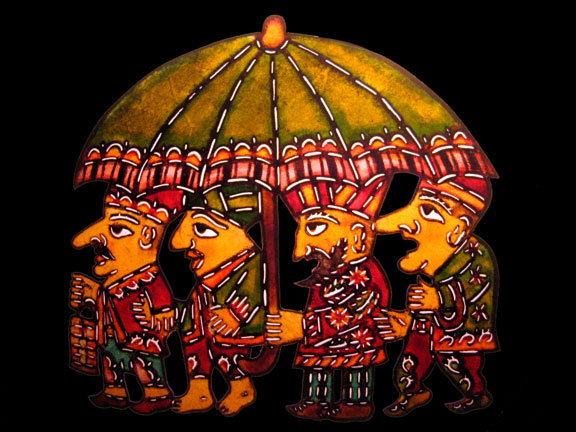
Image of the Karagöz puppets from this website http://www.superiorconcept.org/SCMpages/Istanbul/Karagoz.htm

Traditionally, the song “The Twelve Days of Christmas,” referrs to the days leading away from Christmas, starting on Boxing Day, December 26th.

In an unusual nod to tradition in this, my non-traditional household, I have decided to take a different spin on the twelve days.

For each of the twelve days leading up to the day before Christmas, starting tomorrow, I will introduce one of the members of the troupe of Karagöz shadow puppets who play a major role in my head (and, therefore, who play a major role in this blog). You have already met Karagöz Bey (Mr. Karagöz, for the English speakers out there) in this post, but I am re-posting it below this description of the puppets in the real world.

Over the next twelve days, you will meet the following puppets – all of whom inhabit my mind (and the back seat of the proverbial car) on this roadtrip called cross-cultural marriage…you may meet more along the way – but these are the major players.

1. Esma the organic hippie puppet who loves fuschia & tangerine roses

2. Bebe Ruhi the puppet with Dwarfism & questioner extraordenaire

3. Khadijah the worker from Egypt who drank from the fountain of youth

4. Celebi the modern lover and thinker

5. Kenne the traditional lady in search of maintained honor

6. Tiryaki the opium addict with narcolepsy

7. Zenne the nervous Nellie like a bowl of jelly

8. Mercan the spice trader from Arabia

9. Safiye the vainglorious dancing girl

10. Yehuda Rebbe the Jewish wise man

11. Perihan the fairy godmother

12. Hacivad Bey, the inimitable and learned leader of the puppet troupe

I love this description of the puppets and who they are in the real world of puppetry (from 2010 European Off-Network Festival. Sponsored by Turkish Ministry of Tourism and Culture):

“The Karagöz shadow theater tradition dates back at least 500 years and is still actively performed in Turkey. The plays originally portrayed the layered cross-cultural hierarchy of Ottoman Imperial life, creating a comic ethos filled with shape-shifting, class conflict, cross-dressing, deconstruction of language, and the clash of cultures. Although its stock characters reflect the costumes, language, and historic context of a bygone era, the characters themselves – Karagoz the trickster, Hacivat the intellectual, Celebi the romantic, Tiryaki the addict, etc. – remain timeless and relevant.”

While the role of women in the Karagöz plays is often limited to a shrill wife or sexy dancing girl (a la Ruby in the Berlusconi scandal) – geez no better than girls in a modern day rap video – I have chosen to re-create and/or create female characters in the world of my puppet mind. Traditionally, women are portrayed as follows in this puppetry tradition, again to Ermin Senyer:

“Women in Karagoz plays are young, middle-aged and old, flighty, quarrelsome, only just faithful and always prone to gossip. The main type is always flighty and given to intrigue. In nearly every play, this type causes a scandal in the neighbourhood. Karagoz,s wife often abuses him for not feeding her and not clothing her. As the women in Karagoz are always dubbed by male puppeteers, they speak in cracked voices. They wear a loose, sleeved, cloak-like garment called ferace, two pieces of fine muslin or tarlatan called yasmak, folded and pinned in such a way that one edge covers the mouth and lower part of nose and the other passes across the brow above the eyes, while the rest hangs behind. As the veil is very thin, the features can be quite-clearly seen. They wear a blue bonnet called hotoz, patent leather or velvet slippers on their feet and each carries an umbrella. Some wear a red ferace, a black alpaca thrown over the head and held by a pin under the chin, entirely concealing the face. Courtesans always have their breasts half or fully exposed. Some wear slipper boots of yellow Morocco leather called cedik and carry a stick in their hand. If the woman character represents a Negro slave, she wears black gloves, a red ferace, red pabuc (a strong soled shoe) and a white head band.”

Original post on himself:

Karagöz is a word that refers both to an individual puppet character from the Ottoman Empire era AND to the entire troupe of Karagöz shadow puppets that surround him. I have described this band of puppets in brief, here. And I have also introduced them as they introduced themselves to me, in their hometown of Bursa.

Kara, meaning black is linked with göz, meaning eye. Presumably, this name refers to the puppet with the big, black eye – not from a punch in the face – just a big black eye. While you have heard lots and lots about Karagöz’s favorite approaches to life – namely – twisting, turning, jumping, cartwheeling, flipping and being generally flippant in the most rhyming manner possible, I haven’t told you much more about him than the ways that he tends to act as the shadow puppet personification of the outlier voice in my head, the proverbial agent provocateur. He is the puppet that nags at me, questions me in the most cruel ways, makes me question myself (and sometimes my sanity) and always gets a fight going. He is the nay-sayer that drives me nuts in my head. The problem is, there is always a grain of truth in his antics, it is always in there somewhere.

One of the best English-language websites I have found on the Karagöz puppet tradition in Turkey, http://www.karagoz.net/english/shadowplay.htm , talks a bit about this fellow, saying “I have touched in passing on Karagöz and Hacivat, the two cronies who are the leading characters of the Turkish shadow theatre Karagöz, but the main character is Karagöz . Karagöz is uneducated but honest.” As M. tells it, the Karagöz of his childhood is more than honest – he is brutally honest, calling a spade a spade, as well say, regardless of the context, the company or the consequences. The author of this super website continues on to describe Karagöz in contrast to the ever-present Hacivad (or Hacivat) , saying:
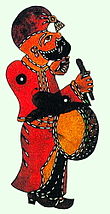
Karagöz the drummer – drumming home his crazy message of the day

“It is always doubtful whether Karagöz and Hacivat ever really existed and, as we have already seen, there are many legends about this. Karagöz was supposed by some to be a gypsy and there are many allusions and much evidence in the plays to support this theory. Karagöz has a round face, his eye is boldly designed with a large black pupil, hence his name –Black Eye-. He has a pug nose and around thick curly black beard. His head, completely bald, sports an enormous turban which, when knocked off, suddenly expose his bald head which always provokes laughter. In all dialogue between Karagöz and Hacivat, we find Hacivat always uses flowing language full of prose rime while Karagöz uses the language of the common people. His promptness with repartee procured for him his fame and reputation. This contrasts artificiality with simplicity and is the first satire to attain these differences. This contrasting language is also noticeable in Hacivat’s erudition. He can recite famous poems, has a vast knowledge of music, is conversant with the names of various rare spices, the terminology of gardening, many varied encyclopedic extracts, and with the etiquette of the aristocracy. This however is superficial and gives him only a scholastic type of making a living for himself and his family. Because he has no trade, he is usually unemployed and fails to provide for his family, and has enough sense to realize that to rectify this, he does not need Hacivat’s superficial knowledge. Though he is stupid and easily taken in, he is constantly able to deceive Hacivat and others.”

The Karagoz Museum in Bursa – From the Bursa Daily Photo blog (click photo for link)

For a more academic exploration of the character, see the Turkish Cultural Foundation‘s description, here.

While I have taken some liberties in my interpretations of the puppets based on my own artisitic license, this is where they started. Even though I cannot understand the majority of Karagöz dialogue in live or video performances of this shadow puppetry, these puppets have fascinated me since I first saw them in 2004. I have loved hearing M.’s stories about them – and about the stock character types they represent – straight out of the Ottoman Empire. One more reason to improve upon my Turkish is next year’s planned visit to the Karagöz museum in Bursa.

Posted in Introducing the Karagöz puppets, On writing about my life with the Karagöz puppets | Tagged , , , , | 24 Comments

We interrupt the Karagoz broadcast to announce: We’ve been nominated for the Versatile Blogger Award (twice!)


My goodness!

A few weeks ago, my fellow blogger, Walking Papers: A Long Strange Family Trip, wrote to let me know that she had nominated me for The Versatile Blogger Award (which as she so hysterically points out has been won by at least “568,312 (or so)” other people.  She – and I – were not too sure about what it really meant to be nominated.  Ignoring the obvious, I presumed, in my fantasy world, that I might someday get an email saying that I had won something – beyond the respect of my fellow blogger for which I am very honored and grateful!

And then comes part two.  In the process of catching up with my favorite blogs after a month off the blogosphere, I found that I was doubly nominated for this award! Jack Scott over at the inimitable Perking the Pansies blog (and author of a fabulous new book on the experiences that he and his husband/partner have had as expats living in Turkey –  and you can order here) – has also nominated me! Thank you, Jack – I wish I had noticed sooner! Slackerish me!

So, after reading what Jack and Walking Papers have to say about the award – and Googling around a bit – I can see that nobody really gets a sense of the origins of this award – but does it matter? No! This is a home grown, grass roots type of award – which I would argue is the very best kind. So, in keeping with tradition, I am posting the image for this award as well as seven quirky things about me – and I am nominating seven other blogs for this award as well! So – here you go – and many, many thanks (she takes a stage bow, and the Karagöz puppets beam with double-sided pride!).

As a recipient of the award, I must post the image of the award (check), write 7 quirky things about me (about to be a check) and pass on the award to 15 others (just about to be a check).  So, enjoy!

7 quirky things about me

1. I had a purple mohawk hairdo (amongst other colors and styles) in high school but attended both hard core punk shows and Grateful Dead shows to be different.

2. I used to be deathly afraid of public speaking and now I am a professional speaker (well, a professor) – neverwouldathoughtit.

3. In 1984, I visited Tbilisi, Georgia as part of a school exchange – this was before perestroika…and ditched an Intourist guide whilst doing so in order to walk through an ancient castle and into supermarkets and churches (not allowed with Intourist guide).

4. During the early 1990s, I worked on a hospital ward for people at the end stages of living with HIV/AIDS – it changed my worldview forever – the most courageous – and pissed off – people ever. They still inspire me and inform my teaching of social work students.

5. I learned how to spot a drug deal from my bodyguard in Brooklyn while doing home visits as a social worker – no lie, we had a bodyguard.  Leon and I pretended to be boyfriend and girlfriend when things got hairy (say, whilst trying to escape a gun battle in the projects in East New York).  I learned a lot from Leon – but I didn’t buy one of his teachings – namely that Islam was started in America, right there in Brooklyn (he didn’t mean the Louis Farrakhan variety, either).

6. I make a mean chocolate-rosewater cupcake with tangy lemon buttercream frosting – or sometimes old fashioned vanilla boiled meringue frosting in honor of my Dad and Grandma.

7. While traveling, my favorite thing to do is to check out the supermarkets.  This likely comes from the odd practice of ethnography my parents engaged in when we were kids while out to eat once a month at the Chinese restaurant – we ate in silence, observing all around us, and then each made up a fairy tale about what was going on around us for the car ride home.  Explains the puppets, maybe?

My nominations for versatile blogs are:

1) Mozzarella Mamma: Deadlines, Diapers and the Dolce Vita:  About an American journalist-Mamma living in Roma (full disclosure – she’s my stepsis).  I love all of her blog posts – but as she knows – those with the strongest “red thread” 😉 are my fave – especially “Mozzarella Mamma vs. Tiger Mamma.”

2)Archers of okçular: ‘Burası türkiye!’ – ‘this is turkey!’ – living, loving and travelling turkey:  The versatile, intriguing and generally gut-splitting musings of a Brit expat slash emiköy on all manner of interesting topics.  I couldn’t possibly choose one favorite – but I knew I had made a true friend when I saw the post entitled “How do you like your eggs, sir (or madam)?” in which Alan coddled an egg in J’s compost bin!

3) Culture Every Day:  Musings on all aspects of culture from an anthropologist and world traveler who is also on a Turkish-American marital roadtrip (to  use my own parlance!).  Right now, my favorite post is the one on globally-inspired holiday gifts – you can check it out here.

4) Pul Biber: With Everything:  A ramble through the versatile lives of two Britpats adjusting to their new life in Selcuk, Turkey – fascinating to watch!  I love tracking the process of these two with each post, but was particularly excited to read their camel wrestling post – as my husband insists this does not go on in Turkey and is not a Turkish tradition (go figure)!

5) Being Koy: A journal of life in Kirazli Koy, Kusadasi, Aegean Turkey: Lovely writing and images about village life in the Aegean region – a treat.  Can’t imagine a favorite – they are all super – but this one captures the essence of what I love about this blog “Village People.”

6) Adventures in Ankara…there’s a new kid in town:  A recounting of the exploits of a Philadelphia-derived expat in Ankara – and a fellow cross-cultural marriage road-tripper that I love to follow!  I am always interested to hear about the latest goings-on in Ankara, but one post that sticks in my mind that I can relate to is  “The Elusive Kekik.”

7) Turkish Travel Blog:  Now this is a blog about Turkey – and it is truly versatile – so many different topics and spins and out of the way highlights – with lovely graphics.  This blog is not only eye candy but it is a public service to all the English-speaking expats out there, I would imagine.  I think my very favorite post is on “The Hard-Core, Street Crew of Herakleia.”

Bravo all of you – and to many others!!!!

Posted in On writing about my life with the Karagöz puppets | Tagged , , , , | 16 Comments

Moving from Madonna to Meditation and Myths


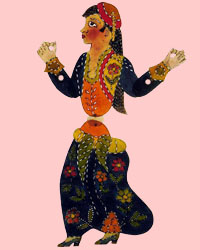
Here is Esma, the only member of the Karagöz shadow puppet troupe that wasn't uber-fashion-obsessed and was willing to take a walk with me!

These days, my internal Karagöz puppets are more like internal Karagöz demons – fashionista demons obsessed with what to wear to the Sultan of Nutcracker’s ball in Provincetown.  In order to get some solace from the fashion madness – and the fact that Madonna’s “vogue” is on repeat in my house, I sat down to meditate on the bay beach along with the one little puppet who would leave the house with me – Esma.

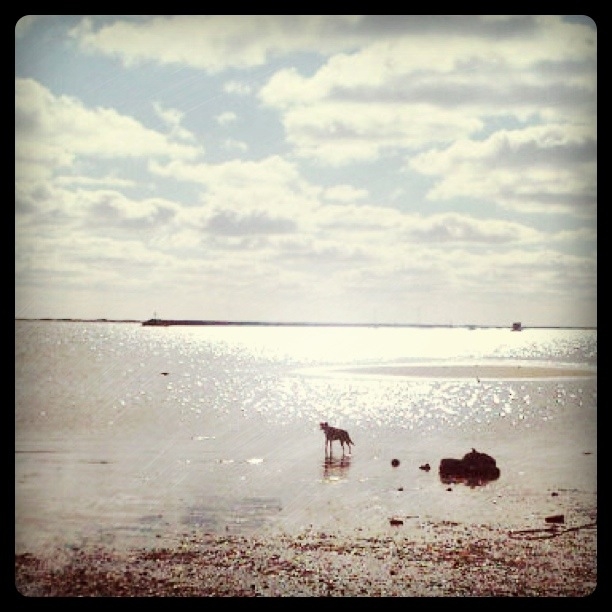
We sat, lotus-style, and meditated to the waves, embracing and then ignoring the chilly air that made its way into our clothing like chilly octopus tentacles sneaking in on a cold night.  The light blue winter sky was wan and the sand a pale silvery golden hue.  Esma broke the silence, saying “deniz çarşaf gibi!” (Here is how you say that: deh-neez char-shaff gib-bee, and it means “the water is as flat as a sheet”).  My dog ran around like crazy and finally settled in to rest near to the waves – seeming to sense our need for meditation.

The bay beach across from our place

As we sat there, trying to meditate, all I could think of was the lack of water back in the house – and then about how surprised I was at the behavior of my internal puppets since we had arrived in Ptown.  They were busting all stereotypes about Ottoman era shadow puppets so far today.   Eventually my mind stopped thinking and I started to notice my breath and just notice the sounds, taking them in, not counting them.  It’s been a long path between me and learning to meditate properly…yavaş yavaş (slowly by slowly) I am getting the hang of it.

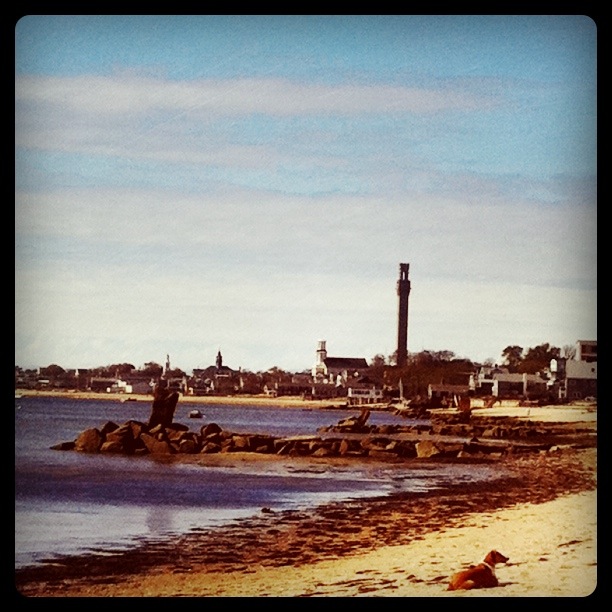
Provincetown monument - and our dog in the foreground - on the bay beach

When I came to, I opened my eyes to see the only tall tower in Provincetown – the monument.  But the first image that popped into my mind was about the “myths vs. realities about the Republic of Turkey” slide show that our twelve year-old niece S. made this past summer when she visited us on Bozcaada.  Lately, S. and I have been re-working her list for a presentation in her school in the States.  Esma, being the mind-reading puppet that she is, heard everything that I said…and started to roll around in the sand, laughing her way mercilessly close to the waves…so much for meditating.  “I think we need to do a myths and facts list for the other puppets, m’lady,” Esma let out, in between chortles “you know – about this place, how do you call it, P-town? And about America? Let’s do it!” So, do it we shall…but first, for a change of pace – I thought I would share it with you today…catch some of the wry comments and picture them being made by the queen of deadpan, my niece S.  Feel free to correct anything or add your own, too!

Myth 1:   Men are allowed to marry as many wives as they wish in Turkey.

Fact 1:    Turkish law say that men are only allowed to have only wife, unless for some reason, their wife died. This law is strictly enforced.  People ask my Aunt if M. has multiple wives, and it upsets her a lot.  M. tells her to say she is the 5th one and he is looking for more.

Myth 2:  Americans thick that because of the country’s name, Turks eat a lot of Turkeys.

Fact 2:    You turkey! Most commonly eaten meat in Turkey is lamb and chicken.

Myth 3:  Turks drink a lot of coffee

Fact 3:    Turks don’t drink very coffee at all, they drink mostly tea.  Coffee is more for after dinner and special occasions.   Men here drink tea all day in cafes but ladies probably drink it in their houses.

Myth 4:  Islam is the law and religion of the land.

Fact 4:   Many Turkish citizens are followers of Islam, but Turkey is not bound by religious law and it is not a religious state.  It is a “secular” state.  That means not-religious.  You should be respectful when you talk about religion so no jokes here.

Myth 5:  Camels are everywhere in Turkey.

Fact 5:   There are some camels in Turkey for tourists (probably imported from other countries), however my Uncle told me that wild camels are not native to Turkey.  He had also never heard about camel wrestling, but apparently that happens a lot.

Myth 6:   Everyone in Turkey speaks Arabic.

Fact 6:    Turkish is Turkey’s official language not Arabic, although the Turks used the Arabic alphabet to sound out Turkish words until 1923.  Turkish is from the Ural-Altaic language family.  Arabic is not part of that language family, it is part of the Semitic language family. Don’t ask my uncle if he is sure that Turks don’t speak Arabic, he might get grumpy (he did once, in a supermarket).

Myth 7:   Every Turk is a Muslim.

Fact 7:    Even though Islam is the predominant religion in Turkey, there are followers of the Jewish and Christian religions (including Gregorian Armenian and Greek Orthodox religions among others). There are a few different types of Islam – Sunni, Shia and Alevi, for example.  There are also Sufis in Turkey, but this is a lifeway, not exactly a religion.

Myth 8:  All Turkish woman cover their hair with a scarf.

Fact 8:   Not all Turkish woman wear veils and many, many do not.  Some wear veils for religious reasons, but some women in working in fields wear veils to keep cool or to be modest due to cultural traditions that have nothing to do with religion.  Like Mosques, Catholic churches once expected their woman to wear veils as well, but this tradition is not practiced as much now.  My Aunt’s grandmother wore a veil to church in Spain where she was born and also in Massachusetts when she went to church, for example.   Lots of people ask my aunt if she has to wear a veil or if M. makes her wear a veil and she says “NO!.” I tried on a veil to visit the mosques on Bozcaada and it was no big deal.

Myth 9:  Turkey is an Arab country, as is the rest of the Middle East

Fact 9:    Turkey is not an Arab country, as many people think.  Most Arab countries are located on the Arabian Peninsula with others in North Africa and other parts of the Middle East.  Not all of the Middle East is Arab.  Turkey is a Middle Eastern and European country, but not an Arab country.  Same point as above, don’t ask my uncle about this in a supermarket or he might get grumpy.

Myth 10:  Turkey, like the rest of the Middle East, is one big dry desert with hardly any rain or snow or cold.

Fact 10:    Contrary to American popular beliefs, Turkey is not one big giant desert.  There is a lot of variation, as in the United States.  Most people in the United States think that Turkey has only two seasons, but this is not true, Turkey has four seasons, as does the rest of the world.  There was a lot of snow in Istanbul last year.

Posted in A Karagöz puppet battle, Cross-cultural learning moments, Introducing the Karagöz puppets, Visits from the Karagöz puppets | Tagged , , , , , , , , | 8 Comments