On the 2nd day of Christmas: Meet Bebe Ruhi, a Karagöz puppet with Dwarfism and a whole lotta goof


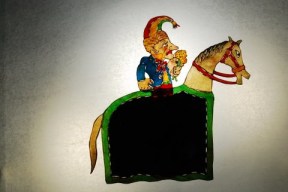
Bebe Ruhi, a Karagoz puppet with Dwarfism, shown here on a horse (thanks to the Asian Shadow Theatre Exhibition's photostream at flikr, click photo for link)

Meet Bebe Ruhi, a Karagöz shadow puppet with Dwarfism, may be a small man, but he is a man with a big heart that is full of goofiness.

My husband M. always says that he liked Bebe Ruhi the best as a child.  In traditional Karagöz shadow puppet theatre, Bebe Ruhi is described as follows thanks to my favorite Karagöz website, run by Emin Senyer: ” (he is a) dwarf (that) has an impediment in his speech and pronounces r and s as y. He asks the same questions over and over again until people become tired of listening to him. Sometimes he is a dwarf and sometimes a hunchback. When he is a dwarf he is called by such names as Beberuhi or altikulac (six-fathom), and is shown to be fidgety, talkative and extremely boastful. He often does odd jobs around the neighbourhood and is somewhat spoiled by the pity of the locals. Karagoz on many occasions, has to beat him in order to get rid of him.”

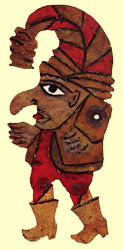
Here is another image of Bebe Ruhi

So, in this non-traditional Karagöz shadow puppet world in my head, things are a little different. There will be no beating, for example.  Bebe Ruhi was born and raised in Bursa – and as his disability was ridiculed as a child – he found a way to make it work for him – in the circus.  Eventually, he joined the Sultan’s court as an oddity.  Ableism aside, as this is a modern concept, Bebe Ruhi has not yet made his presence known in the story of my roadtrip, but true to form, he is a questioner that is true to my heart.  It doesn’t hurt that I am a disability studies scholar in my professional life, of course.  But I think I like Bebe Ruhi best because in my own life, I often feel that I am not heard, and ask the same questions over again, perhaps in the way that Albert Einstein would define as insane, so, perhaps this is why I have such a good feeling for him, I can relate to him and to his insanity.  Bebe Ruhi doesn’t sleep much – and he loves to come out when I am teaching.  He is usually swilling a Red Bull energy drink and then loving the speedy feeling that causes him to think super-analytically and talk at breakneck pace – posing questions to the students that are rhetorical and otherwise.

However, he is also the Karagöz puppet character that is the one who eggs me on – encourages me to be proud of myself – but that often leads me into the dangerously slippery slope of boastfulness.  Bebe Ruhi just LOVES to talk – and encourages me to hang out with the friends that talk the most.  He is the one that has the absolutely most difficult time in the car with M. when we are driving on an actual in-the-car road trip vs. what I refer to as “the roadtrip of cross-cultural marriage.”  That Bebe Ruhi, he chatters all the way, driving M. nuts when all he wants to do is focus on the road.  Bebe Ruhi will often drive Esma nuts – she is the peace-loving, meditative and quiet hippie puppet that you met yesterday. 🙂

Look out for Bebe Ruhi, he’s coming to town soon, and he has a lot to say!.

Posted in Introducing the Karagöz puppets, On writing about my life with the Karagöz puppets | Tagged , , , , | 20 Comments

On the 1st day of Christmas: Meet Esma, the hippie Karagöz puppet


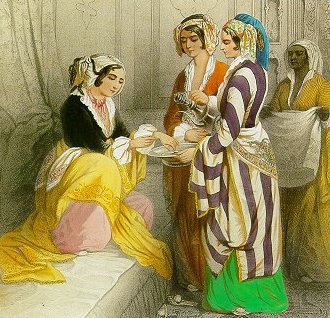
Meet Esma, a member of the chorus of dancing ladies, the largest grouping amongst the Karagöz shadow puppet troupe

So, for the 12 days before Christmas, you are meeting the various Karagöz shadow puppet characters that roam around in my head.  No, I am not a person with a major mental illness.  No, I don’t really, really see puppets in my everyday life.  Yes, I have found that all of the confusion and just generally new stuff that comes along with living in a cross-cultural marriage is well-conceptualized as many different little voices.  I think the puppets have revealed themselves to me in order to help me to see how my partner may view things…or to help me think about how my in laws may view things, etcetera.  These little puppets are having a great time while we are in the States – learning all about what goes on here and what the customs and practices are.  These little puppets also love going back home to Turkey – and guide me all over the place.  So, today, I want you to meet Esma, the hippie Karagöz shadow puppet.

Esma is a reserved young lady, despite her work as a member of the chorus of dancing ladies who always introduce and conclude Karagöz puppet shows.  She spends the early morning hours meditating – and she is a master, or should I say a mistress, at this.  While many of the other lady puppets have a strong personality – often speaking back to their partners or husbands – Esma has no need for this.  She is a tranquil soul, who brings out the best moments in me.  I guess this is why I started with her.

Esma, as I have come to know her slowly, is really and truly a hippie.  I am not sure if there were hippies in the Ottoman Empire era from which she hails, but this lady’s love of nature, calm ways, penchant for meditating and use of herbal tinctures tells me she is of this general ilk.  She also occasionally dies her hair a different color, usually pink, purple or green.

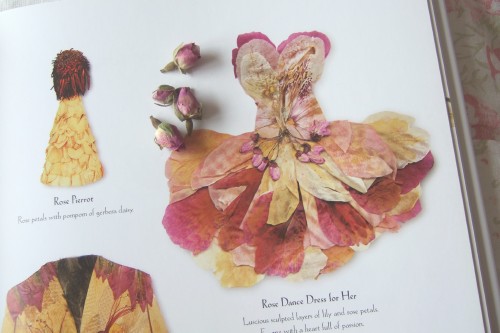
Rose petal dress that Esma plans to wear to the ball, from The Faire-ality Fashion Collection (no lie, check it out)

Esma is a “go with the flow” and “let the way become clear” kind of gal.  She loves the color pink – and recently attended the Sultan of Nutcracker’s holiday ball in a dress made solely of bright, fuschia rose petals – of the softest (and most organic) variety, of course.  She tells me “tabi canım, (of course, dear) it was organic! I will have none other out of respect for Mother Earth!”

Preferring Ada çayı (island tea) to rize çayı in the mornings after her meditation, Esma always uses agave nectar in lieu of massive amounts of sugar lumps, like some other puppets I know.  While she is a svelte young lady, she didn’t rub it in, not even once, when I was going through the whole “I dream of burquini” debacle with my sister-in-law to be in the summer of 2004.  She just accepts all human (and puppet) forms as they are, without judgement.  It’s a bit milk and honey from the outside – and may appear to be insincere, but I have learned that she is not, that it is straight from the heart.

Esma was born in Gaziantep (thus the seemingly genetic love of spices galore) – but emigrated to Bursa when she was just an infant.  Her particularly quiet and meditative form of dancing is what led to her invitation to be part of the Sultan’s troupe of dancing lady puppets.  She sends her family her wages every  month.

How these puppets worked it out with a centuries-dead Sultan to inhabit my mind in the 2000s, I will never know.  I am just grateful for their presence, as they always help me to sort out my business as I navigate this cross-cultural roadtrip of marriage with my Turkish husband, M.  Esma is the most calming influence of the shadow puppets, and I am grateful for her presence.  That little puppet has hear calm head screwed on straight.

Posted in Introducing the Karagöz puppets, On writing about my life with the Karagöz puppets | Tagged , , , , , | 44 Comments

The Twelve Days of Christmas: Karagöz puppet-style


Image of the Karagöz puppets from this website http://www.superiorconcept.org/SCMpages/Istanbul/Karagoz.htm

Traditionally, the song “The Twelve Days of Christmas,” referrs to the days leading away from Christmas, starting on Boxing Day, December 26th.

In an unusual nod to tradition in this, my non-traditional household, I have decided to take a different spin on the twelve days.

For each of the twelve days leading up to the day before Christmas, starting tomorrow, I will introduce one of the members of the troupe of Karagöz shadow puppets who play a major role in my head (and, therefore, who play a major role in this blog). You have already met Karagöz Bey (Mr. Karagöz, for the English speakers out there) in this post, but I am re-posting it below this description of the puppets in the real world.

Over the next twelve days, you will meet the following puppets – all of whom inhabit my mind (and the back seat of the proverbial car) on this roadtrip called cross-cultural marriage…you may meet more along the way – but these are the major players.

1. Esma the organic hippie puppet who loves fuschia & tangerine roses

2. Bebe Ruhi the puppet with Dwarfism & questioner extraordenaire

3. Khadijah the worker from Egypt who drank from the fountain of youth

4. Celebi the modern lover and thinker

5. Kenne the traditional lady in search of maintained honor

6. Tiryaki the opium addict with narcolepsy

7. Zenne the nervous Nellie like a bowl of jelly

8. Mercan the spice trader from Arabia

9. Safiye the vainglorious dancing girl

10. Yehuda Rebbe the Jewish wise man

11. Perihan the fairy godmother

12. Hacivad Bey, the inimitable and learned leader of the puppet troupe

I love this description of the puppets and who they are in the real world of puppetry (from 2010 European Off-Network Festival. Sponsored by Turkish Ministry of Tourism and Culture):

“The Karagöz shadow theater tradition dates back at least 500 years and is still actively performed in Turkey. The plays originally portrayed the layered cross-cultural hierarchy of Ottoman Imperial life, creating a comic ethos filled with shape-shifting, class conflict, cross-dressing, deconstruction of language, and the clash of cultures. Although its stock characters reflect the costumes, language, and historic context of a bygone era, the characters themselves – Karagoz the trickster, Hacivat the intellectual, Celebi the romantic, Tiryaki the addict, etc. – remain timeless and relevant.”

While the role of women in the Karagöz plays is often limited to a shrill wife or sexy dancing girl (a la Ruby in the Berlusconi scandal) – geez no better than girls in a modern day rap video – I have chosen to re-create and/or create female characters in the world of my puppet mind. Traditionally, women are portrayed as follows in this puppetry tradition, again to Ermin Senyer:

“Women in Karagoz plays are young, middle-aged and old, flighty, quarrelsome, only just faithful and always prone to gossip. The main type is always flighty and given to intrigue. In nearly every play, this type causes a scandal in the neighbourhood. Karagoz,s wife often abuses him for not feeding her and not clothing her. As the women in Karagoz are always dubbed by male puppeteers, they speak in cracked voices. They wear a loose, sleeved, cloak-like garment called ferace, two pieces of fine muslin or tarlatan called yasmak, folded and pinned in such a way that one edge covers the mouth and lower part of nose and the other passes across the brow above the eyes, while the rest hangs behind. As the veil is very thin, the features can be quite-clearly seen. They wear a blue bonnet called hotoz, patent leather or velvet slippers on their feet and each carries an umbrella. Some wear a red ferace, a black alpaca thrown over the head and held by a pin under the chin, entirely concealing the face. Courtesans always have their breasts half or fully exposed. Some wear slipper boots of yellow Morocco leather called cedik and carry a stick in their hand. If the woman character represents a Negro slave, she wears black gloves, a red ferace, red pabuc (a strong soled shoe) and a white head band.”

Original post on himself:

Karagöz is a word that refers both to an individual puppet character from the Ottoman Empire era AND to the entire troupe of Karagöz shadow puppets that surround him. I have described this band of puppets in brief, here. And I have also introduced them as they introduced themselves to me, in their hometown of Bursa.

Kara, meaning black is linked with göz, meaning eye. Presumably, this name refers to the puppet with the big, black eye – not from a punch in the face – just a big black eye. While you have heard lots and lots about Karagöz’s favorite approaches to life – namely – twisting, turning, jumping, cartwheeling, flipping and being generally flippant in the most rhyming manner possible, I haven’t told you much more about him than the ways that he tends to act as the shadow puppet personification of the outlier voice in my head, the proverbial agent provocateur. He is the puppet that nags at me, questions me in the most cruel ways, makes me question myself (and sometimes my sanity) and always gets a fight going. He is the nay-sayer that drives me nuts in my head. The problem is, there is always a grain of truth in his antics, it is always in there somewhere.

One of the best English-language websites I have found on the Karagöz puppet tradition in Turkey, http://www.karagoz.net/english/shadowplay.htm , talks a bit about this fellow, saying “I have touched in passing on Karagöz and Hacivat, the two cronies who are the leading characters of the Turkish shadow theatre Karagöz, but the main character is Karagöz . Karagöz is uneducated but honest.” As M. tells it, the Karagöz of his childhood is more than honest – he is brutally honest, calling a spade a spade, as well say, regardless of the context, the company or the consequences. The author of this super website continues on to describe Karagöz in contrast to the ever-present Hacivad (or Hacivat) , saying:

Karagöz the drummer – drumming home his crazy message of the day

“It is always doubtful whether Karagöz and Hacivat ever really existed and, as we have already seen, there are many legends about this. Karagöz was supposed by some to be a gypsy and there are many allusions and much evidence in the plays to support this theory. Karagöz has a round face, his eye is boldly designed with a large black pupil, hence his name –Black Eye-. He has a pug nose and around thick curly black beard. His head, completely bald, sports an enormous turban which, when knocked off, suddenly expose his bald head which always provokes laughter. In all dialogue between Karagöz and Hacivat, we find Hacivat always uses flowing language full of prose rime while Karagöz uses the language of the common people. His promptness with repartee procured for him his fame and reputation. This contrasts artificiality with simplicity and is the first satire to attain these differences. This contrasting language is also noticeable in Hacivat’s erudition. He can recite famous poems, has a vast knowledge of music, is conversant with the names of various rare spices, the terminology of gardening, many varied encyclopedic extracts, and with the etiquette of the aristocracy. This however is superficial and gives him only a scholastic type of making a living for himself and his family. Because he has no trade, he is usually unemployed and fails to provide for his family, and has enough sense to realize that to rectify this, he does not need Hacivat’s superficial knowledge. Though he is stupid and easily taken in, he is constantly able to deceive Hacivat and others.”

The Karagoz Museum in Bursa – From the Bursa Daily Photo blog (click photo for link)

For a more academic exploration of the character, see the Turkish Cultural Foundation‘s description, here.

While I have taken some liberties in my interpretations of the puppets based on my own artisitic license, this is where they started. Even though I cannot understand the majority of Karagöz dialogue in live or video performances of this shadow puppetry, these puppets have fascinated me since I first saw them in 2004. I have loved hearing M.’s stories about them – and about the stock character types they represent – straight out of the Ottoman Empire. One more reason to improve upon my Turkish is next year’s planned visit to the Karagöz museum in Bursa.

Posted in Introducing the Karagöz puppets, On writing about my life with the Karagöz puppets | Tagged , , , , | 24 Comments