
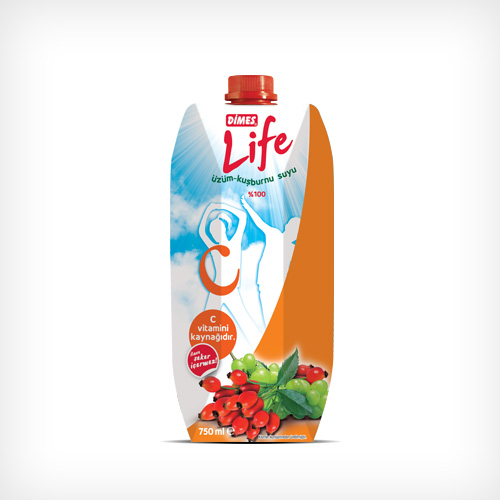
Kuşburnu Suyu (khush-boor-new soo-yoo) a.k.a. Rosehip Juice (with grape juice, in this particular package)
Well, over the last week or so, we have been (virtually) to the U.S. to discuss Obama and 9-11 and Italy to discuss the plight of mozzarella mammas over the last week here on slowly-by-slowly, and now it is time to get back to what happened in Turkey during my very first visit there.
To be specific, slowly-by-slowly is officially now back in Bodrum for the last 24 hours of a visit there in 2004 – a visit punctuated by the slamming of the gates in a gated compound by the sea, the clink-clink of spoons in tea glasses on cement beach and the tsk-tsks of the swim parade ladies who all think I should invest in a bit of liposuction. I, on the other hand, am at this point “over it,” this worse-than-America focus on body size, etc.
My little shadow puppet chorus of Ottoman-era ladies (the ones that reside in my purse but like to come out for a moon dance once in a while) have given me an invisible burqini (Islamic bathing suit) and now I just let that burqini deflect the askance-glance rays that head my way as I walk from my chair to the sea. I’m so over this. Instead, M. and I are plotting our course north, to Bozcaada, where we will meet his Teyze (Aunt) after a week or so exploring the Aegean coastal region.
 “We need snacks, for the car,” M. says, grinning, “Atatürk liked salted chick peas and sunflower seeds in the shell, do you think you could do that? I don’t want any potato chip junk.” Karagöz opened his eyes wide from his spot across the table from me saying, “them’s fightin’ words – you, m’lady, apparently like POTATO CHIP JUNK! WOO-EE!” Ignoring Karagöz , I tell M. that those snacks sound fine to me, as long as we have some fruit juice as well. “And that means, ” I jumped up with happiness, “that means we can do my favorite thing – check out the supermarket in another country, when can we go?”
Since I was a child, I have loved visiting supermarkets in whatever place I am in to really get a sense of the lay of the land. In the 1970s, I found marmite in the local store near my Uncle’s home in Cornwall. In the 1980s in Soviet-era Tbilisi, Georgia, I found canned sardines and walnuts. In the 1990s, I found green packets of tea leaves and Parmalat brand milk for all the chai that is made near Meru, Kenya. In 2001, I found masa harina and pickled loroco flowers in the Xochilt neighborhood of San Salvador, El Salvador. I am lucky enough to say that I have had many other international supermarket adventures, but those are the ones that rise up to my mind at the moment. In any case, I had to, just had to, get to the Turkish supermarket nearest me to complete my own personal shopping-slash-cultural-immersion mandate.
Feeling nostalgic for more time with his little brother, X. drove us out of the compound-by-the-sea and over to the supermarket. As the three of us headed into the modern Migros supermarket, I note an entire aisle for fruit juice and commence purchasing the most exotic (to me) juices possible. In this shopping instance, exotic juice primarily meant the sour cherry (visne) and rosehip (Kuşburnu) varieties. Always an over-shopper, M. does a combination giggle-snort and eye roll upon seeing me roll around the corner with my juice-laden cart. Karagoz approves of this giggle-snort and eye roll combo whole-heartedly and re-creates the sound on my left shoulder, one of his usual haunts.
Coming out to see what’s going on, two of the tiny ladies that are almost inseparable these days make their presence known from where they are hanging, figure-head-like, on my purse strap. Kenne and Khadijah eye my cart suspiciously. “Are you sure, m’lady, that you really want quite so much Kuşburnu suyu?” they ask, as if prodding gently, “do you have THAT big of a problem?” Though I don’t really know what they are on about, I respond to them by speaking in the assured tone of a seasoned Turkish store shopper that I most certainly wasn’t but wanted to be. You know, the voice of an American who just “happens” to buy rosehip and sour cherry juice on a regular old trip to the market. I responded with “I am not sure what you mean by problem, little ladies, and I sure I will be very thirsty, ladies, as we do not have air conditioning, so I will need to stay hydrated and need to mix it up – not all water – some juice too.” You see, if I admit it to myself, I wanted to be exotic, to know what it was to drink rosehip juice and not think it was special or unusual. I wanted to be exotic at home in the U.S. and totally normal and in-sync here in Turkey. Clearly, rosehip juice was the answer according to me in that moment. Kenne and Khadijah just looked at eachother with a sigh, and murmured something that sounded like “we tried to tell her…”
Meanwhile, M. was picking up and looking at the different brands of juice that I have chosen – not only did I have a lot of boxes of juice in my cart, I had multiple brands of boxes of each type of juice – especially the Kuşburnu. “Um, sweetie, are you planning a taste test?” As if he has just heard the little ladies on my shoulders, M.’s Turkish-level-decibal voice (e.g. loud) rings out “do you really have THAT much of a problem? Why didn’t you tell me? Do you know what this juice is for?” Feeling a bit in the spotlight as the ladies shopping around me are giving me the hairy eyeball due to my man’s protestations about the cart contents, I protest a bit, saying “I don’t really know what you mean about a problem – I know what it is for – I mean – my Granny used to drink rosehip tea for her joints, but this is juice, you know, just juice? Juice for the road? Because it is hot? Do you have a problem with that? What about the fact that you look like you are going to feed all of the birds between Bodrum and Bozcaada with that cart full of pumpkin seeds?”
Just as M. says “if you say so, dear,” M.’s brother X. walks around the corner. “Ah – oh dear – THIS IS AN EMERGENCY” X. says – immediately in emergency mode. Although I have only known him for a few weeks, I already know that X. LOVES emergency mode. It is a chance to shine – to be the dude that takes care of stuff – you know – emergency stuff. I am convinced that this is a very big part of the “big brother” role in Turkey – at least in the family I have been observing in Turkey. If X. could have snapped his fingers for an assistant to support him in carrying out his efforts to address whatever the emergency was at that moment, I am sure he would have. His hands are itching to snap – he takes his glasses off – wipes them – runs his hand over his head and stakes out which direction he will go to deal with this EMERGENCY. I, of course, have no clue what the EMERGENCY is.
“I see, you have an EMERGENCY problem,” X. states, as if this is obvious to me. “I don’t have a problem -um, I just really like juice?!” I said, trying to be gracious but sounding a bit panicked at all of the attention placed on my juice-filled basket that was somehow an EMERGENCY. “Oh yes,” Karagöz says with his finger a-wagging, “you do, you do have a PROBLEM lady, a PROBLEM with showing off and being the seasoned rosehip juice-drinking traveler – so nonchalant!”
Before I could ignore Karagöz, X. took me aside, placing his arm around me in a protective stance, playing the big brother role for all it was worth. “No, really, Liz, you should have said something before! Why didn’t you tell me? I have this problem too at times – it is bad- very, very bad, and you must not let it go for so long – but there is an easier way than this juice, really.” He sighed, took off his glasses again, wiped them clean, again, with a handkerchief, and put his arm back around me. “I know it would be easier maybe, to speak with my wife about this, but since we are here, and since you are a guest in my home and I have created this problem, or rather, Kalinka has cooked up this problem, I really do feel terrible about this. You must be so uncomfortable! But all of this? Maybe you should put some back, yes? It cannot be healthy, all of this.” Flummoxed, I stood still, having no idea what the emergent issue around me was.
After two weeks of fitting in completely, I’d be damned if I’d let anybody tell me what I could and could not take on the road trip with me. “Perhaps,” Karagöz piped in with glee, “perhaps you should fill the cart with chocolate bars! That will leave their tongues wagging about the American fatty!” Marching past M., I took my basket up to the checkout line. Placing carton after carton of juice on the conveyor belt, M. joined me, placing packet after packet of dried, salted and spiced seeds and beans along with them. “We’re going to have to stop a lot, but if that’s what you want…” his voice trailed off, as he gave in to my stubborn purchases and his brother’s EMERGENCY sighing.
The shopkeeper at the cashier cracked a joke in Turkish, to which M. and X. responded with laughing approval. On the way out, I tugged at M.’s sleeve while X. was expounding on something on his mobile – it involved a lot of pacing up and down the parking lot, hand waving in the air, excited utterances spilling all over like pumpkin seeds out of a birdfeeder when a squirrel jumps on it unexpectedly. M. explained it all to me “I don’t know why you want all this kuşburnu suyu because you don’t need that much to stop diarrhea…you are going to get really constipated,” he explained gently, “so the shopkeeper suggested it must be really a dire situation if you need all the juice.” I blushed the shade of a thousand glasses of Kuşburnu suyu and had to own up to not knowing about THAT property of rosehips. Having passed what we joked about as the “fart barrier” in our relationship fairly recently (a.k.a. admitting to one another that we did in fact fart once in a while, something M. was more keen to pass than I), this was still shy territory for me. Now, not only was I too plump in the eyes of the Turkish family, but now I was also either going to be constipated, full of diarrhea or just an idiot buying a lot of rosehip juice bulimic – or all of the above. You just can’t win, I thought and in the end, who cares? Why do I care so much? I gave up with a laugh, more blushing, and a lifetime supply of Kuşburnu suyu in the boot.
——
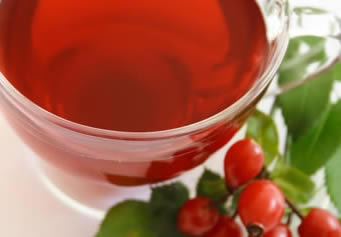
While I have only tried rose hip tea and rose hip juice, this summer, I intend to make some rose hip syrup, akin to this recipe from Epicurious.com that I thought you might enjoy. Apparently, rose hips are not ONLY consumed by people in need of constipation. 🙂
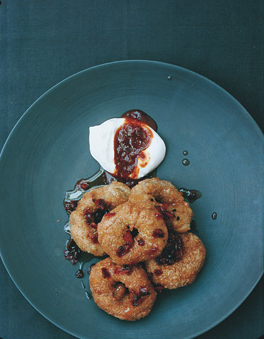 Turkish Doughnuts with Rose Hip Syrup

Gourmet | October 2009
- 1 cup water
- 1 1/2 cups sugar
- 1/2 cup dried rose hips
- 1 teaspoon green cardamom pods
- 1/4 cup rose water
- 2 tablespoons fresh lemon juice
For doughnuts:
- 1 cup all-purpose flour
- 3/4 teaspoon kosher salt
- 1/2 teaspoon ground cardamom
- 1/4 teaspoon cinnamon
- 1 cup water
- 1 stick unsalted butter, cut into pieces
- 1 tablespoons sugar
- 3 large eggs, warmed in very warm water 10 minutes
- About 10 cups vegetable oil for frying
Equipment: a deep-fat thermometer
Make rose hip syrup:
Bring water, sugar, rose hips, and cardamom pods to a simmer in a small heavy saucepan over medium-low heat, stirring until sugar has dissolved, then gently simmer, uncovered, until rose hips are softened, about 30 minutes. Remove from heat and stir in rose water and lemon juice.
Make doughnuts while syrup simmers:
Whisk together flour, kosher salt, and spices in a small bowl.
Bring water to a boil with butter and sugar in a 3-quart heavy saucepan, stirring until butter has melted. Add flour mixture all at once and cook over medium heat, stirring vigorously with a wooden spoon, until mixture pulls away from side of pan, about 1 minute, then cook, stirring constantly, 1 minute more. Cool 5 minutes.
Add eggs 1 at a time, beating well with a wooden spoon after each addition. (Dough will appear to separate at first but will become smooth.)
Heat 2 inches oil to 350°F in a wide 5-quart heavy pot over medium-high heat.
Divide dough into 12 portions. With wet hands, form each portion into a 2-inch ball (dough will be sticky). Slightly flatten one ball in a wet palm, then make a 1-inch hole in center with fingers and add to hot oil. Quickly repeat with 5 more balls and fry, turning occasionally, until golden-brown and just cooked through (cut one open to test), about 8 minutes. Transfer with a slotted spoon to paper towels to drain. Return oil to 350°F and repeat with remaining dough.
Reheat syrup (if necessary), then dip each doughnut in syrup, turning to coat, and transfer to a platter. Drizzle doughnuts with some of remaining syrup and serve warm.
Cooks’notes:
•Syrup can be made 1 day ahead and chilled. Reheat before using.
•Doughnuts can be fried 3 hours ahead and kept at room temperature. Reheat on a baking sheet in a 350°F oven 10 to 15 minutes, then dip in hot syrup.
Related articles
- To burqini or not to burqini: A sea change floats my way (slowly-by-slowly.com)
- ‘Burqini’ street theatre vs. the ‘skinny bitch’ hegemony: Part II (slowly-by-slowly.com)