Of peştemal, patlican and the perfect Turkish junk food (with home-style recipe)


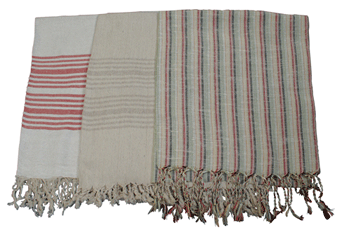
After saying goodbye to Z. after my first-ever great morning at cement beach, M. and I walked up the hill, now expert at pre-stretching our legs in order to elude shin splints.  Upon entering the house, Kalinka was upon us, unleashing a stream of Turkish over M.’s way – the only word of which I understood was “peştemal.”  A peştemal is a Turkish-style towel, often woven in lovely, simple hues in the Bodrum area.  M.’s sister-in-law referred to it as “Bodrum cloth.” Apparently, M.’s niece was missing her favorite peştemal and a new one needed to be purchased immediately, or all hell would break loose.  M. explained that we needed to drive his sister-in-law over to the village bazaar immediately, although it was already late in the day “for the good stuff.”  It was the last of our days on the Bodrum penninsula – and we hadn’t been to the bazaar yet, so this was welcome news. Kalinka (the Moldovan maid who saves my life every time she smiles) warns us that we had better high-tail it over there, and we hop to it, salty hair from swimming and all.  While we are waiting for sister-in-law, Kalinka hoots and hollars in Turkish before saying to me in Russian, our shared broken language, “more fun than house!”

I am excited to shop for some peştemal.  Now that I am done with my burqini fantasy, it’s all about the cotton beach wrap – peştemal – to feel more modest along cement beach in the gated compound regardless of the machine gun-toting guards, for my last afternoon there, that is!  M. and his sister-in-law are conversing with great hilarity about something else – something called “patlican” (“pahtleejhahn” skinny, Chinese-style eggplant in U.S. parlance or aubergine to the Brits).  I hear kuçuk (small) and buyuk (big) and peals of laughter along with this word.  “What ever are you talking about?” I ask M. wishing that my flair for language would finally make its appearance with respect to Turkish.  Hacivad made his presence known just then, with a simple clearing of the throat “So, you are thinking so far, no luck, in the country 3 weeks and counting, must be patient. Remember, Rumi says “patience is the companion of wisdom.”

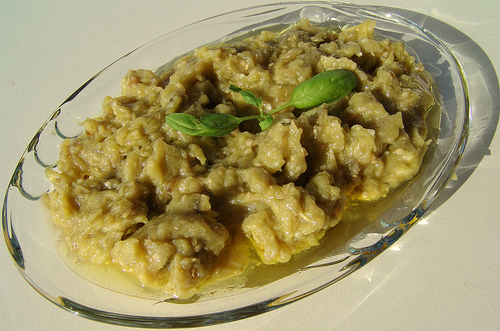
“Aubergine, um, eggplant,” M. explained a broad smile still inhabiting his face, “patlican is eggplant – and you can’t get better than the Turkish one, I can’t find it in the States.  We are going to make patlican salatası.”  Let me move from potato salad – to safer territory, roasted garlicky eggplant.  This territory is a bit safer and we had nothing to navigate here, as there was no American equivalent for me to get pissy about vis-a-vis my mayonnaise mania.  🙂  By the way, I must admit, I am embarrassed to look back at myself then – so convinced that I was open to new things!  I had so much to learn, and am old enough to know that I have too much more to learn than I can realize.  At least I am more open to that reality now.  Wouldn’t trade middle age for anything.  And yes, it is just potato salad and mayonnaise we are talking about, but sometimes the tough stuff comes out in sheep’s clothing, I suppose.

Old-fashioned hues of three Bodrum peştemal

In any case, back to the bazaar, as we meandered through informal rows underneath the white canvas tent on the bazaar grounds, M. bounded up to me happily, saying that he had found not only the perfect peştemal, but also the perfect patlican seeds.  “This is excellent!” M. said, hands waving akimbo, “finally the seeds – I can never find the right eggplant back in the U.S.!”

“Hmm,” Karagöz noted, “p-items, items beginning with the lovely letter P! P into the sea! P all over me!  P, it’s free!”  Kenne pulled him off of his impromptu stage with a hooked cane, shushing him along the way.  He reeled in giggles despite the cane.  Oblivious to the presence of a very goofy Karagöz and horrified Kenne, M. began to explain his eggplant-cooking process. “We have to cook it on the coals (on the mangal or BBQ) to make it smoky, until it explodes and you mash it with garlic – then you can try my version of Turkish junk food.”  Now there’s a concept, I thought, Turkish junk food other than the Turkish-flavored crisps from Lay’s, for example.  “OK, sounds good to me – but junk food, I don’t know about that characterization.”  Armed with patlican and peştemal galore, we snaked through the streets at breakneck pace, feeling glad to be in the sturdy steel-tank that is a Volvo station wagon.

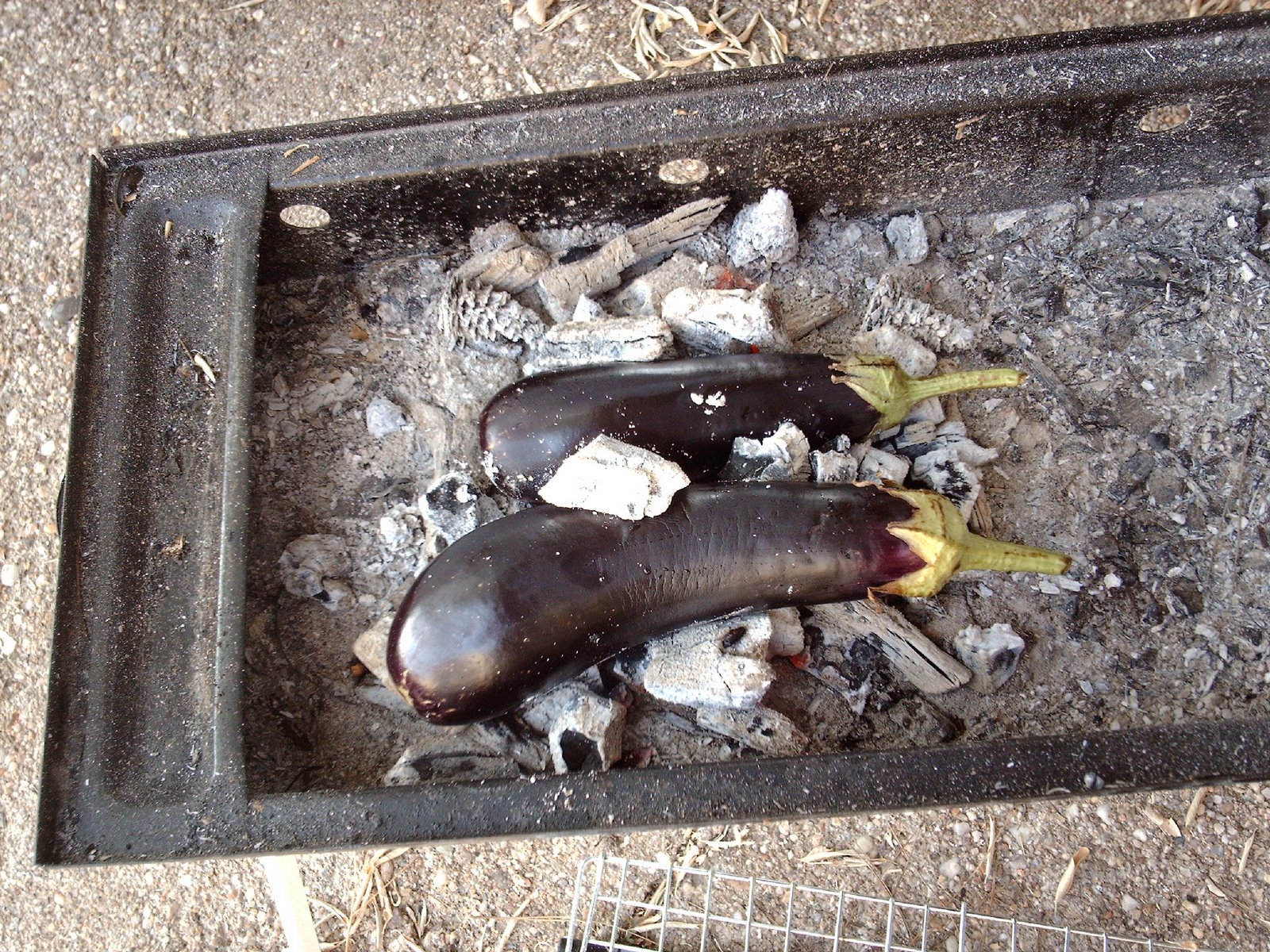
Our own eggplant-grilling moment

On the way home, M. talked nonstop about his various favorite eggplant dishes.  We became so hungry that we stopped for a snack.  An unassuming place by the roadside, with no other customers.  While this did not bode well to me, M. is blessed with the nose for the best places to eat – anywhere in the world – and I had already in our short months together learned to understand this.  M. knew the ancient-looking owner – who sits at the front table molding köfte (“keufteh” spiced meat balls) by hand in the shade of a white pine tree. Although the place was empty, I had faith that M.’s food judgement was still working.

Sitting there, we tried not only mashed eggplant with garlic, but also what M referred to as “my favorite version of Turkish junk food.” Essentially, it is slices (think potato French fry shape) of eggplant, grilled, along with yeşil biber (“yesheel beebehr” long skinny light green color peppers) that have been grilled until they are wilty. These are then dredged in strained sheep’s milk yogurt (cow’s yogurt would be fine too) that has been blended with fresh garlic (vs. dry) that I find often has a different and more pungent and almost fruitier taste. We spent an hour or so just talking eggplant with the waiters and chefs…with me writing down words as I understood them, once M. was up-to-here with the translating.

That night at dinner, M. referred to this visit to the little lokanta as
“research on Turkish junk food.”  Since then, we have done a lot of “research” all over Turkey on this form of Turkish cuisine – as in “two plates of patlican salatası, please!”

Once at home for the evening with M.’s brother, we prepared the mangal on the terrace at the top of the house, which is situated on a hill.  We savored the
wood smoke that comes from the special charcoal they use here – real wood (that in 2011, is all the Whole Foods rage). Here is the home-style recipe for what we did that night – and many other nights in the years since…

Homestyle Patlican Salatası

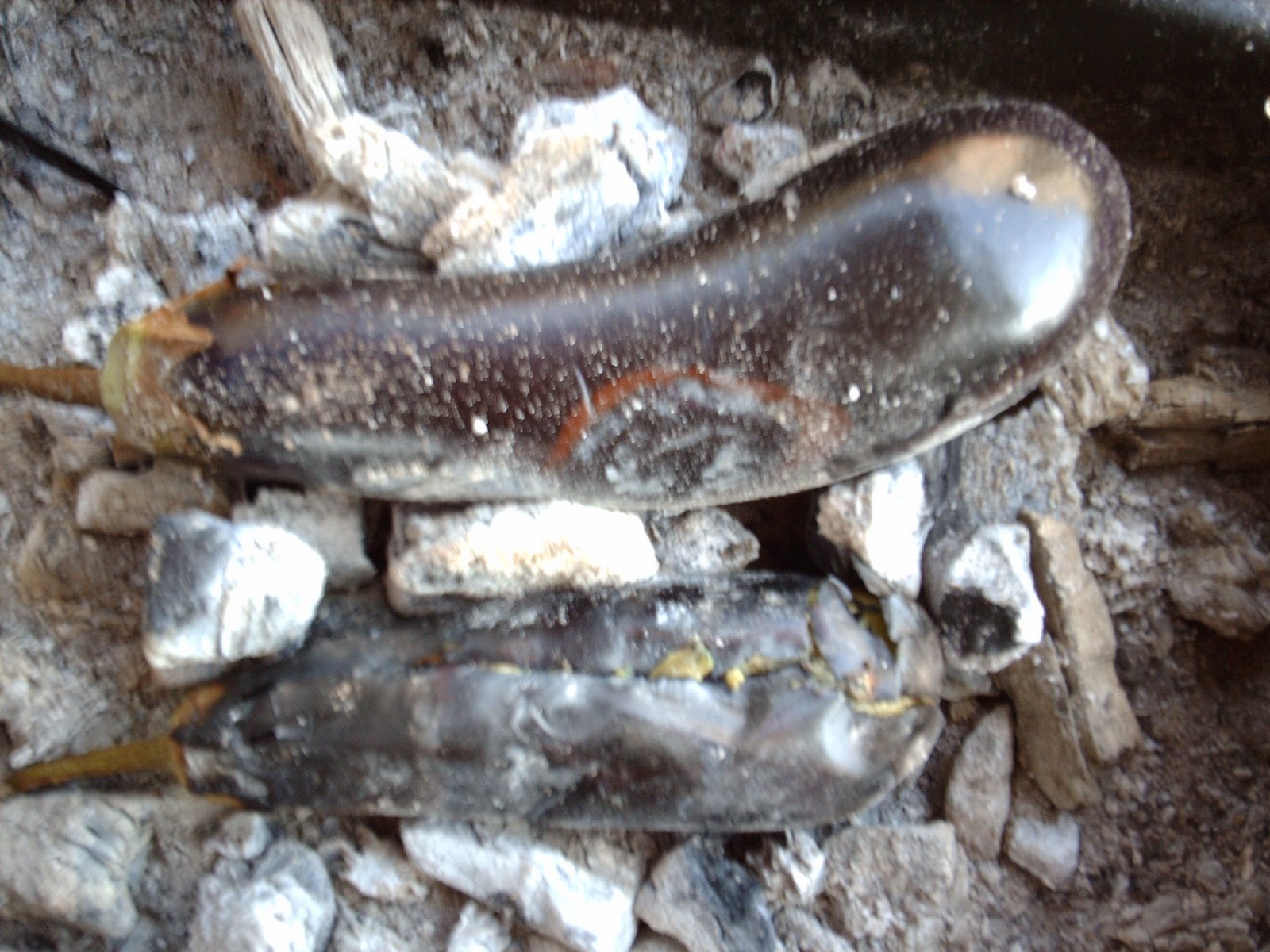
Step 1:  Place the eggplants on the grill – as pictured – or directly on the coals if you prefer.  Once they are white with heat, wait for them to explode – sort of like a sausage bursting a seam.

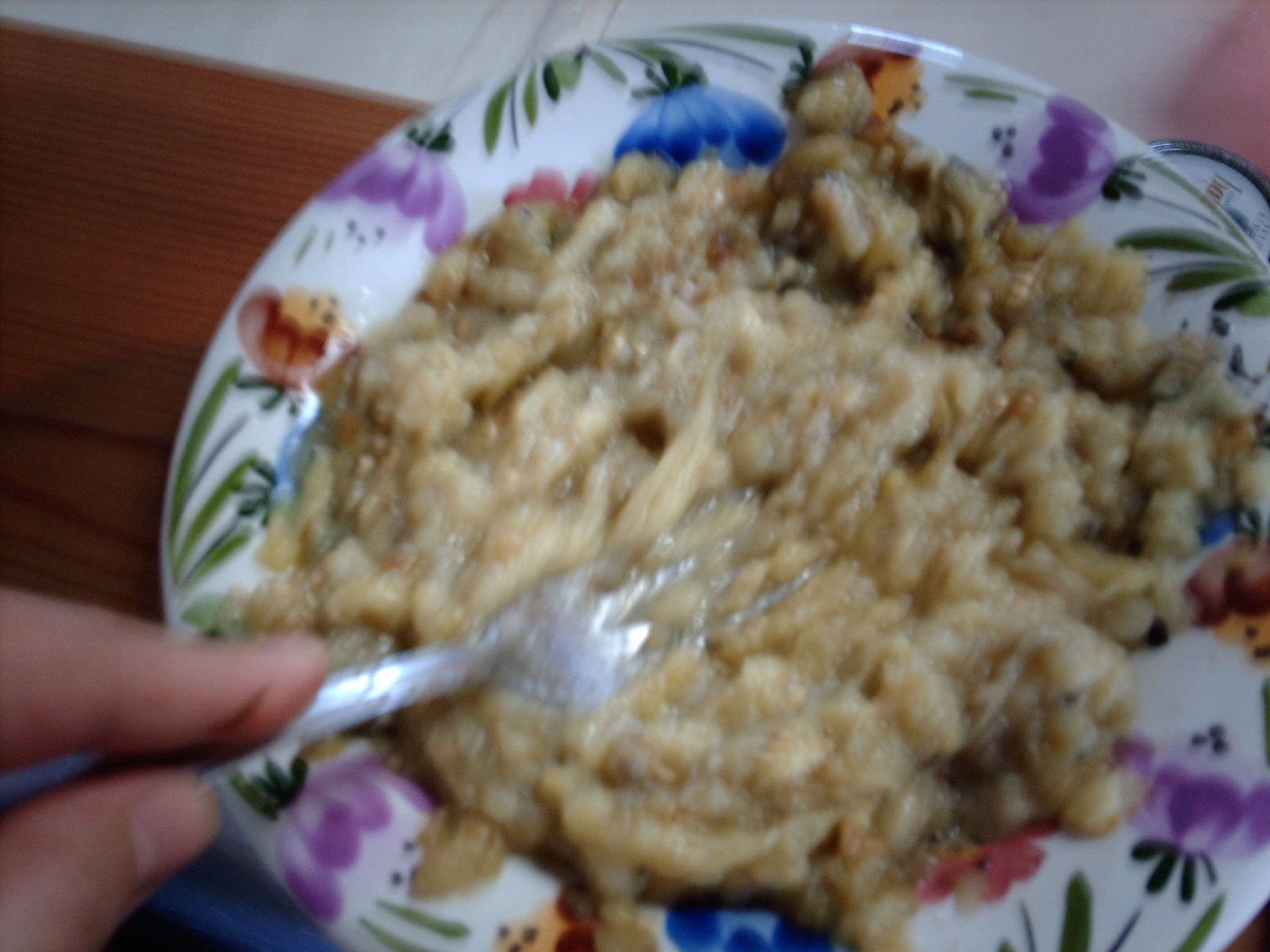
Step 2: After getting them blackened and soft with a split seam, so to speak, extract the soft, oozy interior, mashing the strands of eggplantness with a fork while mixing in extra virgin olive oil, crushed (vs. chopped) raw garlic to taste – we use a whole bulb, but we are garlic fanatics), fresh lemon juice and salt.

Step 3:  Try not to eat the entire deliciousness at one setting with a spoon.

Note:  People often add in roasted peppers, parsley and tomato to this salad as well – but we like it straight up.  Patlican salatası rules! Delicious…and never possible, to date, to re-create quite as well Stateside!

Posted in Turkish Food!, Visits from the Karagöz puppets | Tagged , , , , , , , , , , , , , , , , , , | 3 Comments

Finally, a kindred spirit amidst the swim parade


Although the moon shone with sprightly sparkles on the sea, I did not wake up and worry about the next day. My invisible burqini was bringing me some well-needed peace. After throwing my burqini street theatre idea under the proverbial bad-yet-sexy-while-it-lasted-idea-take-the-high-road bus after receiving the magic, invisible burqini from Kenne, Khadijah and the little ladies, I descended to cement beach the next day with renewed resolve and a slightly improved body image self-rating. Kenne took the left shoulder, holding on to my ear as if she were the figurehead of a ship in the 1800s – with Khadijah her mirror image on my right shoulder. Karagöz and Hacivad were nowhere to be seen. Even the chorus of dancing ladies had taken it upon themselves to emerge from my purse for the occasion, draped on the straps of my purse like seagulls on the rope netting of a clipper ship. All the ladies stood proud, tall and lovely, with nary a word between them. They were just focused on drinking up the sun. It was, after all, our last day on cement beach.

M. and I planned to leave the next day in order to wend our way up the coast to Bozcaada, where we would visit M.’s aunt, the reigning matriarch of the family. We had already spent the majority of the morning finalizing our travel plans, with our next stops in Selcuk and Şirince, Ayvalık, and Assos/Behramkale along the way. We had discovered the first edition of what was then a new thing – the guide to small hotels in Turkey – the Kuçuk Oteler Kitabi. Happy with the idea of breaking free from the machine-gun-toting guards, Cuban cigar smoking generals, judges and businessmen and, of course, the ladies of the swim parade on cement beach, I plopped myself down on the usual tanning chair. As usual, I placed myself next to M.’s sister-in-law, and commenced polite chit-chat for as appropriately long as possible before moving to my textbook on Turkish politics. I was relishing the notion of my invisible burqini, of not caring about all the feminine gaze around me and most importantly about the idea of being able to act like myself again, not double-thinking everything, or worrying about how I looked. I wouldn’t miss M.’s sister in law’s checks of my labels (“Oh, not a designer, I see, and a size large?”). I also wouldn’t miss having a sore tummy from holding in my stomach muscles quite so constantly in the waking hours.

I had just tucked into a particularly good section of my book, when a lady plopped herself down on the tanning bed to my right. Greeting M.’s sister-in-law with respect and an open-hearted friendliness that did not seem at all akin to the gold-dripping wrists, honey-tanned bodies and perfectly coiffed hair of the skinny bitches around us, this lady stood apart. She was gorgeous, don’t get me wrong. Petite, tan and raven-haired with red highlights, she exuded a natural beauty – but what was most noticeable about her was her slight plumpness – just like me. “Hello, nice to meet you, çok memnum oldum,” she said, extending her hand warmly, “I hear you are visiting from America? How do you like Türkiye? What intrigues you about our country?” Curious about this new person so different from the other non-interested lady friends of M.’s sister-in-law, I hesitantly responded with a range of rather banal observations, but soon felt myself drawn out in conversation with a potentially kindred spirit.

Knowing that it would be prudent to ask about her children, as I had picked up on this as the vital bit of information to discuss with all women I met in Turkey since they asked ME the question, I planted the question out in the ether between us. Immediately, I regretted this. As a trained therapist and childless person myself, I realized that the infinitesimally quick grey cloud that shadowed her eyes was a dead give-away. “Oh,” she said, quietly, “um, I am not able to have children, but we are talking about adopting a child – and I have so many nieces and nephews.” Realizing that we were in the same boat, so to speak, the women, no-children-first boat, that is, I had to let her know that she was in “safe” territory. “Oh,” I said, putting on my hopefully-kindest smile and reaching out a hand to hers, “me too. I can’t have kids either, I know how it is.” Her smile spread across her face like a giant, spherical golden-hued firework across the deep, dark night sky. “Really,” she said, “I have not met someone else like this. Why can’t you have kids?” Needless to say, we launched into a drawn-out discussion of endometriosis and infertility challenges, and I even broached the topic of M.’s zero population growth political stance that had led to a vasectomy. “Surely,” she said, “this does not rule out adoption, though?” “No, it doesn’t, but as older people, we may feel we are too old to consider adoption – he is 10 years older than and I am also going to have to take care of my younger sister, who has a major disability.”

We moved from our discussion about children to sharing our histories of treatment with the same hormones (her for infertility and endometriosis, me for the control of endometriosis), we decried our collective weight gain from those hormone treatments, the inability to “lose” the tummy fat and the horrible mood swings we had endured on those awful medicines. Laughing hysterically at a range of stories about the latter, including the time that normally police-shy me got in a massive fight with a ticketing policeman, M.’s sister-in-law tried to join in the fun at first, but soon lost interest. Later, my new friend and I walked the swim parade forgetting that it was the swim parade, locked deep in laughter and connection. In the water, we compared our keloid-rich belly scars from numerous surgeries. It felt a little bit like junior high school again, finding a friend you could “click” with like this. Meanwhile, her husband and my boyfriend sat in the cigar smoking section with M.’s brother, wrapped up in discussions of the politics and economics of the day. Yes, it did feel a bit gendered.

As my new friend finished packing her bag to leave cement beach for lunch and a flight back to Istanbul, she embraced me deeply. “I am so glad to meet you, I am so glad,” she said “to not be alone.” No sooner had she said this, than M.’s sister-in-law approached, threading her arm around my new friend’s back “it’s such a shame, you see,” she tried to join in, “that Z. has not been able to have children, it is indeed a woman’s right. As it is your right, and would that M. hadn’t had that vasectomy! It is so selfish.” The bubble was slightly burst, the reality of our environment was back, but it didn’t seem to matter quite as much, we had made a connection. I never saw her again, but she reminded me that the domination of the skinny bitch morphed with the child-bearing/rearing factory that is Turkish womanhood does not reign totally supreme.

Posted in Cross-cultural learning moments, Visits from the Karagöz puppets | Tagged , , , , , , , , , | 3 Comments

Cross-cultural compromise – on potato salad (with recipe!)


Mayonnaise for American-style potato salad

Lemon for Turkish-style potato salad

We stood, facing each other, with what can only be described as a glowering look.  Me – hand on my hip, mayonnaise in the other hand resting next to the bottom of my apron.  M. – hand on his hip, a lemon in his outstretched hand.  Usually, I am the first to explore something new vis-a-vis culinary creations. As we stood, locked in the detente that only a stubborn set of in-love human beings can achieve, the seconds ticked by.  Even our dog got in on the act, sitting in between us, looking back and forth at us with doleful, confused eyes.  His head moved as if there was a tennis match going on, even though neither M. nor I were moving an inch.  What, you may ask, led to this tense moment?  A request to bring potato salad to a party combined with our New Year’s resolution to do more cooking together.  Of course, we thought, we will just make the salad together.

Getting the ingredients from the market was bad enough – M. voted for waxy Idaho style-potatoes and I voted for the small red potatoes more familiar to me.  I compromised.  In my mind, we had all the rest of the stuff we needed at home.  In M.’s mind, we had all the rest of the stuff we needed at home.  We swung the heavy bag out of the store and walked up the street.  I should have known I was in for it when all of the shadow puppet troupe was lined up on the kitchen windowsills, heads in hands as if relaxing in the Sultan’s sitting room on low recliners.  They rarely all amass for regular goings on.  I just nodded my greetings to them, and placed a pot of water on to boil by starting with heating up a bay leaf (a.k.a. defne) in the bottom of the pot.  My grandmother always started this way, just heating the leaf ever-so-slightly in the pot to release some oils that would then make their way, very subtly, into the potatoes via the water that would soon boil there.

Defne (a.k.a. bay leaf or laurel leaf)

“What are you doing?”  M. cried, rushing into the kitchen.  “What is that smell – you are burning defne? We have to cook the salad, not burn some defne.  Is this your house purification ritual again?  I prefer to do that with lemons, not defne.”  Feeling put out, the hand immediately went to my hip “what’s it to you, a little defne, it is for the potato salad.” M. just looked at me quizzically and went to wash the potatoes before chopping them.  “Grandma Verna did it like this.  You know, something about the defne oil going into the potatoes?”  I said, feeling a bit insecure and a lot grumpy.  “OK, that’s your way, ok.” M. proceeded to chop the potatoes perfectly AND to clean up the resultant mess.  I am always thrilled to note this as one of the stupid things people ask me is whether I have trouble getting him to do work around the house.  In fact, it is probably more vice versa!  Reading my mind as only shadow puppets can do, Kenne and Khadijah clicked disapproving sounds, whispering to each other “she’s making a mistake, she should let that be her domain, not his.  This relationship is all out of whack.  A man, cleaning?”

As the perfectly-chopped potatoes bubbled away, their starchy steam fogging the windows behind the shadow puppets on the windowsill, we commenced preparing the salad.  I fished the mayonnaise out of the fridge and turned around to see M. choose a lemon from the cheery ceramic bowl on the counter.  As we met each other’s eye, the detente commenced.  “What do you need a lemon for?” I queried.  “Well, what are you doing with mayonnaise – you aren’t going to make that terrible, gooky stuff like in the market, are you? I really hate that” he said, with a bit less decorum than one might wish for.  As if poised towards a planful jinx, we both said “I am making it my Grandmother’s way.”  At this point, the detente was full-on.  The shadow puppets all leaned forward on their elbows – waiting for the next moments of the potato salad drama to play out.

All my life, I have made potato salad one way, my Grandma Verna’s way.  This way involves mayonnaise, garlic powder, celery, white onions, tarragon, pepper, salt and paprika.  All his life, M. has made potato salad his Babane‘s (Grandmother on the father’s side) way.  This way involves lemon juice, red onions, parsley, salt, pepper and pul biber (a.k.a. aleppo pepper, or red pepper flakes minus the seeds).  After much negociation and protest, a quick consideration of two different potato salads and a non-partisan taste test, I gave in.  I don’t know why I had a hard time letting go of my Grandmother’s approach that day – maybe just an off day – but I decided that having M. take the lead on our required potato salad was novel.  Even though he is a fabulous cook, I do most of the cooking around here.

The resulting salad was truly amazing – a mind blower for me – more akin to German-style potato salad than the salad I am used to – the one that you have to fight against in order to avoid the glop factor.  With smoked salt highlighting the lemon juice-infused potatoes, the fresh brightness of parsley and the soft crunch of purple onions all fused together with some high quality olive oil, it was the hit of the party, and I stood corrected – and proud of the man who could cook so well.  Even Kenne and Khadijah relented a little bit upon splitting a tiny, puppet-sized portion of the unctuous stuff.

Now, as the years have flown by, the potato salad we love has evolved into what can only be referred to as a cross-cultural dish, and here is how it goes.

Turkish-American Compromise Potato Salad

Step 1:  Heat the defne in the bottom of the pot for boiling the potatoes – don’t burn it though.  Just heat it enough, no blackening need.

Step 2: Chop and boil the potatoes (we have moved to red bliss potatoes over the years).  It takes less time than you might imagine, so be sure to test them along the way, you don’t want mashed potatoes.

Smoked paprika, celery salt, freshly cracked black pepper, smoked salt, pul biber (Aleppo pepper) red wine vinegar and lemon juice waiting to be made into a slurry

Step 3: Choose a low, wide bowl, so that when you mix the dressing with the hot potatoes, they can cool enough and it is easy to mix.  In the bowl, put more red vinegar than you might imagine (1/2 cup? I don’t know, I eyeball it) and the juice of three lemons after zesting one of them and putting it in the bowl.  Add smoked salt and cracked pepper, smoked paprika (I use a whole jar of the standard spice jar size), celery salt, pul biber and even some cayenne if you like, and using a fork, make it into a slurry of the red, fiery sort.

Add more celery salt, to taste - an underused and interesting flavor in my mind

Step 4:  Check your potatoes to make sure they are not overcooking and taste the slurry to see if you have enough celery salt.

Step 5:  Chop up one large purple onion, squeeze lots of garlic with a garlic press (we prefer that to chopping garlic, as you get more garlic juice and we are major garlic lovers), wash and chop a head of flat-leafed maydanoz (parsley) and finely chop a chunk of the heart of celery.  Throw it all in the big bowl and mix with the red, fiery slurry.Chopped celery, maydanoz (parsley), purple onion and pressed garlic with lemon zest and pul biber

Step 6:Drain the potatoes when they are just right and mix them with what is in the bowl.  Let it sit for about 20 minutes so it can absorb the flavors. If you feel it is not wet enough, squeeze another lemon over the mix and/or add some more red wine vinegar (I have also used white balsamic vinegar, to great effect, try this brand).

Mix it all up before you add the hot, steamy potatoes

Step 7: Drizzle a nice extra virgin olive oil over the salad and mix it up.  It is important to do this last, so that the acidic flavors can make their way into the potatoes first.  Then enjoy!

Drizzle some super delicious extra virgin olive oil that tastes good on its own all over the salad and mix it up - after the salad has been marinating for a while

So there you go – you will note that over the years, the defne ritual made it into our recipe along with the celery I am used to along with the paprika and cayenne – and as with everything else in our home – we spice with abandon so there is a lot more than my Grandma Verna would approve of, but we love it!  Try it out, and make your own recipe renovations.  Health to your hands!

Posted in Cross-cultural learning moments, Turkish Food!, Visits from the Karagöz puppets | Tagged , , , , , , , , , , , , , , , , , , , , | 2 Comments