Women judging the unspoken "swim parade" with mercilous yet silent glee
I am mid-breath, and it is a deep one. Although I am surrounded by blue sky and buoyant hot air of the weather type – not to mention buoyant hot air of the verbal type, I feel backed into a corner. I am back down by the water, taking in the sun, which I must admit, feels amazing, although the commentary from the ladies I am meeting here is leaving a lot to be desired.
“Is it true that you eat two hamburgers with cheese for dinner every night? And french fries?” asks one lady friend of M.’s sister in law. Another pipes in “Americans walk their children on leashes like a dog – they can’t run and jump for health.” A third turns to me and asks “how did you gain all of your weight? You don’t have children, even.” Perhaps most shocking is the fact that they are so flat-affect-faced during and after these comments, that I actually begin to wonder if they are serious about what they are saying – and in fact do not mean to insult me. Sometimes the verdict is out on that, sometimes it is more clear.
Mustering all of the “take-the-high-road” and etiquette-to-the-end behavior I can, I grin and bear it. Lather, rinse, repeat. Whenever I turn to my blessed ipod for some Corsican chanting to calgon-take-me-away, I am usually pulled into the conversation again. I finally start telling people that I have a cancerous growth in my stomach, which explains the slight bulge there. (No kidding, I really did this). Of course, I got the idea from Karagöz, who has been repeating a few Run DMC lines for the past hour “Now you’re the flyest girl, in the whole school but they don’t call you fly – they call you fool Because you don’t go to class, you will not pass.” Hacivad surprises me with his presence on the beach – “I feel the need to tell m’lady that while the jester-beast is quite repetitive today, the ironic humor of quoting a rap star with these particularly choice lyrics does make sense for the audience of a doctoral student surrounded by women without serious education or occupation.” I can hear the chorus of dancing girls giggling from the opening into my purse, a cavernous one, filled to the brim with items designed to extricate me from lots of uncomfortable Turkish lady situations if at all possible down here on cement beach.
 “Maybe your prince charming will come by for a swim!” I hear from the purse from a light, almost tinny-voiced dancing girl. Another dancing girl, more frog-sounding but pleasant says “no, you must let him bond with the men, just hope he does not consider trying a Cohiba, it’s too stinky, but this is what the men do.” Oblivious to the observations of the dancing girls who can, apparently, see through walls with their x-ray eyes, M. is locked in conversation with his brother and a circle of tea-drinking, cigar smoking men. He ambles over once in a while, reads his art history book for a bit, spends some time with me – and we sneak off of sunbathing alley for a dip in the Aegean. Over the weeks that we are visiting, I have gotten used to walking on my own as I take the occasional self-conscious walk from my chair to the stairs down into the sea. The water is truly like silken sheets, hot in the sun, but just refreshing enough.
Whenever I stand up to go and cool off, the ladies eye me from their reclining chairs as I walk by. The hats moved to the side, the sunglasses positioned just so – the newspaper down, the tea glass suspended in mid-air, the novel placed askance, the conversation halted ever so slightly. There is the check of the hair, consideration of the two-seasons old bathing suit brand, the assessment of the pedicure and lord knows what else. I am not alone though, all the ladies are checking anyone who does this on-the-way-to-swim-parade- akin to the “perp walk” or the “walk of shame” for women in my country in various situations. So much seems to ride on looks here in this gated community of heavenly hell. “Really,” I think to myself, “you are truly being a bit dramatic here – this is hardly hell….hell, who am I kidding, this is hell on beach.” M. laughs at all of this – we notice that the women are more interested in checking out the other women – not them men. “They have to assess the competition, I guess,” M. says, chuckling all the way to the water, “you ladies, I don’t get it.”
So,when I have mustered up the courage to do the “swim parade” – that or enough red-faced over-heated-ness – I just stand up straight, suck in my tummy and brave the cat walk. At 5 feet 10 inches and 160 pounds in 2004, there wasn’t much to suck in, but still, a size 14 is considered “women’s” clothing in the States – a euphemism for fat, obese, overweight. “So crazy,” the chorus of dancing ladies cry from their spot in the velvety inside pocket of my purse, “that you are considered obese – the Ottoman era men liked a little meat on the bones, you know.” M. dubs it the “cat fight in the eyes” walk, and I laugh. Forgoing the ladder into the Aegean, we run and jump into the water like energetic teenagers on a rampage of thundering fun. Then we swim as far from the cement beach as we can, grab eachother’s hands, and start floating on our backs.
As I float, I can hear my back adjusting into some sane, non-doctoral-student-stumped posture as I float there, salty sun on my face, cool silken water flowing around me with rivulets of warmth from the top of the sea that is simmered in the sun. I remember my first medicinal float experience in South London, at a flotation center. The walls were turquoise, the water super-salinated, the crick-cracks from my back intense – and here I am, getting a float for free. I emerge so relaxed that I could care less about facing the unending gaze of the “swim parade” back to my seat. The ladies coax me along from the purse each time, saying “c’mon girl, you’re as good as they are, and you don’t care about all that surface stuff – you care about the important stuff – and your man is happy too!”
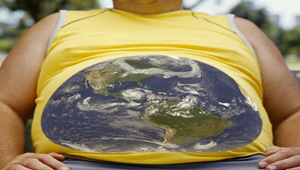
One day, after returning somewhat renewed from the water and managing the swim parade without too much internal angst, I note that there is an article placed just under my “modern Turkish politics” textbook (my light beach reading goes over like a lead balloon with the ladies – that’s the dancing ladies in my purse as well as all of the beach ladies). The article shows an impossibly obese baby and a range of quotes from the Centers for Disease Control on the prevalence and incidence of obesity in the U.S. All eyes are on my in their bikini-skinny splendor, as I reach down to quizzically pick up the newsprint. Some of the ink smudges messily onto my hands. Feeling the sting of tears, I will them back to their tear-cave, and lift my head up smiling. “Yes,” I say, not sure what will come next, “I am aware of this problem in the United States. It is something we health care professionals take very seriously.” My words fall on deaf ears as the tea man comes by – pointer fingers raised in unison into the warm blue air lead to the tinkly glass trinket cups being placed on tables all around. I forgo tea, and opt for a David Sedaris recording instead. “Calgon, take her away!” one of the dancing ladies cry, now hip to my 20th century references.
 At the Internet cafe that night, I googled “Turkey and obesity.” We had a good, cackling, gut-splitting laugh at the results, M. and I. We really had a must-stop-laughing-this-is-embarassing moment, if you ask me. And certainly it was a we-are-way-too-middle-aged-to-laugh-like-this moment as well. In any case, according to a United States-based study, published in a peer-review journal, between 1994 and 2004, the Turkish population has gone from being 1/3 overweight to 1/3 obese, 1/3 overweight – which seems about on par with the U.S., at least approaching it, anyway. I also find a Turkish-authored study, and I decide to pay the exorbitantly high fee for printing out the one Turkish-authored paper on the topic by Dr. V. Yumuk, the abstract of which reads as follows:
“Obesity and overweight are increasing in Turkey according to the field surveys that were carried out a decade apart (TEKHARF 1990 and 2000). The overall prevalence of obesity in adults was 18.6% in the year 1990. Ten years later in 2000, the prevalence was 21.9%, which shows a relative increase rate of 17.7%. As it is true for most of the countries, overweight is more common in men and obesity is more prevalent among women in Turkey.”
Glad to have some ammunition now for my smiling retort, I make sure to place this on the chair of M.’s sister-in-law as she is walking back during the swim parade – she gets the same stares, the same check-outs, but she walks with the confidence of the striking model Iman, crossing her legs carrot-like down a runway at breakneck speed. As she walks up, I smile widely “I thought you might be interested to see that obesity is a problem in Turkiye as well,” I say, trying to sound open, feeling bad at being engaged in a put-down, but also secretly happy about it. “Women are most dangerous, I think,” Karagöz says in his loopy, lingering voice, “when they are smiling during the ultimate put-down.” Hacivad is, as usual, ignoring Karagöz, favoring instead the academic musings of the moment. “If the numerous satellite dishes and young men who are spending their afternoons in the Internet café playing video games instead of running on the beach and splashing in the lovely water are any indication of where this country is going,” he says, sighing, ” Turks should take note and not follow the United State’s ‘couch-potato-ism’ mistakes. This is the term, no?”
As usual, M.’s sister-in-law bursts my bubble almost immediately, with a nose-downward dismissive movement, she says “it’s all the peasants, you know, dear. Not us.” Although a bit deflated, it was still worth it, as I see her secretly reading the article while it is hidden inside a Cosmopolitan magazine. I sigh and settle in to the afternoon’s readings on the origins of three of the main parties – the CHP (social democrats), the MHP (fascists, as I understand it) and the AKP (moderate Islamists). Tiring of the beach scene, I leave early, climbing the steep stairs cut into the hill to go home and take a shower. As I hang my towel on the line, I stoop to pick up a piece of trash – and find a plastic surgeon’s card on the floor. On the back of the card ,there is a price quoted for what M. later tells me is a word that refers to liposuction. The jig is up, she’s busted, but I never say a word. The gentler and kinder me remembers that body insecurity seems to know no geographic boundaries.
Please share if you like this!

 Karagöz is ecstatic. He is swinging along the mavi boncuğu evil eye beads hanging off of the car mirror. “We’re on a date! Let’s riot, let’s rock the house! Let’s get wild and woolly! We’re on a date.” Hacivad interrupts his meditating on top of the neutral tab on the gear shift, “no, Karagöz, YOU are not on a date, they are on a date, just let them (and me) commune with nature a bit.” Hacivad does not seem to realize that careening off of Storrow Drive and onto the Fenway at breakneck pace does not constitute what I would consider communing with nature, but that’s where he’s at, so what can I do? Though we don’t have children of our own, we have lots (and lots) of children, youth and adults in our life, especially during the summer, and it’s been a while since we have done something fun, just the two of us. Squinching his face into a twist, Hacivad barely opens an eye, maintaining his perfect meditation posture “just keep breathing, ok?”
 As usual, I am breathing deeply in order to make it through the Turk-driving-in-Boston experience. While Boston drivers are well-known for their insane driving, Istanbul drivers take the cake. They are nowhere near Roman drivers, to boot. But before I completely malign my beloved, he is an amazing driver, and, knock on wood, has never been in an accident. Once I drove in his passenger seat in Turkey, I completely understood why he drove the way he did, and I felt very secure. Translating that back into our life in the States has been a bigger challenge and we have certainly had our share of driving-related arguments. My therapist laughed at this, “do you know how many people have hum-dingers in the car?” she snorted when I expressed my concerns about this. Today, however, the deep breathing seems to be working, maybe the heat is helping or maybe all of these years of practicing life together have helped, either way, I am feeling pretty calm. Hacivad chuckles in approval as he can read my mind. I wonder how his waxy, paper self can fold into the lotus pose so easily.
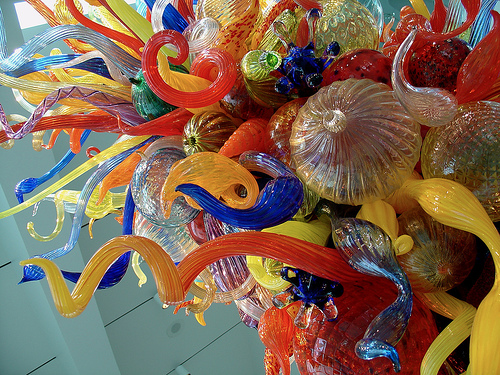
 We are heading for the Chihuly exhibit at the Museum of Fine Arts in Boston for our date – an exhibit which holds some special meaning for us as Chihuly is part of the reason we began dating. Dale Chihuly is best known as the shaggy haired, pirate eye-patched eccentric glass artist who creates glass environments all over the world. Many Americans know him as a result of seeing his ostentatiously delicious glass ceiling in the Belagio Hotel in Las Vegas, Nevada. I was first introduced to Chihuly’s glass art by my cousin, who gave me a book about the famous installation in Jerusalem, “In the light of Jerusalem, 2000.” It was the curious, undulating shapes that stayed with me once the book landed in my storage space – and led me to choose an image of Chihuly’s for the Internet dating site profile that connected us.
 It was the Chihuly, my husband jokes, that made the online profile catch his eye. Although not a major fan, my husband is an artist, and was happy to see that I had some interest in art, something that was apparently lacking in the other profiles he came across. I hear Kenne and Khadijah swoon from inside of my purse. I wonder why they are hiding there. Karagöz screeches with sarcastic delight. “What a lovey-hovey-dovey story!” Hacivad does not bat an eyelash. “Was it love at first click?” Hacivad’s arm turns into silly putty as it stretches out to grab Karagöz off of his swinging beads, tossing him out the window. “Chihuly – it’s all for loooooooooooove…..” he cried as the wind pulled him away into the tunnel behind the speed of our car.
 My attention is split three ways between my Chihuly memory lane, the Karagöz slapstick show in my brain and my husband’s narration of whether and how he can break parking rules. On our third roll around the block after finding the parking lot full. “We should have taken the subway,” I protest. I then try to pre-empt each potentially illegal parking attempt by shouting out “hydrant,” or “resident parking only!” I hurumph each time he stops where we have failed to find a legal parking space before. “Maybe if I back in like this, it will not SEEM like we are breaking the law,” he says, ignoring my dark look angled his way. Lather, rinse, repeat – this is how the next 15 minutes are spent. My main goal is to be able to compartmentalize the grump long enough to not ruin this nice date, our first out in a long time.