Hacivad snorts, Karagöz revels: On reviewing idiotic Internet posts on Turkish-American marriage/partner relationships


Don’t buy into all you see on the Internet

It’s a windy, hot morning on the island again, and I am risking sitting on the patio in my demure cotton nightgown again, despite yesterday’s mishaps with Ahmet’s visit.  It is only 7 a.m., I think, he can’t “just stop by” that early.  My boyfriend is off on the beach early this morning to see what treasures the Aegean Sea churned up in the somewhat wavy and windy night.  He woke me just at dawn to let me know he was heading down to the water to see what he can conjure out of the soft sands.  “All the best specimens show up on days like these!” he tells me, with the glee that only an ocean-lover can muster without difficulty.

So, I am on my own with my laptop on the patio enjoying some once-brewed tea, yes, with milk.  His face twists up into confused, disgusted horror that turns to laughter whenever he sees the milk in my tea.  It has become a beloved ritual of ours, this joking about milky tea.  I am giggling to myself about this – alone on the patio here in Turkey – typing away on my laptop about it all.  It all seems so foreign and I am drinking up the experience of being different, trying on a different culture for a bit.  I had brought my laptop to finish some consulting work I was doing, but my feverish fluster of data analysis and write-up of my evaluation report are done.  Now, I’m just writing for my travel blog (the bulk of which became fodder for this slowly-by-slowly writing).

If Ahmet shows up, I’m not sure what I’ll do, but for now, I am not going to worry about it.  This is sacred writing time.  “Yes, mademoiselle,” Hacivad intones, his eyes peeking out over his very studious-looking glasses, ” focus on the life of the mind, always the best choice.”  I am glad to have his approval – although I am sure he is just a figment of my imagination in perhaps a culture-shock-induced bit of cross-cultural temporary psychosis (sorry, the social worker in me must diagnose).

Hacivad settles in to read his morning selection of Rumi’s work.  He is leaning against the hand-thrown pottery vase made by my boyfriend’s aunt, which is full of tiny star-shaped fuschia-purple wildflowers that are fooling the bees into thinking they are still attached to the ground.  I busy myself writing a journal entry about whether I could see myself here for retirement or even if I could see myself with my boyfriend in the long term.  I am liking the idea, I like what I see here, the way he interacts with people, the way he is open to talking about how our experiences differ, they way he is a partner even in the tough moments when we are learning.  He has broached the topic of the future – but when I told him I would love to live in Turkey for a while, he made it clear that he prefers life in the States, but waxes romantic about retiring together on Bozcaada for part of the year.  He seems so sure in our relationship, too sure, I think, after just a few months, is this really real?  Was it a mistake to come here?  But look at where I am, and look at how great he is, this cannot be a mistake, I assure myself.

Karagöz opens one eye from his early morning slumber after many jester-like antics all night long at the entrance to the gecko’s lair inside the bedroom ceiling.  All night spinning, he was.  “You are blithering-blathering in confusion in love, you are.  Just go with the flow, lady, go with the oodles-woodles of love talk and thought and just ‘be here  now’ like my ol’ buddy Ram Das.  Flipping over from one side of the daybed to the other, the wrinkly hand-spun cotton sheets all askew, he continues “write about something interesting! Hee Hee!”  As if narcoleptic, Karagöz is out again after delivering his dictate, like a light on a prison ward, boom, off.

View to the Aegean

“Good riddance in the most peaceful wishing of manners,” Hacivad remarks with a mid-morning yawn, “focus on what is important, just get to know each other.”  I get back to typing away with a fury, and before long, my boyfriend is back, his hands full of tiny vials (they look like the crack vials I used to see in the Bronx outside of the criminal court) that contain microscopic specimens.  Excitedly, he tells me all about the unexpected species of Indian Ocean sea life that have shown up here, at the Aegean’s bridge with the Dardanelles Strait.  Plastering what I hope is an interested smile on my face, I nod and try to make out what he is talking about in between the scientific terminology, carefully turning important words over in my head to remember them.

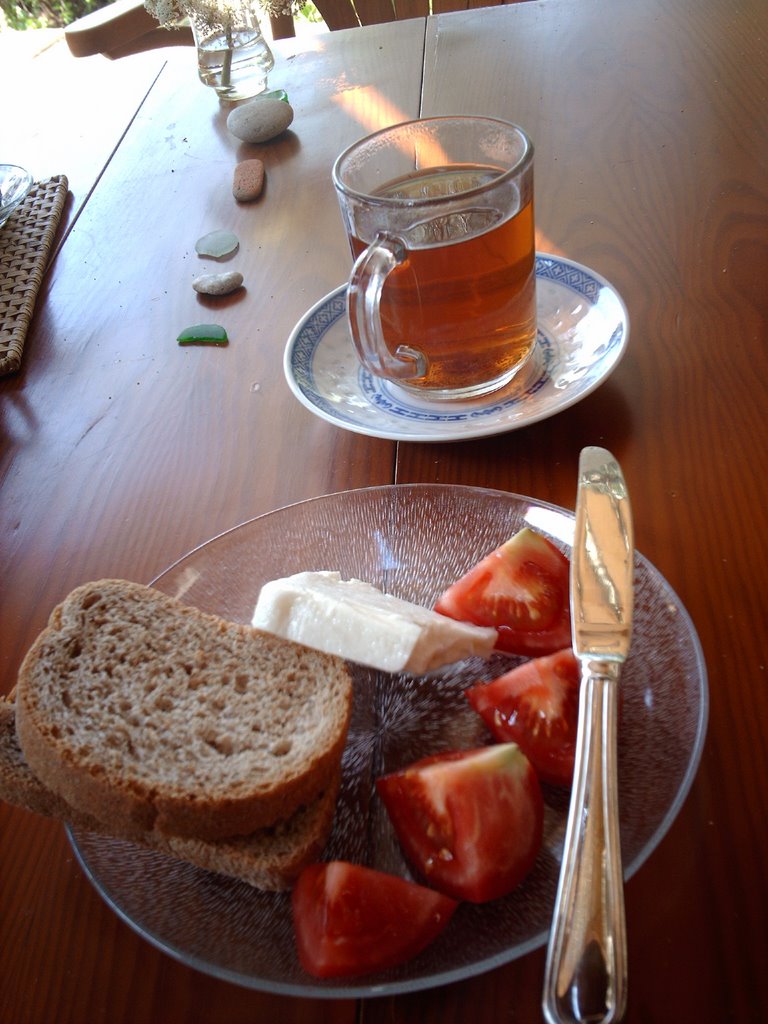
Our simple island breakfast, with new pebble treasures from the beach

The talk continues during our breakfast, where I switch to black, non-milky tea, with fresh whole wheat bread, what is left of the fragrant tomatoes from yesterday and fresh, feta-like cheese called beyaz peynir.  This is my first indication, learning this word, that there is some connection between South Asian Indian languages and Turkish.  I am reminded of my favorite spinach and cheese dish, saag peynir.  There is so much more to know about this country, I think, I have only scratched the surface – and here I thought I was SO prepared, with all of my academic readings.  Karagöz awakens with a start “I will always awaken to applaud you when you realize how ridiculous you are!” he proclaims just before dropping back to sleep like a rock through water to the bottom of a pond.

We head into town, with a somewhat relaxed driving effort – our hands trailing the breeze out the window as we wind up the hill past the shipwreck that has been at this corner of Ayazma Plaj for years.  We sidle by the Greek Orthodox baptismal font, now almost bereft given that most of the Greek-descended Turks have left this cross-cultural island.  Before heading to the farmer’s market just outside town, we make a pit stop in the one Internet cafe on the island.  I email my folks, to let them know that I am alive and post on the previous day’s explorations through the flowering thyme fields of the island.  Revisiting my questioning this morning, I google “Turkish-American marriage.”  Within moments, I regret doing so.  The first link results in my jaw dropping, I have found some of the most racist, nationalistic, threatening and just plain ignorant commentary from a group of women on inter-marriage between Christians and Muslims (see the dialogue here, if you can stand it).

Although I am so shocked that I can barely un-glue myself from this page, I recognize these folks as outliers and move to the next link, which is somewhat better, but includes questions posted by women engaged to or married to Turkish men.

The first one is not so bad, but not so good either:

“I am marring a Turkish man. He is from Adana and is a traditional Turkish man in a lot of ways. He follows the engagement and marriage traditions. But is not a demanding man. Meaning he is not controlling over me. I am an American woman. He is very westernized. And I am just wondering some of the differences there might be in our marriages compared to an American marriage? What is it like being married to a Turkish man? And if we moved to the US what are some of the difficulties he may have with jobs, friends, and just a difference in overall cultures and life in general?”

The second post includes this question:

“Will I have the freedom to “override” his viewpoint, if I find it completely unreasonable?” and this one “Are Turkish men typically dominant and controlling?”

The third advises these two based on her own experiences – expect lots of time with family, get clear on the whether to have children issue, be prepared for him not to use sunscreen and ends on a light note: ” Try to get him to get his mothers recipes – and have him cook for you. He’ll appreciate your efforts in trying to cook, but I swear he’ll still do it better. It’s a wonderful thing.”

Keying into this last bit with some hope for the human race and the Americans in particular, I tug my boyfriend’s shoulder, showing him the results.  We laugh until we have tears in our eyes.  How can people be so black and white, I think, surely if they are looking for answers on the Internet, this is not a good sign for the relationship?

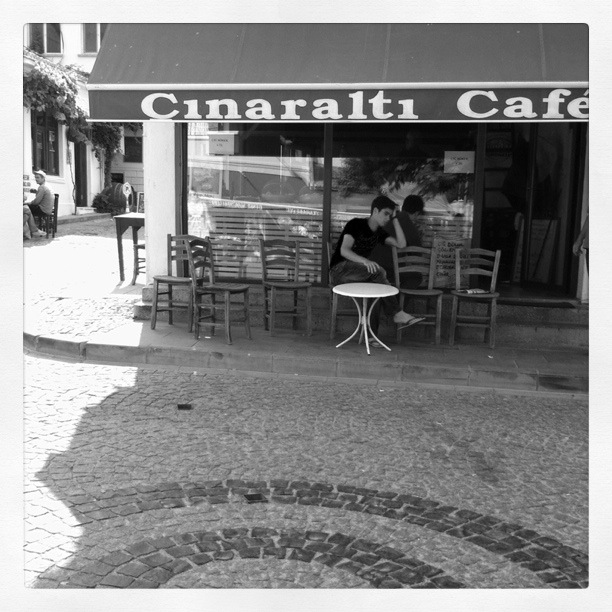
After our laughing, we sit for tea in the Çinaraltı (“chih-nahr-ahl-tuh”) Café, under the Çinar, a.k.a. sycamore tree.  “What you need to know about me,” my boyfriend says, “is that while I am loyal to my family and I love them, I want my own life.  I grew up listening to the extended family argue during our weekly Sunday lunches…I am more of an independent type, and that, as you may guess, is a big part of why I landed in the States in the first place.”

While this conversation leads to a deep place that we needed to go, Karagöz is a constant presence for the rest of the day.  He has taken up residence around the top of my ear, hanging by his feet so that he is yelling right into my ear in between sit-ups – like some sort of deranged, jester Marine soldier.  Some of his chorus of sing-song-y questions includes “You’re not so sure – it’s a blur – are his intentions pure?” Hacivad, sitting in the lotus pose on my left shoulder does not deign to look at Karagöz, but responds with “you idiot, Karagöz, this guy is a U.S. citizen, he is head over heels in love, don’t stir the pot – we should block those insane web postings that are clouding her mind.  We should get Khadijah to fix some black-arts potion to erase the memory of those from her confused head.  Karagöz cackles and sings “he loves you for sure, will it last, is he stuck in the past, is he the last? Will he fast?”  Hacivad finally succumbs to his frustration and stands up – drawing an impossibly large bullhorn from his shirt pocket akin to clowns spilling out of a tiny VW bug, he tells me in no uncertain terms “what you need is patience – for Karagöz, for yourself, for this relationship…just let it unfold.  Remember the words of Rumi on patience: From cane reeds, sugar.
From a worm’s cocoon, silk.  Be patient if you can, and from sour grapes will come something sweet.”

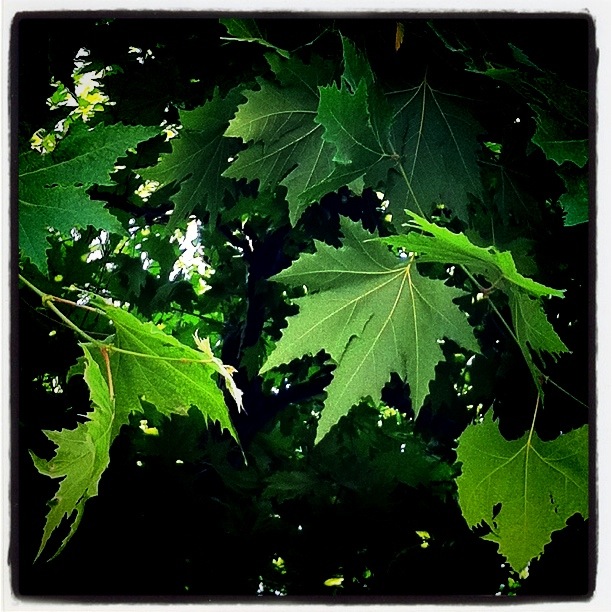
Taking his advice in hand, I pluck Karagöz from my right ear, and place him on a floating sycamore leaf – sending him off into the breeze as if on a magic carpet for the night.  I am done thinking for today.  Time to let everything settle in.  This isn’t the last of this topic, I am sure.  The Karagöz shadow puppet troupe howls with laughter from their collective spot on the window sill.  “You’ve got that right,” they chorus with guffaws that will surely wake the neighbors.

Sycamore leaves (Image by Liz Cameron)

Posted in Cross-cultural learning moments, Visits from the Karagöz puppets | Tagged , , , , , , , | 7 Comments

Just dropping by: Caught in the white cotton nightgown with juicy peaches and once-boiled tea


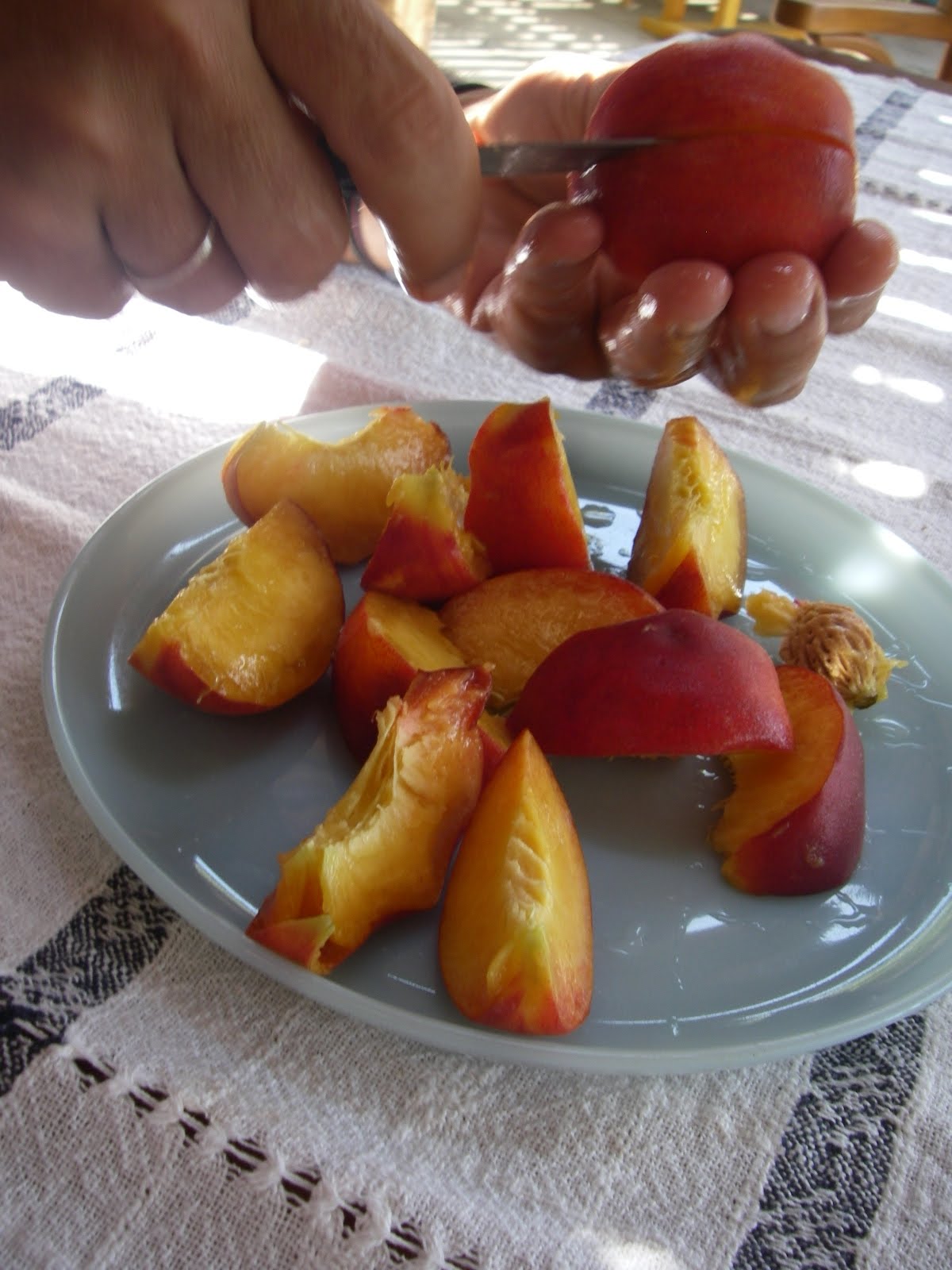
Fresh peaches on the Bozcaada patio

It is 10 a.m. and the sun is beating down on the waxy leaves of the pomegranate bush outside – I can almost see the heat waves emanating from the leaves themselves. I thought that only happened from inanimate objects…like rocks.  It is really hot here, and this Yankee New England rose is wilting before noon.

I am still in my white, cotton nightgown that my stepmother kindly bought for me back at Lord & Taylor in Boston just one month ago.  The demure oyster blue and white as white can be seersucker robe is nowhere in sight.  I can’t even fathom even three quarter length sleeves in this hair-dryer heat, to quote Jack at Perking the Pansies (a fabulous blog about two gay expats from the UK living in Bodrum, Turkey).  It is 2004, and we are sitting on Bozcaada, in my boyfriend’s family’s summer home.  It is a rustic spot way off the beaten path.  We are facing the northern Aegean sea and I am feeling pretty damned lucky to be there.

We are sitting in the breezy spot between the fifty year-old pines, the tallest around, enjoying fresh peaches.  It’s the kind of thing you do when you are in love and there is nothing else to do but listen to the breeze, feel the sun, eat juicy peaches and commune with one another in your nightgown or pajamas.  My boyfriend is cutting and peeling them, feeding them to me one by one.  We don’t even need to remark on how much we are enjoying the silence of crickets in the grassy field next door, the sound of eucalyptus branches scratching the skin of the roof ever so slightly in what breeze makes it that far along.  Along the frame of the screened window to the bedroom, the entire troupe of Karagoz shadow puppets are looking a bit wilted in the heat.  Some are snoring, some are sweating bits of their waxy exterior before they move into the shadow as the sun passes along their ledge.

Looking out to the Aegean, my boyfriend instinctively licks his fingers, glazed with fresh peach juice like a sunrise, and remarks how his friend Ahmet (name changed) who lives on the island always says there is no place like this particular spot between the pines on the island.  As I ask for guidance on how that sentiment would be worded in Turkish, I hear the soft crunch of pine needles and a hoot of laughter, it is Ahmet himself who finishes the sentence, picking up where my boyfriend left off.  Karagoz awakens and jumps to attention, singing ” uh, oh, spaghetti-os, whatever that means.”

“Crap,” I think, the blushing onset of panic rising up my neck to my cheeks, “I am stuck.”  I am sitting in the middle of the garden in my reserved, long white cotton nightgown that is not only somewhat transparent in a few spots where errant peach juice has landed, but does not hide well the fact that I have no bra on.  Karagöz screeches out from the nightstand with an ‘I-told-you-so’ sound to his voice “shoulda bought that bullet bra, woulda come in handy just about now, eh?”  He cackles and commences spinning around.  I always wonder how a flat, wax paper puppet can spin so well.

I will him a grumpy brain wave, saying”It’s a nightgown, for goodness sake, and while I may be a Yankee, I am not puritanical when it comes to surviving the heat.  Bras be damned.”   Khadijah and Kenne, two other shadow puppets, are on my shoulders, shaking their fists at Karagöz and rooting for me, as he is on their last nerve.  They do, however, hasten to tell me to hurry up and get into the house in case any of the neighbors are about.  Karagöz grins, remarking “even THEY know you are at risk of being an ugly American right now, take heed!”

Meanwhile, the etiquette instinct part of my brain is freaking out.  That part of my brain is hardwired from the classes my Granny made me take during the summer months in hopes I would be a debutante like my mother (despite the fact that she hated every moment of it).  The etiquette portio of the brain is signaling me to stand up, to greet Ahmet with a firm, respectful handshake and to ignore the fact that I am standing on the patio in my nightgown.  Some other part of my brain, perhaps the trying-to-be-Turkish part, feels that I will be too exposed.   As my brain short-circuits, I curse myself for not wearing the damned robe.  All of this preparation for an auntie who might be shocked at the wrong nightgown – I didn’t prepare for guests who just walk in, unannounced.  This will be the first of many incidents of “just dropping by” which I come to learn is totally normal and accepted in Turkey.  I still haven’t gotten used to it as I write this, eight years later.

The blue and white seersucker robe I was pining for in my near-naked moment

Feigning an excuse in English that Ahmet will not understand anyway, I twist the fabric of my nightgown in my hand, holding it away from my body, hoping he will not notice that I am in a nightgown and have no bra on.  “Maybe it looks a bit like a kaftan?” I wonder silently, with a wan smile, “What do I have to be ashamed of?  I am in my home, and I should not be ashamed of my body. ”  “Oh honey,” Kenne says, you have so much to learn about this country.”  In the split second it takes me to dash away from the patio, my mind is reeling with questions.  Is this disrespectful in Turkish culture?  Am I going to be seen as a harlot or some such?  Does he know we are not married?  Does it matter? Why does it matter to me?  I don’t care that we are not married.  Should I care that anyone else does?  Should I not care in America, but care in Turkey?  Why do people always “just show up? I think this is so rude…I don’t think I can get used to this.  I am not sure about this Turkey business, I don’t know if I can do this.  Why can’t I?  I have to, if this is the guy for me.  Oh dear.”

Ignoring Karagöz , I quickly place Khadijah and Kenne on the marble-topped bureau as I enter the bedroom and frantically toss on a tunic and long cotton pants.  I put on shoes as well, just to be safe.  Then I wrap my messy hair up in a lavender scarf with white embroidery, turban style.  My boyfriend always refers to this as a “mihraje moment,” using what I think is the Turkish word for the Maharajahs, or ruling elite of ancient India.  I know he will think I am trying to “do” some form of Turkish dressing for etiquette’s sake, but my hair is really an oily mess at the moment – I was trying out olive oil as conditioner as I was out, and it backfired.  All in all, I’m feeling pretty much a wreck.

Then things get interesting.  My boyfriend calls out to me – “canım” – he says, meaning “dear.”

Example of Liz in a "mihraje" turban

He is using a sweet tone that smacks of guilt -and just then he has switched to English – “will you, um, will you make some tea for us?”  His voice cracks a bit and he turns his head as if to say – “sorry. Sorry to ask you this, I am not sure I feel right about this either, but I am sort of in a bind here.”  I realize that he feels he cannot leave his guest to make the tea – and serving tea is a requisite – I have gathered that by now, along with the fact that tea is indeed the beverage of choice although all we hear about in the states is Turkish coffee.  Khadijah motions me over “he wants you to make the tea, you know, you have to serve it.”

Of course, I answer in the affirmative, not wanting the bubble of curious resentment and odd feeling to show in front of our guest.  “Didn’t it say in my guidebook never to embarrass your husband or contradict him?” I wonder.  Kenne scoffs at the book “any woman should know that they should be serving the tea to their husband, no doubt.”   Khadijah says, “we have to do what we have to do – nightgown, olive oil, bra or not and I suppose that is a good rule for anywhere, not just Turkey.  And not just wives to husbands, pitching in when people just stop by.”  “Why Khadijah, I thought you were a 14th century Ottoman era servant – this is sounding pretty much like a feminist humanist to me.”  Khadijah winks at me and motions me along to the kitchen.

Entering the kitchen, with three puppets nestled in my turban at various angles, I realize that I am supposed to make tea the Turkish way – involving double-boiling, and lots of hot water with the potential to burn me in between teapot transfers.  Turkish tea-making involves two teapots.  I reach into the recesses of my Yankee toolkit, and squarely grab for that age-old item, the stiff upper lip.  Well, here I am, in someone else’s kitchen, the lady of the house for the time being, and it is my time to make tea.  “Not a big deal,” I whisper, I have made tea all my life. It’s just that this time, I’ll make it the American way -with a teabag.”  Khadija, Kenne and Karagöz all faint simultaneously.  Hacivad shows up on the back of the stove and explains that this is not acceptable behavior, even though I am an American, the tea MUST be double boiled.  I recall my mother’s insistence that tea be made “properly” with water at the full boil.  Taking stock of the situation, I realize that I have only seen my boyfriend make the tea a couple of times, and I had better not try this.  I suppose I surrendered to the teaching-old-dogs-new-tricks phenomenon, but I find myself just heating the water up to boiling and pouring the water into a cup with leaves, then straining it out.  “I wonder if they will be able to tell the difference.”  My three puppet friends are still knocked out cold, although Hacivad is fanning them with a napkin he has taken from the table.  He is intent in his efforts to revive the trio.

Teabags will not cut the mustard in Turkey - thanks to reusable photo from Anders Andemak at Flikr

I take some comfort in setting up the perfectly round, rimmed plastic red tray that my boyfriend’s aunt uses for teatime. It is sun-whitened but tried and true.  On it, I place the traditional Turkish tea delivery mechanisms  – tulip-shaped clear glasses that are maybe an eighth the size of the mugs I choose for tea at home.  Placing each one on three delicate tea glass saucers, I search for the small, aluminum spoons that accompany the glass items.  Each spoon has tulips somewhat indelicately stamped onto it.  I can see that they are the hardware store version of spoons, not a finely hewn set.  I imagine the machine that was created to do the stamping in some fabrika in Anatolia.  I see that the tulip image is a clinging remnant of the Ottoman empire’s fascination with that flower and it’s shape.  A mini part of history that I would not have caught without reading up on some of the Sultans. “This is no time for waxing poetic about the Sultans!” Hacivad cries, “you must get on with serving the tea – I hope you will follow the tradition!”

Having no idea what that tradition is, I add a bowl of paper-thin slices of lemon onto the tray next to the rectangular sugar lumps that I used to feed the horses with my Grandmother, Verna.   My hands go through the motions as I remember the feeling of the coarse tongue of the horse on my hand where the sugar is.  I pour the once-boiled tea into the glasses.  Before long, I realize that the red plastic tray island is fully inhabited.  Silencing the ladies who are now sitting up, holding their heads and alternately cluck-clucking, tut-tutting and poo-pooing with an alacrity that belies their displeasure at the once-boiledness of the tea, I make my way out of the kitchen as the door bangs shut behind me in the breeze.  I enter an unknown territory.

Karagöz alights my shoulder with his usual twirling, “you’re gonna fall, you’re gonna spill.”  My hands start to shake as I descend the two stone steps to the breezy spot as the ladies hold their breath from atop my turban. The black tea sloshes up to the rim of the tulip-shaped glass on the left, but limits itself from going farther.   I wonder how Ahmet is perceiving all of this.  I know that my husband’s guest is liberal and has devoted himself to his girl’s education, but I also note that my husband’s friend is being studied at not looking at me.  It has been explained to me that this is a sign of his friend showing him respect.

In the village streets, traditional men will not look at or talk to a wife and her husband for this reason.  It has taken me a while to understand why my good-spirited “iyi akşamlars” (good evenings) are not responded to in the village, but I am getting the picture.  This village existence is so very different from my experience in Istanbul with my husband’s family and friends – much less my own Cantabrigian streets.  I remember that Ahmet did, however, greet me warmly when we arrived on the island, inquiring about my family though he does not know them and they are thousands of miles away, asking how I liked the island, and other pleasantries.  As with the country as a whole, there is still somewhat of a schizophrenic schism between old ways and new ways, west and east.

I serve the tea, and within moments, I can tell they know the difference – Ahmet is pronouncing it very light tea indeed, and I can hear “Amerikan” in there with the laughter.  I am caught in my duplicitous effort.  Karagöz and my boyfriend simultaneously say “Busted! You only brewed it once!”  My boyfriend calls me over, thanks me, and tells me he’ll commence teaching me the right way to do it for next time.  I am happy at the light touch he offers to fix the moment – but not so happy at the idea of being the tea girl.  I smile and plan to bring the issue up later.  For now, it has to wait.  At least I didn’t serve it with milk in front of guests.


Posted in Cross-cultural learning moments, Visits from the Karagöz puppets | Tagged , , , , , , , | 16 Comments

From Islamic feminism and the perfect demure nightgown to topless ladies on the beach


A typical Turkish breakfast

One day over a Turkish breakfast feast in his breezy South Boston apartment, my boyfriend invited me to visit Turkey with him.   It was mid-bite – and a delicious bite at that – fresh, white feta-like cheese with sour cherry jam on whole wheat bread fresh from a nearby bakery.  My first response, while enthusiastic, was also somewhat garbled and crumb-filled. “Yes!” I spluttered, reaching for the black tea with sugar.

You see, I wasn’t really surprised when my boyfriend invited me to join him on his summer visit to Turkey – a visit, he was sure to tell me, was not a visit “home” as he considered the United States to be his home after 15 years as a citizen.  We were in the initial phase of a relationship when you can’t do enough talking – it seems there are scads upon scads of topics that need discussing into the wee hours of the night.  I wasn’t really surprised when I said “yes,” either, “yes, I will join you on this trip.”  We had known each other for three months at that point – and to complicate matters – I had initiated divorce proceedings with my first husband just a month before meeting my boyfriend for the first time.  It was a chaotic time. Nothing was supposed to happen when it did.

Love is, of course, very blind in this way – why not take a trip to a Middle Eastern country with someone you have known for three months while you are still engaged in divorce proceedings and need to write a doctoral dissertation?  Makes perfect sense, right?  Therefore, I was not at all surprised when my parents were taken aback at the notion of my summer plans.  Hardly a time to go traipsing around the Middle East with a newfound love when there were chapters to edit, legal fees to pay.  But most importantly, there were stereotypes to overcome.  Forget all of the questions from well-meaning friends and some family members about whether I would have to veil, to attend services in a mosque, to sponsor my boyfriend’s citizenship (usually just *after* I had explained that he had been a citizen for at least 10 years already) or to assume responsibility for his extended family members – the major question became – what will you wear?  I found this odd, as I am more of a dress and skirt type of person – and these days not so much of a mini skirt person as middle age sinks in.  This question of “what to wear” or perhaps “what not to wear” was the question of the hour.

The Karagöz puppets had not yet infiltrated their way into my awareness, but I sure could have used them.  They were to become the embodiments of my cultural confusion, cultural reckoning and attempts at cultural sensitivity, but at this time, I was all on my own.

One day as we wound our way down Boston’s Storrow Drive on the way to an Turkish restaurant, I gripped my seat at the latest lane-change, and attempted to cover up my fear of boyfriend’s driving by asking “are there any particular customs I should plan to respect, and, um, what should I wear?  Will your family expect me to wear something in particular?” My boyfriend let out a guffaw just before an errant lane changer got in in the way. After slamming the steering wheel with his right hand in perfect rhythm with an impossibly romantic sounding Turkish curse (only reserved for the very worst of traffic grievances, the rest just got the inferior American approach), he emitted something between a giggle and a snort.  “You want to know what my family wants you to wear?  Hah – um, how about Prada?  Or something fancy like that?  I wouldn’t worry about all that – don’t believe what you read in these books of yours about Iran – Turkey is Turkey – just be yourself. That’s why I love you.”  Needless to say, I didn’t get much out of that, and was certainly confused at the Prada reference.

Appreciating the support and individualism that had in many ways drawn me to my boyfriend was not enough for me, though, as I apparently I felt that I knew that I needed to prepare to dress in some particular manner – but not sure exactly what.  Ignoring what I knew were internal mental memos about social impropriety, ethical and moral duty to keep up appearances while finishing the latest dissertation chapter, I focused on preparing for the trip.  Looking back, I realize now that I was really clueless, no amount of reading Orhan Pamuk or Elif Şafak novels, travel guides, travel blogs, the Lonely Planet’s thorn tree posts or somewhat futile discussions with my boyfriend could really prepare me for what to expect or how to comport myself in the clothing department.

I am sure I had some romantic notions about the Middle East, Islam, kind old family ladies and veils – I think I drew on my experience of being grandmothered by a lady raised in Southeastern Spain at the turn of the 20th century.  She was old-fashioned in all ways, her slow, sun-infused lifestyle a constant in my growing up, as was the soft flush of her fan sending summer breeze in minute proportion over to me.  She wore a black lace veil to church for all the years after her husband’s death.  She kept it folded up in an empty cream-colored sugar bowl in the china cabinet in her living room.  I attempted to channel her sage advice on the matter, and as a result, I felt I knew what to expect, and in some cases, this was spot on.

Asma Gull Hasan -see link for more information when you hover cursor over image

But truth be told, I still tried my doctoral student best to prepare anyway – “I-will-be-culturally-sensitive!” I thought, with a self-imposed superiority.  As a result of this self-set edict, I read up on as much Turkish history, politics and culture as I could muster, subscribed to an English language Turkish newspaper and dusted off two old favorites:  Tiffany’s Table Manners for Teenagers and Fatima Mernissi’s Islamic Feminism (on how Islam and veiling in particular allow women to be treated as respected equals, more on this another time).  I knew that both, in their own way, would help me to find my own way through the experience along with my boyfriend’s help.  I called on Mernissi’s work to decry friend’s concerns about dating a man from the Middle East -“Islam is empowering to some women – it is not all-consuming blue Burquas in Afghanistan and stonings in Saudi Arabia,” I would explain, “look at the Islamic feminism movement?” People did not seem to want to hear this.  The stereotype was more comfortable to stay with, I think.  The safety of the “other,” perhaps.

A controversial image of a woman in a burqa championing women's liberation

Interestingly, it was my boyfriend who rejected the validity of Islamic feminism the most. “I am so glad,” he said sweetly, “that you are reading a lot.  But you need to know that this is in a particular context in North Africa – it can’t and doesn’t happen anywhere that women feel empowered by Islam.  Look at Iran!  Look at Saudi Arabia!  Look at Qatar!  Look at what the Islamist movement is doing in Turkey – there were *hardly any* veiled people in Istanbul when I was growing up.  I support their right to wear what they choose, but I truly do fear the potential bad things about this movement.”  I later learned that the latter point he made was a common view amongst most secular Istanbullus I met.

I had been introduced, after all, to the notion of feminism, by Mernissi herself.  An odd angle for an American girl, but that’s what happened.  It just caught my eye in the library one day.  Before I could get back to a good second read, I had to contend with my parents at breakfast each morning, as I was still living with them during my divorce and dissertation-writing phase (God bless them for that, it must have been trying!).

Although I had more than an inkling’s worth of evidence that they were horrified by my relationship with this new boyfriend who was somewhat of a bull in a china shop, as they say, my stepmother stepped up to the plate in lieu of complete silence from my father who I think was trying to deny his way through it – and what father wouldn’t?  No stranger to international travel herself and no dummy when it comes to the need for cross-cultural concordance whenever possible, she announced that we needed to shop for a nightgown – and a robe.  “I am sure that something demure is in order,” she pronounced, “I am thinking about an old Turkish auntie, the matriarch of the family.  Definitely, a demure nightgown is called for.”  I supposed that my usual sweat pants and t-shirt combo were not going to cut it and went along for the ride.  Without protest – as I really had no idea what I would be venturing into vis-a-vis the meeting of the matriarch, I demurred and found myself in the lingerie section of Lord & Taylor.

Perhaps the only bastion left of traditional department stores in the United States, a matronly, be-spectacled auntie of sorts ambled up to me with a cloth ruler around her neck, stating more than asking “In the market for a bra measurement? Or can I help you with something else?”  Not missing a beat, my stepmother piped up “not in the market for a bra measurement, but in the market for a suitable nightgown and robe for meeting a boyfriend’s older aunt in the Middle East.”  Quickly erasing the comical image of me greeting a matriarch in a nightgown and robe for the first time while doing the Queen’s curtsey, I bit my tongue.  “Oh yes, of course.  Why don’t you start over here by the cottons,” she clucked, knowingly, as if people with Middle Eastern boyfriends going home for a first visit came in daily in this Boston suburb.

My demure cotton nightgown was something along these lines, but not as low cut 🙂

Whispering while Barbara was out of earshot, she surprised me with “Will you be sharing a room?  I doubt that!” Not knowing what to say, I began to compliment the selection of rosebud-patterned fabrics out this year from Lanz of Salzberg.  I suppose the sexual revolution had hit her too at some point.  I was mortified.  Before I could conjure up the right thing to say, Barbara called out from across the floor, her voice muffled from the padded bullet bras and wispy next-to-nothings floating languidly on their hangers around her.  “I think I have found a good candidate!”  It was a long, slightly baggy number, in white with blue flecks – accompanied by a seersucker bathrobe which reminded me of my Dad’s summer wedding suit.  It fit the bill.  “We just have to do the bend-over, see-through and sit-down tests now,” she indicated, marching us along to the dressing room for a modesty check.

I was reminded of lady in the wonderful contemporary memoir, Lipstick Jihad who had to dodge the fashion police – literally – the fashion police in Tehran who made sure that veils were covering the right amount of hair and that skin-tight versions of the required raincoat did not make it down their street.  These were my images of what I knew was the more extreme end of the spectrum with respect to dress and veiling in particular in the Middle East.  While I knew that Turkey was a secular country that did not require women to veil, well, I really didn’t know what to expect.  I had better go with modest.  The nightgown robe set, meanwhile, passed all tests – not too much cleavage, not too see-through and certainly no risk of revealing my personal bits upon sitting down, such as, at breakfast or during a late night tête-à-tête upon meeting in the hallway during the jetlag phase, I thought.

Little did I know that while the nightgown would provide me with much comfort in overly air conditioned rooms in Istanbul, the need for modesty at his aunt’s home was not at all an issue – though I wore it as socially-prescribed armor anyway.  The Turks, I have come to learn, have an odd mix of tradition laced with conservative notions and acceptance of ribald and open sexuality right alongside them.  For example, take Turkish commercials – for anything – candy, gum, cleaners, cars or books – the sexual references are blatant and bold.  Although I had seen them on cable TV before my first trip to Turkey, I did not internalize how absolutely explicit commercials that accompany all Turkish television shows.  All manner of cleavage, visual references to specific sex acts were eminently apparent on television at any hour of the day.

Example of an explicit ad campaign for Turkish jeans

Ever since my first glance at Turkish TV ads, I have had some sort of moral moment of shame involving a lot of blushing, say, when standing in front of a television in a Turkish café as dancers inevitably gyrated and grooved around the product of the moment while veiled village ladies or city mavens stood about in line.  It didn’t make sense to me, this veiling and sexual openness verging on vulgarity all in one fell swoop.  A product of the pro-sex generation of third wave feminists in the 1980s and 1990s, I knew that sex was not necessarily a bad thing at all – and that one’s sexuality should be celebrated and honored instead of shamed and ignored.  Why, then, I would ask myself, do I blush in this moment?  It made no sense whatsoever.  In retrospect, I do believe that this was me facing the reality of my stereotype about a somewhat Islamic country – I was so sure that from reading I truly understood what was going on in Turkey – that the reality which was never captured in anything that I had read was not possible as real reality.

Nowhere was this more obvious than on the beach on Bozcaada, a Northern Aegean island where my boyfriend’s aunt has her summer home.  One day, while walking with my boyfriend and his aunt on the beach, we walked by two women sharing a beach blanket – one edging up her tan, lying topless on her back while reading a pulpy magazine, and the other, covered head to toe in an “Islamic bathing suit” made of light track suit cloth, who threw a blanket over herself as we passed.  I wondered if the currents in the water would be more likely to pull her away with all of that cloth.  The image is emblazoned in my mind as a symbol of what epitomizes Turkey, the east and the west, the modern and the traditional, the ever-present conundrum that Elif Şafak writes about.  It is not at all abnormal to see a lady in skinny jeans and a tank top sharing a latte with her fully veil-covered sister – I have seen this many times.

My own photo of two women on the street in Istanbul (black whole body veils are pretty uncommon there, but the image gets the larger point across about veiling tolerance)

So, although I am glad that I had re-dipped-into Mernissi’s work on Islamic feminism before the trip as a starting point, it wasn’t much of a help.  Seeing the nightgown each night in my suitcase was more of a trigger for doing what I really needed to do, reflect on my experiences that day, match my assumptions to realities and talk it out into the wee hours after watching my gorgeous sister-in-law ascend to her bedroom in a stunning, low-cut mauve silk negligee and matching robe. I finally understood the Prada comment my boyfriend had made back in Boston.  This Turkish family, very secular, was more interested in Prada and  Dolce & Gabbanna than discourse on Islamic feminism.  I was stuck in “does not compute” territory, and it took a while to get out of that loop.  In the meantime, I took comfort in my Puritanical cotton nightgown.

Posted in Cross-cultural learning moments, Gendered moments, Turkish Food!, Turkish-American Matters | Tagged , , , , , , , , , , , , , , , , , , | 9 Comments