Karagöz daydream #2: Flying from west to east with Khadijah and Kenne, my first female Karagöz shadow puppets


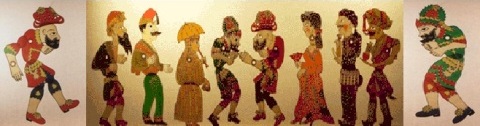
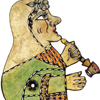
A string of Karagöz shadow puppet characters

The shadows are back.  They exist beyond my boyfriend’s South Boston apartment, I think.  Not sure this is a good or bad thing.  This time, it is a man in western Ottoman-era dress with a pince-nez and a lady in the red dress of household helpers.  Even in my dream I can’t bring myself to say “servant.” Their hands are touching gently enough to reveal the love between them.  They gaze, mesmerized by eachother’s eyes, with only tree and cloud puppets moving around them on the white screen behind them.  The flickering of the candle behind the screen brings a warm, glow, almost as if illuminating a secret, but I can hear pots and pans clanging in the background, thanks to the puppeteers, who are creating thunder to indicate an ominous mood.  The camera pans to me, the narrator of the dream, “who knows if a mixed race couple was an unlikely couple in Ottoman times,” I note with reserve, “there was so much cultural mixing, and besides that, they seem really in love, but I wonder why the thunder?” 

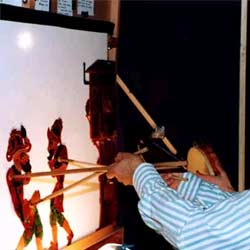
Behind the scenes of a Karagöz puppet screen

The hypnotic mood is broken by a clash of thunder, a crack of bright white light – and the appearance of Karagöz and Hacivad.  “Eee gads,” Hacivad declares, “you most certainly may not continue this improper behavior!  Stop at once, Khadijah, back to the servant’s quarters! And Celebi, I should expect such from a dandy such as yourself, but really, what of the girls of good breeding? We must conference at once.  It is one thing to have an affair with a lady of the house and another to propose marriage.”  As Hacivad is delivering this dictate, Karagöz is amping him from behind, making faces behind his back and generally striding about in preposterously exaggerated poses.  He takes his chance and creates the fray he is simultaneously jumping into “Oh pooh – fahgeddaboutit, let love live, viva love!  Look at the love and tender looks like so much rose syrup flowing over the soft curves of the poached quince and kaymak.” 

As Karagöz is camping it up, the white stage fills with spectators – the lovers are still touching their hands in that gentle manner, but they have turned away from each other, back to back, looking alternately downward in defeat at being found out and defiant in their love and the very rightness of it.  Addressing the growing crowd, which now includes his parents, the owners of the red dress lady who are tugging on her arms – and any manner of other folk, Celebi stands forthright and declares his love for the woman I now realize is named Khadijah.  “I intend to make this wonderful woman my life – we may come from alternate ends of the earth, accustomed to different practices and stations in life, but we are willing to learn eachother’s ways, and find a happy medium together, if you will allow us to take this modern route, and make a life together.” 

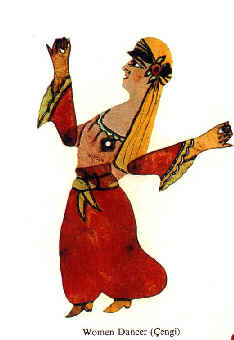
Khadijah - my name for one woman çengi dancer in Karagöz puppetry

The crowd bursts into an uproar, with cries of “what of her customs? They are not welcome here” and “she is ignorant, as are the race in her country, not sophisticated.  Do you want an Egyptian child?”  Khadijah tilts her chin up “judge me by my actions and not my words,” a tear slides down her face, “do not stereotype me.” Celebi announces “she is a wise woman, do unto her as you would do unto yourself.” The crowd continues with sure-footed commentary along the lines of “he will tire of her, and seek another wife, who will be none too pleased to be second wife to Khadijah” and “but they follow different religions – she the dark ways of North Africa and he Islam – it is not possible.” 

Celebi responds with confidence and disdain “I respect but do not embrace Islam as my religion, I, as the Sultan, believe in science and the power of the earth – not the idols of man – but I accept her religion, it is her doing, not mine.”  The lovers stand firm, their right hands holding the left, and the left right on the other side, they are firmly back to back now as the crowd comes closer and closer, their admonitions like flames in the fire of a witch burning, they begin to spin, and fade into the view of what is becoming the pinhole, the angry crowd’s voices become a cricket chorus as their size lessens…I am spinning, Khadijah’s red dress is spinning, Celebi’s hands are spinning, I wake up in the dark, dizzy.

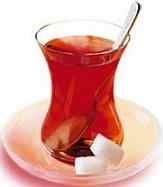
Turkish teaglass - no milk around!

I awaken dizzily to the pilot’s voice in my headphones, a disruption to the Sufi chanting that has lulled me to sleep.  I wonder if the lovers made it out alive.  “Will this be us,” I wonder, “will we be resisted this way by our communities, or will things settle down? Will we find acceptance and find ways to bridge the differences for our families? Perhaps,” I think, “I am just being too melodramatic.  This is, after all, not Romeo and Juliet, and it is just a visit to meet his family, a first visit.  Why am I so worried?”

Meanwhile my boyfriend is handing negotiations with the flight attendant for some milk to go in my tea, which does not compute, as this is not done in Turkey, no milk in tea.  All I can understand of this are the words he has taught me “çay” (“chai,” for tea), “süt” (sort of like “sooht,” for milk) and “lütfen,” (“lute-phen” for please).  Shaking my head to awaken, I am disoriented enough about the crescendo of discussion around the milky tea but more disoriented as I am trying to remember my vivid dream.

Here I am, I think, I am still in the airplane, my face pressed to the side of the oval window to the clouds, I can already feel the sleep-derived dented groove along my forehead and cheek.  I am a deep sleeper, and these dents take hours to fill back in.  I turn to my boyfriend, who laughs at me and kisses me with the kind of new-in-love enthusiasm that ignores the dent.  “We’re about to land, sweetheart, and you have a mark on your face!”  As if shot with adrenalin, I bolted over him and made for the bathroom to try to get the sleeping dent out with a bit of home-style microdermabrasion.  I was not relishing the inauspicious start to the arrival from the aesthetic, self-centered standpoint, so I broke my usual rule of visits to the airplane bathroom only at last resort.

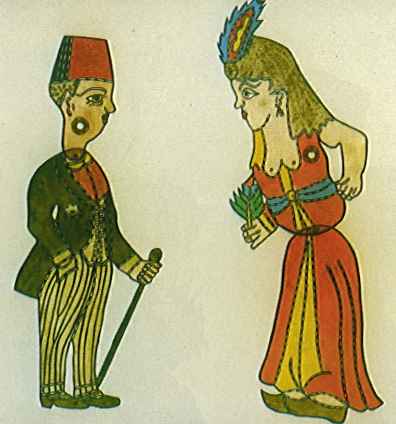
Celebi and Zenne (yes, her boobs are showing as is the tradition, apparently)

I knew I looked ok in my outfit.  It had already taken me over a week to decide what to wear on the airplane with multiple movements of outfits from closet to body to bed and back to closet before starting again the next day.  I had finally settled on black Capri pants, black patent leather sandals that highlighted my freshly-pedicured metallic coral-pink toes and a smart black top that seemed to work well with my hair, styled just an hour before leaving for the flight by my hairdresser.  I could not take a chance on frizz potential – I went for full-on straightening.  It was my New York style at its best, and I hoped it would suffice as conservative enough, yet also stylish enough.  I knew my boyfriend’s family were secular Turks, but I couldn’t be too sure and wear something too revealing, I thought.

Once standing face to face with myself in the cramped but shockingly not really malodorous privy by now filled with the  crumpled brown paper hand towels of the entire airplane’s human cargo after over nine hours of flight time, my heart was beating fast and butterflies were way too quaint and dainty of an animal to describe the Neolithic dinosaurs battling it out in my stomach.  I hate to admit it, but I am very insecure about my appearance and meeting new people – especially the new people of a boyfriend from a different culture – sends me into anxious orbit.

My vision of my stylish self was nowhere to be found.  My hair was flat and stringy from the pressurized air.  A white smudge graced the front of my new shirt from where I had spilled my airplane dinner’s odd, chalky pudding.  I had discarded any interest in eating if after just one bite.  I was sweating in the way that only airplanes force one to sweat – a sort of smell exuding in the controlled air that highlights and ferments normal sweat.  And, of course, I thought, to top it all off, I have a dent across my face, and no amount of cold water pressed on with paper towels is going to change that in time.  “This can’t be happening,” I complain to nobody in particular in a fit of teenage-like angst, “I can’t meet his family looking like this!”

“Why yes, ma’m, you certainly can, and you will, with your head held high!  Nothing to be ‘fraid of – you are a lovely lady, pay that mark no mind, it’ll disappear right quick.” The southern-sweet voice rang out behind me and I questioned my sanity with increasing alarm.  Looking up and down the length of the bathroom mirror, I notice her first by the shadow illuminated along the back wall of the bathroom.  She is the lady in the red dress, the one who got yelled at by her mistress for doing something wrong in my dream.  “I remember you,” I stammered, “you had some kind of goo on you.”  “Oh, you remember your dream, we weren’t sure you were aware of us yet, my mistress didn’t like my kine work,” red dress lady sighed.  I remember that kine is a green henna paste used to make drawings on women’s hands before weddings but I don’t recall the details.  Not crucial knowledge at this stage, I think to myself, but I must look this up.  Still sighing, the red dress lady is explaining on – “she never liked mucha anything I do, and there are just some people like that, you just gotta deal and say ‘bless their hearts’ is what my momma told me. And why on earth do you care what somebody thinks?”

“Who are you, I mean…what are you?” I stammered, thinking I must still be asleep, “what the hell is going on – have I had some sort of airplane-induced psychosis?  Ignoring this, the red dress lady paid me no mind and continued on. “You know, you are likely going to meet some fancy ladies who may not like your way of dressing – and that hair!  They’ll fuss about the grey that you call silver,” she laughed with an easy manner.  “It’ll all be just ok.  Just be proud, be you and don’t worry so much!”

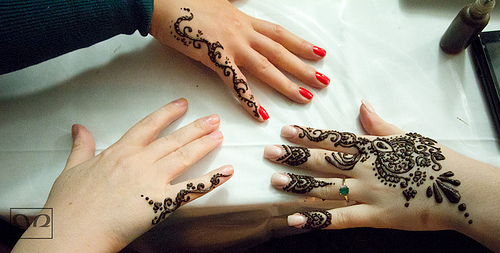
Turkish henna/kine drawings on hands for a wedding - thanks to The Lotus at Flikr

No sooner could red dress lady offer this kind advice than blue dress lady showed up too.  I had a half-second warning as her shadow figure was illuminated on the back wall into my mirror as she made her way up my other arm.  “Why now what kind of advice is that, Khadijah! I not in the mood as you are just about on my last nerve after that kine incident.  You know damn well that in Turkey, ladies dye their hair – NOBODY has grey hair and look at all of this mess on her head!  She’s about to walk into a hair disaster zone!”

“OK,” I muttered to myself, “red dress lady is Khadijah, blue dress lady is apparently histrionic.”  Khadijah stood firm, her face didn’t crumple like mine would at that talk – she seemed as strong as the feeling of a finger traced around the inner part of a 24 carat gold ring – smooth, but strong and stalwart, ready to withstand, unbendable.  “She pops a gasket, as they would say in your century, at pretty much anyhting” Khadijah winked over to me in sotto vocce, “you just have to let it roll over you and get on with your task.”

Blue dress lady appeared in front of me now, by the soap dispenser.  She was jumping with all of her might on the handle, trying to wash her self-described ‘disastrous hand kine’ off of her hands with modern-day soap.  “Disgusting, the way people leave their detritus and goo around just anywhere on airplanes,” she opined with disdain, “but you really must fix your face before you get out of here and meet his family! Don’t you have any foundation? Powder or mascara? Don’t you depend on this one, Khadijah messed up my pre-wedding henna hands by using the wrong henna, such an embarrassment, I tell you, I will never get over it.”  As she delivered her dictates, she warped and bended her tiny waxy-paper doll self, catching just enough of the bathroom’s bright light for quite a show on the bathroom wall.  “Call me Zenne, that’s Zen-neh, there’s a right and a wrong way to pronounce everything in Turkish, and you must learn it post-haste. Pronounce every syllable, but don’t call us A-rahbs, please, because we are not.”

“Now look,” Zenne said, “Khadijah and I may have our differences, she is, after all, from the nether regions of Egypt, far from the glorious capital of Osman’s empire in Bursa where I hail from, but we agree, you have to be both a little bit carefree and yourself and a lot rule bound and observant to their ways when you meet this man’s family – even though they are a non-religious lot like so many there.”  My head was spinning already – how was I supposed to do what seemed to be an impossibly imbalanced task?

Someone pounded on the door, speaking, presumably, in Turkish.  “Time to go, canım, (dear)” Zenne said, “mind your manners – remember that book I guided you to – you didn’t know it, but it was me who sent your hand to that book, the one on Turkish etiquette. Your man doesn’t like it, but what does he know, that Karagöz-inspired giant is a bull in a china shop indeed! Bye Bye!” With that, Zenne folded herself up, making me realize she was some sort of wax paper illuminated apparition and before I knew it, she had wiggled her way under my clothes and back inside my psyche.  I could hear her humming a bit as she walked to her Iznik tiled fountain room – “don’t worry,” she called out, a bit faint now, “I will come to your aid when you need me.”

Khadijah followed suit, folding herself up and into me, but not before saying “you are wonderful just be yourself, and it will all be alright.  Just go with the flow when you have no other options, like me.”  I wanted to hug her and thank her but she disappeared too quickly as I was extricating myself from the bathroom.  A line of raven-haired middle-agers like me waited in the aisle, looking at me impatiently, their Balenciaga, Prada and Berkin designer bags resting on their arms as they awaited their turn to freshen up before landing.  I held my breath and slipped back into my boyfriend’s cocoon, hoping for the best at landing.  “Well,” I thought to myself, “it’s nice to meet some female puppets at least, I may be losing my mind, but at least it is a gender-balanced world in there.”

Posted in Karagöz puppets in dreamland, Visits from the Karagöz puppets | Tagged , , , , , , , , , , , , , , , , , , , , , , , , | 9 Comments

Stereotypes where you least expect it: Turkish breakfast for colleagues


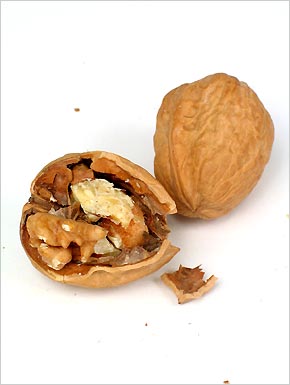
A freshly-cracked walnut

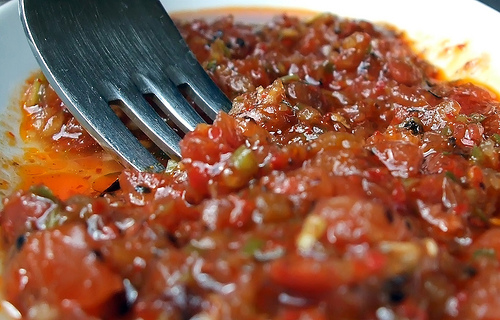
Placing the lovely, fresh walnuts on a baking pan to roast, my husband remarks “why are you spending all of this money on breakfast for your colleagues – do other people do this?”  We are making ezme, a purée akin to hummus that consists of red peppers, lemon juice, walnuts, garlic, tomato and pomegranate syrup, etc., well, that’s how I make it anyway, there are lots of variations across Turkey.  With a big sigh, I finish mincing the garlic and reach for the pomegranate syrup.  “I want them to learn a bit about Turkey – whether they want to or not – you know, like Malcolm X, by any means necessary.  I am troubled that the Middle East is some big ‘other’ that can be generalized into some vitriolic mullah or blue-sheeted lady in pain.  I want them to know more and this is my stealth way of doing it – most people bring coffee and donuts, but I wanted something healthy and interesting too.”

As we move to the counter to peel the charred skin off of the red peppers, my husband chuckles, telling me “this is one of the reasons I love you so much, you are such an idealist in this way – usually you are more of a cynic.  I want to be honest, though, I do not think most people will get it.”  Feeling deflated, Hacivad tells me to keep it low and slow on the emotional front, but I am pissed.  Karagöz is needling me, poking his pointer finger into my shoulder over and over, ready to make me engage in some sort of angry outburst about how wrong my husband is, insisting he learn about cultural sensitivity trainings “the authentic way.”  All I can muster is “Rome was not built in a day, and neither was Istanbul.” Smirking in the loving manner only he can do, he just turns to tending the roasting walnuts and making sure that they don’t brown too too much.

It is 2009, I am making ezme for a Turkish-style breakfast I am offering at work during our monthly meeting.  In my idealistic mind, it is a small way that I am trying to raise awareness of Turkey, of the Middle East, of the culture (if it can be lumped into one) that I have become a part of or the culture that has touched me some.  I am carrying brown grocery bags up the hill into my building, hoping to race the rain so that the glass jars of home made ezme do not fall and crash on the asphalt.

Hacivad, indelibly marked by his non-stop academic attitude and commentary is right along with me on my shoulder, supervising the entire breakfast-spread preparation process.  “You have to set up the educational Powerpoint on Turkey next to the cheese, not the jam, this will be the most effective spot.,” he pronounces.  Karagöz is nowhere to be found.  I am feeling proud of my effort – and perhaps at the same time a little too full of myself today – doing this good deed for the knowledge of my colleagues.  It is for the latter reason that I am surprised that Karagöz is not screaming in my ear and highlighting this insecurity with wild enthusiasm like he normally does.

Running back to the parking lot to get more of my breakfast prep stuff, I realize where Karagöz has been – I hear him before I see him.  “Well, looky here,” he whoops in a cowboy drawl – perhaps picked up from the spaghetti westerns filmed all over Turkey’s Anatolia region – “looky here I got me sum ‘Mericans what for you to edjudicate!”  I sigh, knowing I am in for something now.  “This one over here,” he motions with a long, pointed finger and his long pointed shoe, “he’s about to spring a doozy on you – I can read minds, did I tell you?”  Ignoring Karagöz, I greet my colleagues warmly – they are some of my favorite folks to work with.  The morning starts to sour immediately as one explains that the educational PowerPoint presentation I sent out the previous night (about Turkey, the middle east and Turkish breakfast in particular) clogged the person’s mailbox.

As start to explain what the file contained and why I was sending it, Karagöz whispers in sotto voce“it’s a LOST cause, man, give up the ghost – don’t even try – whattayagonnado – fix the ugly American in them?  Not gonna happen, boyee!”  I continue my studious effort to ignore Karagöz, wishing for Hacivad to weigh in, but he is silent, watching the whole thing unfold with his head cocked to the side and a chartreuse silk parasol twirling over his head.  As we walk in the door, one of my colleagues turns to me and says “so, is your husband’s family arguing for him to have another wife yet?”

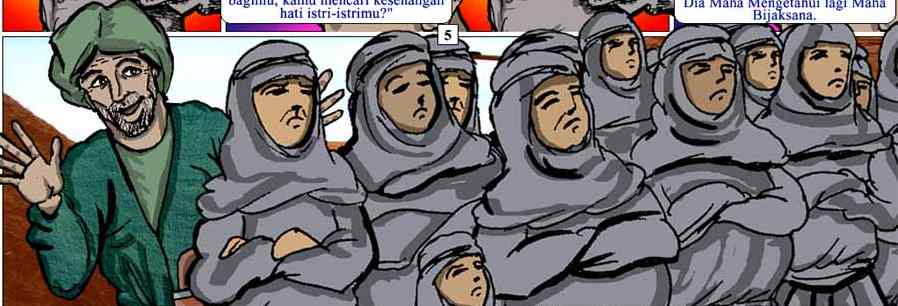
Stereotypical image of a Muslim man with many wives

I am floored.  Karagöz screams with delight at the immediate representation of ugly Americans right here in New England.  “Who knew,” he croons, “they can even be ugly about other cultures when they are still IN the United States.”  Hacivad drops the parasol and it rolls into the gutter in front of our building immediately becoming caked in mud.  This is an educated, thoughtful human being whose teaching and activism I respect tremendously. Stammering, all I can get out is “Turkey is a secular country – that is not allowed – and he’s not from a religious background.”  Karagöz is in his element now, speaking in an exaggerated, slow and almost whiney tone, he scoffs “up to your eyeballs, it only gets worse from here – the point of no return!”

“Oh,” says my colleague with a confidence that re-confirms his previous comment was totally serious, “I am sure if they don’t want it now – it will come along soon enough – I have heard this from all of my Arab clients.”  Hacivad is trying to act like a shadow puppet teleprompter, telling me what to say, strategizing on response, but my hearing is in slow motion.  Karagöz is whooping and rolling around the top of the grocery bag now, running victory laps.  “Well,” I offer in a somewhat defeated voice, “Turkey is not an Arab country and my husband likes to joke that I know more about Islam than he does – as he was not raised in a religious family.”  As if I have not even spoken, my colleague, an experienced professional trained in the art and craft of listening to people carefully effectively ends the conversation, saying “well, culture comes out whether you like it or not – you’d better be careful.  Remember Sally Field in Not Without My Daughter, yes?”

(Click on film name for info about this film on a custody battle in an American-Iranian marriage during its dissolution.  The film has been heavily criticized for unfairly portraying a demonized version of a Muslim husband but may also get at some of the truths of some people’s experiences).

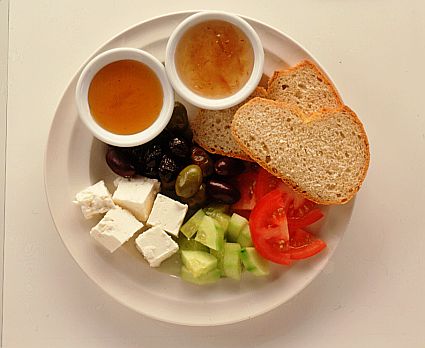
Hacivad’s mouth is agape, and Karagöz is cheerleading on my colleague’s shoulder, whispering things into his unconscious ear. Once again, I am astonished at how many people feel they have the right to tell me about my life, how it is and will be, and seem to have lost their ability to listen or channel new information in to their brains to augment, supplement or replace existing knowledge and/or stereotypes.  Deflated for a moment, I force myself to lay out the rest of the Turkish breakfast spread – strong black tea in tulip-shaped glasses, green and black olives, fresh bread, white farmer’s cheese, rose and sour cherry jam, my ezme, and a salad of fresh tomato and cucumber with soft red pepper flakes and dried limon kekik (lemon thyme) picked by ancient looking old ladies on the hills of Behramkale near the Temple of Athena, overlooking the Isle of Lesvos from the western Turkish coast.

Athena is still revered in Turkey as a symbol of feminine power and strength, and I wish that this image could balance the stereotyped images that abound about women in Turkey (dominated by men, living pure gender inequality, not valued, treated as chattel, etc.) These are stereotypes for a host of important reasons as I am sure this is present in many Turkish communities, but what gets me is that this certainly not the whole truth for all communities in Turkey – and I have witnessed this firsthand.  Hacivad pronounces his great pleasure at my thinking on this topic and commends me for my reasoned analysis whereas his jester colleague has started snoring at the bottom of the bag, exhausted from those laps.

Suddenly, I am conscious of some other voices out there – and I turn to see two Ottoman era women clapping and hooting at me.  “Bravo, bravo,” they cry from the olive plate, “you are getting it just right about women in Turkey.  I am Aglaia, the wife of your jester, and she is Zenne, Hacivad’s wife.  We have to go to the hammam (communal baths) now as it is the woman’s hour and we have business to attend to there along with bathing, but we’ll be back to talk more – for now you can entertain our husbands and keep them out of our hair.  Hee hee!”

One image of the wife of Karagöz

As my colleagues wander in one by one, I welcome them and walk them through how Turkish breakfast is eaten – a bit of fresh cheese on the bread and a dollop of rose jam with tea.  People loved the food and asked lots of questions, I felt a bit like I might be beaming but Karagöz was kidding me about my pollyana-ish thinking, “try,” he says, “not to be too earnest-wernest about your adopted culture.”  Maybe my sneak attack on cultural knowledge provision is not a total failure.  “That’s the spirit,” Hacivad remarks, “if at first you don’t succeed, try, try again.  Change is a slow process, the prophet once said…”

Tuning out of his historical commentary, I sit down and take time for breakfast of my own, and let the process just be what it is.  Exposure to my husband’s “eastern ways,” as he calls them, has helped me to slow down a bit in this regard, but its been a long journey.  I remember my Granny’s use of the proverb “patience is a virtue,” and I add another sugar cube to my tea in just the right amount of time to tune back in to Hacivad’s impromptu lecture as Karagöz begins his latest round of interrupting to quote the Sufi prophet Rumi:

“Many people don’t think, Those who think, think that they have arrived! They think, you know! There are people who think and go mad! I don’t want to think.  There are people who already thought for us. If we can learn from them, we can live even thinking!”

Karagöz makes sense for once, I realize, in what is masked by his nonsense wording.  “You know, Karagöz, for once you have me.  I am sure that I think I have arrived, figured it all out.  And so does my colleague about the many wives.  All of this thinking does make me go a bit mad.  Maybe it is time to go back to reading.”  Hacivad nods his head, concurring – a very rare occurrence for the two to agree.  Karagöz is agreeing while he is spinning silently on one pointed foot so fast that his cap falls off, revealing his balding head.  His silence makes way for me to focus in on the start of our meeting – the topic of which is “how to think about cultural responsiveness for social work education.”  Well, there it is, the universe working in mysterious ways. Time to read.

Posted in Cross-cultural learning moments, Visits from the Karagöz puppets | Tagged , , , , , , , , , , , , | 6 Comments

On navigating through mushrooming Istanbul and a lecture to Hacivad’s students


We are surrounded by the particularly Istanbul-style sprawl around the highway – gecekondu (shantytowns) turned formal.  Every time we drive from the island house on Bozcaada back to the city, the city is bigger, there is just more of it.  When I ask about the names of the places we pass on the highway, such as Mahmutbey or Başakşehir my boyfriend shakes his head “no, I have no idea what that place is known for, or who lives there, it’s all made up stuff, made up names it’s all new.  I don’t know it or recognize it at all – it used to be green space…none of the tradition is left, all of my friends prefer Italian food to Turkish food, coca cola is everywhere, the old ways are gone…” He goes on and on like a tired Grandfather commenting on the much maligned latest generation who will surely sink us all.

I feel his tension at the changes before him keenly, I feel as though he wants to shut his eyes and take a nap, but being the only one in the couple willing to brave the Turkish drivers out here, that’s not going to happen . I am especially careful not to show any sort of disrespect of his driving in such moments.  Hacivad sits on the gear shift as this goes on.  He is stroking his beard and doing a tennis-watching style left to right look as we talk.  “Indeed,” he says very quietly, “all of this is very overwhelming for him  – to see a city of 10 million turn to 17 since he has left the country just 15 years ago.  This must be disconcerting.  You are doing well to be quiet about the weaving in and out of traffic and the like.  He is facing his future and past and wondering just where home is.  My wife is cooking me a snack just now, but she has called over to say you are doing JUST the right thing that a good wife should do – which in this case is listen, empathize and shut the heck up.  It is his mourning for home, you see, home is Istanbul whether he says it is or not.”

“Home, home, dome, is it Rome, no, it’s home!”  Karagöz is vamping Hacivad as he swings wildly from the rental-car mirror, dotty and bright with headlamps of the cars that are impossibly tangled around us despite going full speed ahead.  Looping his hands from here to there on the string of nazar boncugu (evil eye) beads that I have placed on the mirror to protect us, he is doing flips worthy of the Olympics, I think.  “He’s a tender hearted farted, this Turkish boyfriend of yours, who cares if all of this is built up now?  Why so maudlin-paudlin? I think you should start an argument about that last maneuver with the truck – that’ll get him out of his funk about this ‘where am I’ stuff.”  Karagöz is on a cackling roll – and I shake my head to rid the image of him, but after his image wiggles a bit, it’s back to the jester and his looping swings.  I hope he doesn’t break that string of beads all over the rental car.

Shooting him a sidelong “he is so immature, will he ever learn?” look, Hacivad continues.  “Clearly, this is the lot of the expatriate,” he notes, “you don’t belong there, you don’t belong here.”  It is the ultimate duality we learned of in Indian philosophy – the coexistence of two – in fact, if you refer to the Sufi poet…”

Karagöz interrupts the academic reflect ion by letting out a blood-curdling yodel as he repells himself down from the mirror in a series of airborne somersaults that cause him to lose his pointy, Ottoman-style shoes.  “Indian, shmindian, duality, reality,” let’s stop for some lokma – did you see that man boiling up those things in an old oil barrel by the road?  I know you American types, you call lokma beignets in New Orleans – you need to try this one, it has superior quality with rancid motor oil in the mix – that’ll really rattle him up – motor oil lokma! Woo-hoo!  Too much bellyaching, I say, too much navel gazing, if you don’t like the Bosphorus, get back to the Charles River, eh?”   Before I finish suggesting taking a vacation from the traffic with the side-of-the-road lokma vendor, my boyfriend tells me that his mother warned him not to drink pickle juice from the lahmacun vendor as a child, given it’s yellow quality, and suggests that highway lokma is not a good bet.

Turkish lokma - akin to beignets from New Orleans

Before I can come up with a smart-alecky response for either my boyfriend or  Karagöz, I note that we are stuck in impossible traffic, and it is stopped for miles.  We have been in the car for almost 8 hours and are nowhere near the part of Istanbul we need to be in for the night.  The trip usually takes 6 hours, my boyfriend tells me, before entreating me to turn on my navigation switch “because I can’t stay on this highway, I will lose my mind – we have to go through the city.”  The joke in our relationship is that I have a built-in compass, and he was born and raised in a country where the concepts of North, South, East and West were not used for finding one’s way.  While I have my doubts about the latter claim of his, I am game, and, of course, whip out my trusty map.  We begin to navigate the back roads through the cement sprawl – it is about 10 p.m. but mangal (bbq) smoke is still wafting here and there from one person’s kebap and another’s köfte.  “The one good thing about these areas,” my boyfriend says with a limp balloon’s amount of defeat, “is that they cook the old way.”

We spend the next two hours with me and the map – which I abandon at some point in favor of dead reckoning, and I do this navigating until we are in a place that he knows…I am glad to be able to step in and do something constructive and am feeling good about this teaming, even though I know my boyfriend is feeling defeated by his culture shock at re-entry.  We will deal with this phenomenon each year upon our return, but I do not know this yet.

Karagöz is mimicking a Sufi dance – one hand to God, one hand to the earth as he twirls – but he is, as usual, exhibiting oodles of disrespect for this ancient ritual by screeching in circles about “culture shock, smell my sock, the Rolling Stones rock and you I mock.”  I note that my latest read on the Turkish vernacular, or common speech, educated me on the tradition of rhyming words during a repetition – something that appears to have moved into English for these puppets who insist on accompanying me wherever I go now.  I have grown to love them, despite their frustrating ways – as they embody my confusion at what I feel, do and see here in Turkey.  I was learning to navigate anew – something I had thought I knew all about – and these puppets allowed me to see that a bit more clearly once I tuned into them.

Navigating by maps, the sun, the stars, and my gut is something I have always done, but doing this with a partner, in a new country, with different expectations, realities, approaches, beliefs, you name it, that was tough.

As we approach the family apartment, Hacivad places his hand respectfully on my leg in a fatherly way, saying “I am proud of you, American lady Liz, you navigate well – on the roads that is.  And a bit, yes, on the relationships too, but this needs work – and you MUST stop interrupting, but that is for another day.”  Looking at me quizzically, Hacivad asks “how is it, then, that you learned how to navigate so well? And why would you choose to navigate across cultures?”

A small group of Hacivad’s young students creates a circle around him on the gearshift and in the beverage holders as I tell him my story, which goes like this.  “Well, Hacivad,” I tell him, “As I grew up, I learned about navigating my immediate surroundings with a compass that my father gifted me with at age eight along with a radio. He used to set me free in the woods – with my sister in tow – and tell me to find my way home using my compass and my wits. It wasn’t until years later that I knew he was nearby, tracking our every move very quietly behind the trees. I was never too nervous in these moments – I loved navigating, and creating a mental map in my mind of where I was. I always made it home pretty much lickety split.”

Mouths agape, students and teacher alike are flabbergasted.  “What type of father is that,” Hacivad asks with significant alarm, “to leave his girls in the WOODS even if behind a tree? Horrors!”  After a lot of cluck-clucking and tut-tutting, he reminds me of his second question, about why I chose to do navigation across cultures.

“Well, Hacivad, navigating is what I do  – but not always on roads…” Taking a deep breath to explain it all, I note that Karagöz has exhausted himself and is taking a nap.  “Well, now that he is asleep, let me tell you about it.  While I became an adept at navigating the justice system and its many cultures as a social worker in New York City, I started out my life navigating the ways of my own diverse familial cultures came from early on.”  Karagöz sniffs – “you aren’t really saying much there, missy-moosey.”

“OK, here is some more detail – I was raised by a first-generation European immigrant with Spanish and Scottish parents and a fifteenth-generation New England Yankee with a Canadian mother who had married in, the need to navigate cultures was constant but quite expected and unspoken. Navigating difference was nothing unfamiliar to me, but was often difficult to explain to my schoolmates, who did not understand the somewhat antiquated traditions across all elements of my family, such as not having a TV, always wearing a skirt, not blow-drying my hair and having all of my clothes made for me – and forget about the old bowl haircut. My family was positively, definitely, not normal. Of this I was sure and while often embarrassed by this difference, I embraced it nonetheless.

The crowd of Hacivad’s students murmurs approval – they can clearly relate, one is nodding off.  It is late, almost midnight now.  Hacivad is rapt at attention.

“Part of embracing my own difference was about learning to navigate the wider world through books and maps related to those books.   My mother taught me to interpret road maps from an early age from the back seat of her car – encouraging me to be curious and embrace the notion of travel to far away places she, as a woman with severe diabetes and two young children, one with a major disability, could not venture. In addition to dreaming about a journey on the Trans-Siberian railroad, spurred on by Nabokov’s Speak Memory, she spoke of wanting to return to her mother’s home in Spain, her father’s home in Scotland – and a place called Gallipoli where an uncle she had never met had died in a war. Navigating maps accompanied all of our nightly reading sessions, be it a real map (of Chile, for example, to narrate Neruda’s realities) or imagined of Middle Earth (during Tolkein’s trilogy), Narnia (during the C.S. Lewis series now a movie), Moominland (Tove Jansson) or the Doldrums (Jules Feiffer).”

“We need to know those books,” cries the crowd of students – waking up the one laggard, “they are not yet in Turkish, and we bet our English is too spotty just yet.”  Hacivad reprimands them for thinking their English is poor, and turns back to me out of respect.

“But the navigating I have always liked the most gets back to maps. Being part of a family of immigrants on my mother’s side, Europe never felt far from our collective psyche. Maps covered my Granny’s house on Cape Cod, where I spent much of each summer. Most of those maps detailed the roads and bridges of far-away places in Europe, but there were three that captured my imagination.

First, there was the map of Spain, my Granny’s birthplace, for which she clearly pined. Granny had emigrated from Spain to New York City with her infant son in 1921 to join her husband. They had married two years prior in Paris, while he was on leave from the trenches of World War I. She had, I later ascertained, returned to Spain pregnant with her first son. I loved to hear her tell the story of her wedding in Paris after a long boat journey from Southern Spain while perusing the faded map under her hands. It wasn’t until many years later that I noticed markings, in faded pencil, showing the start of her journey from Spain to Paris and the year – Paris did not figure on the map, but the direction north did. There was also an arrow towards “the new world,” as she still called it, from Spain in 1921.  She grounded herself in this map even years later while stuck stateside for life. Lovingly framed in delicately carved wood with floral scrolls at the edges, I could see the path of her finger across the map through the dust on the glass. This desert snail’s trail highlighted the drive from the southeastern city of Murcia to the smaller town of Aguilas, where her father ran an esparto grass plantation – from which suitcase paper was made. This man, I knew, loved to travel and had mastered the international language known as Esperanto. I knew this because there was a map of Europe with an Esperanto introduction hanging in the kitchen which seemed fitting, given the often globalized content cooked therein.”

“Aha – so you are a sister of sorts,” Hacivad notes, “you have some sort of Mediterranean blood, and thus you have found this Turk here.  It all becomes clear.”

“Well,” I say, not wanting to get into it, “yeah maybe – but let me tell you about the second map, it was framed more conservatively was a map from the 1920s picturing England, Scotland and Wales. Ireland was excluded. The ebony black frame was smooth and simple in the strong plastic that came with the 1950s, but no roads were drawn lovingly through the dust here. My grandparents were first cousins, both having hailed from Scotland, but my Granny always wished to attain the “better status” of being from England and only tolerated the legions of Scottish paraphernalia around the house – thistle-carved crystal glasses for whisky, a poster of Robert Burns’ birthplace and tartan blankets abounding. While Granny had never but visited the ancestral home of her family in Scotland, Grandpa had never known any other place before fleeing to America as a teenager from Glasgow, having no “opportunity” it was explained to me by my mother. I knew that he had struck out for a better life given his status as an orphan and his unwillingness to join his brother’s family in Southern Spain. None of this was relayed in the map of these three countries – nor was the care and attention of the map of Spain evident in the location of this map in the back hall, upstairs, near my mother’s room.”

“Aha!” says Karagöz, “favoritism, she was bus-ted!”  He is writhing around the beverage holder now, trying to fill it with fizzy water to make a little sauna for himself.  I clean up the mess, and place him squarely in front of me, on the dashboard.

Map of the Aegean Sea

Forcing my eyes into his, I don’t even comment on the sauna incident, instead continuing my reflection.  “There was a third framed map, however, which received very special yet mournful attention. It sat in a carefully polished silver frame inside a hand-sewn flannel pocket designed to limit the need for polishing. It did not adorn the wall, instead, it laid rest inside my grandmother’s writing desk on its side, along with a photo of her dead brother Allan, my great Uncle, in a military uniform. The map of western Turkey in my Granny’s mahogany desk was from about 1930 – and someone had highlighted the Dardanelles Strait in a great, silvery pencil oval. It was a very deliberate, and slow marking. The Dardanelles, as these waters are often referred to as you know, Karagöz, consist of a body of water known for separating the European and Asian sides of Turkey – but most importantly for containing the Gelibolu Peninsula – where the fated Gallipoli Battles were situated.

You know, I couldn’t understand the loving care afforded this secret map – I only knew it was there from sneaking into her writing desk while she rested during the afternoons – I was after her calligraphy pens. I didn’t know what a Dardanelle was, and couldn’t imagine why my granny was so interested in this seemingly arcane spot on the globe. Many years later, I had learned that my great uncle had died here, having been raised in Spain, schooled in Scotland and enlisted in the army upon seeking his fortune in Australia soon to die on the steep, straw-grass hills of the Aegean Turkish coast that have achieved such fame.”

We are pulling into the garage, and I notice that I have just about lost everyone – the students are all asleep.  Karagöz is resting on the DRIVE 4 side of the gear shift while Hacivad is on the PARK side, which I find to be an apt metaphor for their personality types – one a jester, one a thoughtful if not somewhat obnoxiously plodding teacher.  They are sharing a hookah now, I think it has the rose-scented tobacco, but it is hard to tell when you are dealing with Karagöz puppet smoke.  They are on to bigger and better things.  They got me to think and reflect on what I needed to think and reflect about, and now they need a break.

I think back to our time at Gallipoli earlier today (see yesterday’s blog post) and wonder at the map in my Granny’s desk and the fact that I stood in the place of that map today with my boyfriend looking down at the Dardanelles, framing a new visual map in a floating silver frame. Standing on that impossibly hot and steep summer hill, we touched hands without looking at each other, as if our relationship was foretold by my Granny’s mournful map, and indeed, I believe it was.  There are no puppets around to comment, it’s just me, my boyfriend and history falling heavy around us in the Istanbul night.

Posted in Visits from the Karagöz puppets | Tagged , , , , , , , , , , , , , , | 3 Comments