Hard work: On the retreat of the Write-a-matrix and the victory of her nemesis, Hacıyatmaz


une réunion pas stable

A dark army of roly poly Haciyatmaz warriors – laying in wait in case the Write-a-Matrix comes back with her own army of whipcrackers (Photo credit: bu.)

Now that I have challenged myself to carefully consider the topic of “work” as part of December’s NaBloPoMo, two of the primary metaphorical puppets that have inhabited my mind for some years now are popping up once again in earnest.  I think they are bubbling up with a geyser-like fury because the BlogHer writing prompt of the day is “how hard do you think you work?”

Regular readers will recall that on occasion, two or more of my mental puppets get into what I have dubbed “a puppet battle” (you can click here to read all posts categorized as such) and there is no more fierce a battle than the one in which the Write-a-matrix and Hacıyatmaz (Hah-juh-yacht-maz) are engaged in.  It may be an eternal battle, but I hope it will just subside into the occasional debate/skirmish that dissolves with subtle mediation.

Now, one of my Moms, who is likely reading this post, has told me that she worries about these Karagöz puppets in my head, with all of their battles.  She wants me to feel whole, not so fragmented. Of course, I can understand and appreciate this loving concern.  My take on it is that this puppet exploration is a natural and healthy part of the process of figuring things out that must be named and recognized before moving on. She’ll likely sigh, maybe shake her head, and chalk it up to personality differences, but the puppets and I are asking her to please not worry, I am on the right path, and it is a healthy one. Let me encourage her to listen to the other puppets in the Karagöz puppet troupe, who have different stakes in my brain, heart and soul.

Those puppets are reminding me that Hacıyatmaz and the Write-a-matrix are located in only one side of my self – they are not in my whole self.  Hacivad Bey reminds me that Hacıyatmaz (named for a Turkish children’s toy that has a roly poly bottom and never stops rocking, albeit gently) was sent by the rest of the puppets to tango with the whip-cracker herself, that Write-a-matrix.  You know, fighting fire with fire, and all that.  To bring you up to speed, the Write-a-matrix was the dominatrix-type who had me by the throat, publishing scads of articles for tenure…too many articles compared to what secured what I now know to be the bittersweet brass ring for my colleagues.

Ignoring all that noise from the Write-a-matrix, Hacıyatmaz stayed true to his mission, to shock me back into some better balance.  As a result, he decided to affix me with the creative writing bug with as much energy as I had devoted to my academic research. Not a perfect approach in the larger scheme of things as for a stretch I was throwing myself into both, but that approach did engage the part of me that was caught up in the frenzy that is the Write-a-matrix – and made it take notice.  As it turns out, it took about a year, my Dad’s passing – and a rotator cuff injury on my writing side to wake me up from the madness. I need time for my own writing work – and my academic work.

So, as I leave my Write-a-matrix in the corner and head upstairs into a more healthy, but uncharted territory, I agree that it is time for more balance (can you hear the cheers and huzzahs of the puppet troupe?). Hacıyatmaz is smiling now, but the rhythm of his roly-poly-ness is steady. You see, has been patiently waiting for me since the 6th grade, when I turned down the special art/writing curriculum as the cool kids made too much fun of me already – why be a bullied artsy geek, I reasoned without a second glance.  I could just lift that young girl up and shake her senseless, I am so disappointed in her for that. Hacıyatmaz has a lot of compassion for her, it seems, and just stuck around, almost imperceptibly, rolling back and forth in the corner. He doesn’t speak, he just rolls, functioning as some sort of Buddhist metronome from which I should take my cue.

Seeing me write all this, the Write-a-matrix screeches in a banshee-like wail and claws at the walls. It is beyond painful to watch, hear and write about.  That poor Write-a-matrix, she cannot bear this utter *failure* on the loss of additions to “what’s in the publishing pipeline” writing front.  She tells me I have yet to publish in the journals with the highest “impact factor” using more advanced statistical analyses. She tells me I am an academic nobody who has wasted my training, my potential.  For her, existence itself equals an unhealthy all-or-nothing approach to one tiny sliver of what life can be vis-à-vis making a contribution to the world. She is upset beyond red, puffy-faced bitter rage, as she is realizing that I now know I only need her in moderation, such as on a deadline, not all the time. She is also horrified to hear that I am no longer trying to make my parents proud by amassing an academic publishing record akin to their own, regardless of impact factors and fancy statistics. But more than anything, the Write-a-matrix is also afraid of what is lurking behind all of that whip-cracking workaholism that needs tending to, but that is another story altogether.

So as the Write-a-matrix retreats in despair and Hacıyatmaz rolls steadily along, I am reminded of a playground fixture I saw in my childhood – it was something in between a carnival tilt-a-whirl and a see-saw, and it required all the kids playing on it to balance just so in order to keep the spinning up at a fun – and reasonable rate. That’s how I will approach the work of writing from now on.

It’s a new world out here.

Posted in A Karagöz puppet battle, Academic hell, Family Challenges, On writing about my life with the Karagöz puppets, Visits from the Karagöz puppets | Tagged , , , , , , , | 6 Comments

When I found my teaching spark: A Sufi-like exchange with Hacivad Bey on the work of teaching


Sparks

Sparks (Photo credit: Gnal)


Today’s writing prompt from Blogher’s December’s NaBloPoMo is: Do you enjoy teaching others? Talk about a time you taught someone how to do something.


Well, as soon as I read that, Hacivad Bey appeared on my shoulder, ready for a chat.  He is, as you may recall, the learned Sufi elder within the Karagöz puppet troupe that inhabits my head as I navigate my life in and around my sometimes-confusing Turkish-American marriage.


Eyeing me quizzically from atop my left shoulder, Hacivad Bey cleared his throat before speaking. “So, m’lady, today, you are addressing the question of ‘whether you enjoy teaching others – and a time you taught someone something’ – that should be easy as your work is teaching,” he said, the obvious paradox hanging in the mist of his slow, deliberate voice.


Before I could blurt out the instance I usually call upon to answer questions about how I knew I was able to be a teacher, namely the night I explained the mechanics of how statistical confidence intervals for means work to my friend John, who told me “wow, you are a natural-born teacher,” I paused, caught in a time warp. I didn’t even have time to remember the warm flush of joy that pulsed through my body as I realized that for one of the first times in my life, I felt truly confident and competent when it came to explaining this difficult concept to another doctoral student colleague – even before he paid me that compliment.


“Forget means, medians and modes, m’lady, forget confidence intervals that are mathematical and visual, and just start to tell me the story,” Hacivad Bey whispered, “not of what you are good at teaching, but rather of how you came to be a teacher.  This will help you in your new leaf journey.  It is, after all, in the telling and re-telling of stories, that Sufis find hidden gems – look at all of the wisdom that emerged from the talking friendship between Shams and the Mevlana Rumi himself.” Winking, Hacivad Bey said “Perhaps you should convert, m’lady?”


Ignoring his unusual effort at proselytizing, I just began to narrate – as if caught in a peach-colored isolation chamber in which my voice could and would not turn off…


“I never imagined, in a million star-scapes of light years, that I would end up *speaking* in front of a classroom full of people who were watching me, and waiting for me to get something going for all of them in the form of a lecture-discussion.  It is Zenne, the nervous Nellie like a bowl of jelly puppet, who reminds me that I used to sit slunk down in my wooden desk by the emergency exit, face covered to nose with my stretched-out elastic turtleneck, living in horror at the thought of being called on in class.  Even today, eight years into teaching, it is that young lady I have to assuage on what still feels to her like the death march to my classroom. “It’s ok, sweetheart,” I tell her, “I know how to do this now, even if I am a bit anxious.”  Zenne usually steps in to hug that little girl whose legs quiver in fear in these moments, as she is equally nervous.  You see, the only books on Zenne’s bookshelf have titles such as Travel to the most dangerous places on Earth (so she can avoid them), How to get out of a locked car that has plunged into a river and Ms. Manner’s Proper Guide to Etiquette in Every Worst Case Scenario, among scads of others.


And as I began to embrace Hacivad Bey’s challenge, nobody was more shocked than Zenne and my little girl self at the tale I began to tell.  I began to reflect back on the specific night in my adult life when I realized I was good at explaining – and teaching.  And that teaching can wield a great power when it comes to human connections and the promise of something positive, however small.  Let me tell you a bit more.


It is 3 a.m., and I am sitting in the courthouse in the South Bronx, near Yankee stadium – but the game was long finished.  The air is stale, the atmosphere is grey even though the smoking is out in the hallway.  Family, friends and gang posses alternately sleep and posture as they wait for their loved one to have their arraignment hearing.  Working the graveyard shift in arraignments court, where all new case originate in “the system,” I spent my “on call” night sitting and watching the circus-like goings on, just taking it all in.


Once in a while, one of the attorneys on my team (all public defenders), would call me back to the arraignments cell, covered in the vomit of people in withdrawal from this or that addiction, in order to assist in interviewing the next person up for their first appearance before the judge.  They usually only called me in when it was a “tough cookie,” as the most seasoned among the attorneys called them – she was an Italian-American lady with nerves of steel and humor to beat the band.  Her name was Amy, and she pranced about in her Christian Louboutin high heels and charmed the wits out of everyone – judges, prosecutors, criminal defendants, court guards – me – everyone.  I loved working with her, and I especially loved watching her build relationships with her clients, the people that were about to be charged with criminal offenses. She was magical in her work.


Usually, Amy did her own work – but I was called in by other more “green” lawyers to deal with people that were either too “dope sick” to talk much, too mentally ill to get much of what the attorneys were saying in legalese or too confused and sad and embarrassed to look eye to eye with a sharp-looking attorney in a flashy suit.  I worked with some majorly dandy dressers – male and female – and I often felt this helped the battle of winning over the judges and prosecutors – but lost the war of engaging our clients.  But that is another story for another time.


The young woman I had in front of me that night, no more than 16 years old, and being charged as an adult, had a great keloid-scarred welt along her cheek.  It did not surprise me to learn that “Jasmine” (as I will call her) was “in” for cutting another girl – the girl – she told me with no remorse – who had cut her own face.


“Girls,” my partner attorney whispered in sotto voce, as if that would help with engaging our client, “are the worst clients ever. Jasmine, let me tell you again – I get that you are proud that you got justice for yourself by cutting this girl back – but in this arraignments matter, you need to plead not guilty – you will do yourself a disservice if you admit your guilt – especially with pride.”


Of course, I understood that the exhausted and vastly inexperienced attorney was nonetheless guiding her the right way, to set up her criminal case in the best way possible-but between his legalese (which I have translated here into English) and his disaffected and burned out manner, it wasn’t working a whit. He had no idea how to get her to play ball.


Juiced up on fear and hours sitting in the stink of the human pen that is the arraignments holding cell (50 people in about a 10 by 20 room with one open toilet, Jasmine let rip a string of curse words not even the most hardened criminal could muster under duress – this was one angry – and hurt lady.  I kicked the lawyer out of the room and decided to level with her.  “Look,” I said, “I’m a White girl from the suburbs, I can’t relate to you at all with what you are going through from my own experience – but I can tell you this, I can tell you how this system works.  And you have some choices to make today that can impact tomorrow.  You can hate that dandy lawyer all you like – and you can hate me all you like as well – but please just let me explain to you how the process works here.  If you listen to me, and show me to the best of your ability that you understand, I will respect whichever decision you would like to make, no problem. And besides that, it’s my job, ok?”


Despite her side-eyed sneer over folded arms with sharp elbows ready to fight her way out of the room with me, she sat and listened as I walked through the process of arraignment – and beyond.  And a good thing started happening, she started asking clarification questions (although she spat out words like bullets, with hate and pain).  I learned that if you can ignore those bullets, that hate and that pain, and you can just get through by “starting where the client is” as so many social workers like to say, you can get somewhere.


And before long, she stood up, and asked me to stand with her up in the courtroom.  “I ain’t standin’ next to no stoopit attorney for my not-guilty plea,” she said, “but I be standing next to you, I get you. You gonna explain that to my family? They out there, I think.”  Of course, I just said, “sure, ok, let’s roll – and be sure to let me know who your family is, so I can talk to them after you have your appearance, ok?”


And that was all the thanks I needed.  She had “gotten it.”  And it was also the moment I realized that I had taught someone something – how the system works and doesn’t work, where you have some choice, and where you don’t.  What can help you, and what can hurt you.  After the hearing, and after sitting with her family, explaining it all again, I watched the dawn come up through the tiny windows at the top of the room’s tall walls, and I realized “I have the capacity to teach. It’s probably the most important thing I can do in this work.”  And that, Hacivad Bey, that is how I learned that I could teach – by teaching someone  that someone vastly different than herself could stay present, listen and do her best to explain what was next on the path, and that it could work if I listened, and if I used the right words.


And I have never forgotten Jasmine, and it is Jasmine that I call upon whenever I work with a really upset, challenged or challenging student in a policy analysis or research methods course.  And it works every time.  And I love it, I love teaching.


Zenne, the nervous Nellie puppet who shakes at nothing much at all as if she were a glass of jelly, well, she’s just in shock, suspended in time at this story. It’s too much for her.  Her loss.


Posted in On writing about my life with the Karagöz puppets, Visits from the Karagöz puppets | Tagged , , , , , , , | 6 Comments

Babane, Anane & Kaynana make jam: A lesson in leading, following and collaborating


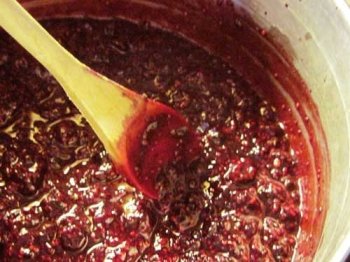
Cooking raspberry jam

Cooking raspberry jam

This month, I am reflecting on work as part of the Blogher NaBloPoMo challenge. And I sure have a lot to say on the topic when it comes to my job at the University.

But if I really think about it, one way I really learned how to work was by watching my Granny and my Grandmother work hard for the family through providing nourishment and healing.

Often, this involved growing things and cooking things, But what comes to mind most is jam. Yes, you read that right, jam as in sour cherry jam, quince jam, gooseberry jam or raspberry jam. No jelly need apply.

For the Turks and Turklishes out there, My Granny was my anane and my Grandma was my babane. And let me tell you, those women knew how to work.
They made everything for breakfast, lunch, dinner a cold or a belly ache, by hand, usually from scratch, and often with items from their kitchen gardens. I barely remember them outside of the kitchen, truth be told.

In the summer, the kitchen gardens were a major source of important bits and pieces. My babane, for example regularly harvested of a snitchet of chervil, dill or chives from just outside the kitchen door to add flavor to a dish.

My anane, on the other hand was more likely to look for raspberries, gooseberries or rhubarb in the back garden for jam – but also for the occasional berry fool or pie or pastry. But she also had an herbal garden on the south side of the house where she grew medicinal herbs That went into twisty concoctions that made my nose curl. I’ll leave those vile concoctions for another day’s description.

What was most memorable about watching my anane and babane work was the process of home canning in the summertime – and that’s where I learned all about leadership and collaboration.

Let me tell you that is hard And dangerous work, canning vegetables and fruit over massive boiling pots in a house with no air conditioning in the height of July afternoon. My babane canned a lot of tomatoes… But I was rarely there to watch it. I learned more about watching her stretch them through the winter season into all sorts of meals, usually a nice spaghetti sauce.

In late June, my mother and my anane would always make raspberry jam, gooseberry jam and a mix of raspberry gooseberry jam. They made so many home canned wax sealed jams that we had them all year long, and you could really taste the sunshine in them.

And I saw that all that hard work they did, sweat dripping down their brows furrowed with the bird’s feet of deep concentration about the viscosity of the bubbling sugary mixture, and whether it was “time” – that “time” thing meant that the magic of jam perfection had been achieved. I still act the same in my own work, although it isn’t jam I produce.

In many ways, it is the images of the raspberry and gooseberry jam making that allows me to relate to my kaynana or rather the stories about her, in which she would make great steaming vats of sour cherry jam, M.’s favorite, so that he could enjoy it for as long as it would last. It’s a romantic image for this American lady,the making of some exotic sounding jam that we don’t have here.

Yet, I know full well from watching my anane make gooseberry raspberry jam in the sticky swamp of a hot Cape Cod summer, that this was no feat for the weak hearted. It is all you can do to avoid hot splatters of red green jam that easily make sugar burns like odd egg-shaped freckles on your arm at a rate faster than sunburn In the noon day sun. Work has consequences, despite it’s necessity. I Watched my anane lead at some point when she was the expert, and I watched my Mother lead at other points as she was the heavy lifter. There was leading and following and collaborating in consideration of whether the jam was ready or not. It was a dance of leadership, collaboration and following all at different moments with different pirouettes.

When my babane died, at her memorial, I remember that she was the one who taught me that the work of preparing food is love. But teaching a young woman to cook for her family and modeling that for all to see is also a lesson in the work of childrearing & responsibility, jam or no jam.

So in answer to today’s Blogher NaBloPoMo daily prompt for writing on work, which was:

Do you feel most comfortable being a leader, a follower, or a collaborator?

I would have to say, it depends on what type of jam I’m making that day. So thank you to my anane and my babane for teaching me about the necessity for all three roles in my work life.

Posted in Family Challenges, Gendered moments, Turkish Food! | Tagged , , , , , , , , , , | 10 Comments