Pointing the way to Mecca: Karagöz questions how to share space on Turkish Airlines


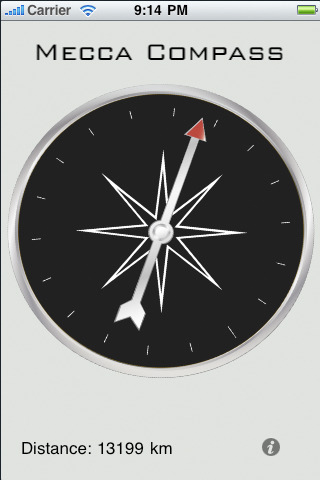
Yes, there’s an app for that too – an arrow to Mecca, or more specifically to the qibla (Image thanks to MacWorld article at this link)

Before it registered that I was waking up in the airplane, mid-flight from Istanbul to New York, I could hear Karagöz swinging back and forth.  It was even more than an instant before I remembered that I was returning home to be with my family, as my father was at the end of his life, and entering hospice.

His wooden joints were creaking a bit, clearly in need of a bit of oil.  Opening one eye ever-so-slightly, I observed Karagöz to have lodged himself, upside-down, in the overhead compartment.  A perfect plan, I realized, for a puppet who categorically needs to swing back and forth in order for all to be right with the world.

Cooing at me with the craziest of tones, as he had realized I was awake, Karagöz thrust one of his usual, un-diplomatically timed and phrased questions my way.  As usual, I knew it was likely to be a hum-dinger, as my Grandpa used to say.

“I have had just about enough of being culturally aware – and more than enough of listening to debates about what to do with dead bodies in Turkey and the United States.  What I want to ask you now, M’lady, is another question altogether.  Why is it, M’lady,” he ventured with his signature ironic sneer, “that we must ALL see the way to Mecca here on this iron box you call ‘airplane?’  And why, M’lady, is it that the companies that own this mechanical beast are so caught up on being culturally sensitive – oh wait – now it’s culturally competent – oh wait again – now it’s culturally responsive? What is all of this drivel anyway?  What about the theory of shared space – you call it the theory of the commons, yes?”

“Well, Karagöz,” I began hesitantly, slowly opening my other sleepy eye, “first of all, the theory of the commons is about common resources – and people have, for example, written about the tragedy of the commons, when common resources are squandered or spoiled -”

“That’s exactly it, M’lady,” he screeched, waking the other puppets stowed away like hanging bats near him in the process, “what is more precious than our common space – and the neutrality therein?  And isn’t it a shame that each claims it for their own, thus spoiling it? A travesty of sig-nif-ic-ant proportions, M’lady, this arrow to Mecca problem.”

Sighing internally yet again, at the start of another L-O-N-G discussion, I sat upright to engage in the process.  The other puppets were waking up around me. “Well, I suppose that, dear Karagöz, is the crux of the matter, now isn’t it. Namely, should shared space be neutral – culture-non-specific – so that we may all be comfortable there.  Of course, the challenge is, that the bottom line for one culture may be non-neutral to that of another culture.  So, it seems that what is culture-neutral to you – is oppressive or, I suppose, problematic to practicing Muslims.”  Feeling quite proud of my sleepy soliloquy, I turned my head to the side and raised my eyebrows, bracing for a response.

“Hogwash!” Karagöz cried out, no religion should be the baseline – back in the day, all we Ottoman Empire subjects, well, we got along JUST FINE.” Celebi, the modernist puppet, lined up next to Karagöz, saluting his words in a muster of silent support.  His bride-to-be, Khadijah, stood nodding her head in agreement, just behind Celebi’s shoulder.

Not one to miss out on the action (a.k.a. a chance to pontificate), Kenne, the Queen Puppet of Manners (and ladylike behavior, which, in this case, started to go by the wayside a bit in favor of a good debate) stepped up to the top of the seat in front of me, pressing the “off screen” button on the way in order that all pay complete attention to her – and not the Sufi sleeping music I had located before my all-too-short snooze.

“Now hear this, puppets and M’lady,” she bellowed in as ladylike a manner as possible, “THIS is a moment for cross-cultural etiquette consultation if at all possible.  We must, you see, respect our fellow puppets and humans who wish to pray – and wish to pray PROPERLY as fits their religious practice.  Really, what is to us to see an arrow pointing to Mecca on the screen of this airplane – if we want to?  It has it’s own channel – and we may look at that channel or not.  This, therefore, for anyone with HALF a brain and a care for others, is the best possible option in the form of cultural sensitivity, a VERY IMPORTANT aspect of modern day etiquette – and – not surprisingly – the topic of my forthcoming book.”  Harumph-ing across the seat and jumping down onto my armrest in order to capture more of her classroom’s attention, Kenne continued “and you, Karagöz, might do well to a) consider the potential for revisionist notions of Ottoman history in the acceptance and difference department and b) remember that you too are a Muslim!”

Esma, the hippie puppet stood up at this moment, with Yehuda Rebbe and Hacivad Bey close by her side.  “While what Kenne Hanim says is a bit shrill and self-serving, if you don’t mind the lovingly-intended critique, it is also true – and we may think of this Turkish Airlines company as being quite culturally sensitive – or as the new rage in the American political correctness sphere dictates – culturally ‘competent’ and ‘responsive.’  Yes, this is indeed the way to harmony and understanding, not to mention peace abounding, if I might quote from the musical Aquarius.”  At this point, all of the puppets began to argue loudly.  It’s a good thing humans (well, most humans, can’t hear these puppets or we might have been arrested by the on-board TSA-goons).

“Will you listen to yourselves, fellow puppets?!” Karagöz blurted out in frustration – like a bunch of mewling kittens you are, so eager to kow-tow to the religious zealots amongst us. Beyond the importance of the neutral commons – listen to this drivel – I mean really, what IS the difference between cultural sensitivity, cultural competence and cultural responsiveness?”

“A good question, you thinking puppet you,” I said with confidence – hoping to improve the tone of the raging debate around me, “I can tell you how I experience these terms in my line of work – although I am not sure I can solve the pointing-to-Mecca debate for all of us.  It doesn’t bother me personally, but I can see it bothers you and Celebi…but back to your question…as I understand it, these terms came about sequentially.”

“Yes,” Yehuda Rebbe cried, “this is true – I have made quick study of this matter on the Internet – puppets have free WiFi wherever we go, you see, and I have learned a great deal.  It all started, you see, with migration patterns and inter-cultural existence – and the need to move away from assimilation-only stances (in the U.S. context) to a stance in which people at least KNEW or were OPEN to knowing about cultural differences or specific cultural practices. This was an attempt to show goodwill.  According to this model, I suppose those that are culturally sensitive would show that they know how important it is to observant Muslims to know the location of Mecca, or the Qibla – and what that is.”

“Yes, Hacivad Bey cried, “I heard about that old approach in an encounter group retreat I went to last year – but it has been supplanted as of late with a different approach that is called cultural competence, as Karagöz has mentioned.  It is my understanding that BEFORE interacting with someone of a different culture, one should study up as much as possible in order to understand what may be hot-button issues ahead of time – and show that one is ready to avoid those hot buttons in favor of safe passage.  So, I would argue, this model would basically be the same with respect to the Qibla, but people would be more ‘out there’ about pointing out their knowledge and facilitating people’s prayers before they pray.”

Rolling his eyes, Karagöz turned to Esma the hippie puppet, who had risen to speak as Hacivad Bey was finishing up.  “And you,” he snorted, “what PC drivel have you got to share with us now?”  Turning the other cheek, the righteous and confident Esma puffed herself up and pronounced her verdict on the arrow to Mecca mess, stating “Well, she said, I favor the ‘cultural responsivity’ approach in general.  This one means that you show people from a different culture that you encounter that you can be responsive to learning from them – without solely putting the burden of teaching on them AND simultaneously not pedantically ‘studying up’ ahead of time in a way that would make people uncomfortable.  It seems to me that the owners of this airplane are being culturally competent – and that is their choice.  There is no right answer here, no right approach.  Just the challenge of co-existence.  How to resolve the potential for a neutral commons, well, dear friend puppets, that is an unanswerable riddle that we shall all likely debate in myriad ways for years to come.”

Nodding their heads in agreement, all the puppets, even oppositional Karagöz, began to settle down, it was, after all, time for kahvaltı, and nothing gets between a puppet and their morning Çay.  Just as we all began sipping the aforementioned Çay, I looked ahead to the front row, and noted a tiny lady, conducting her prayers in between the seats and the screen, approximating as best she could supplication towards the Qibla given our cramped quarters.
Posted in A Karagöz puppet battle, Cross-cultural learning moments, Turkish Controversies, Visits from the Karagöz puppets | Tagged , , , , , , , , | 6 Comments

Death in America, Death in Turkey: The Karagöz puppets work on cultural awareness


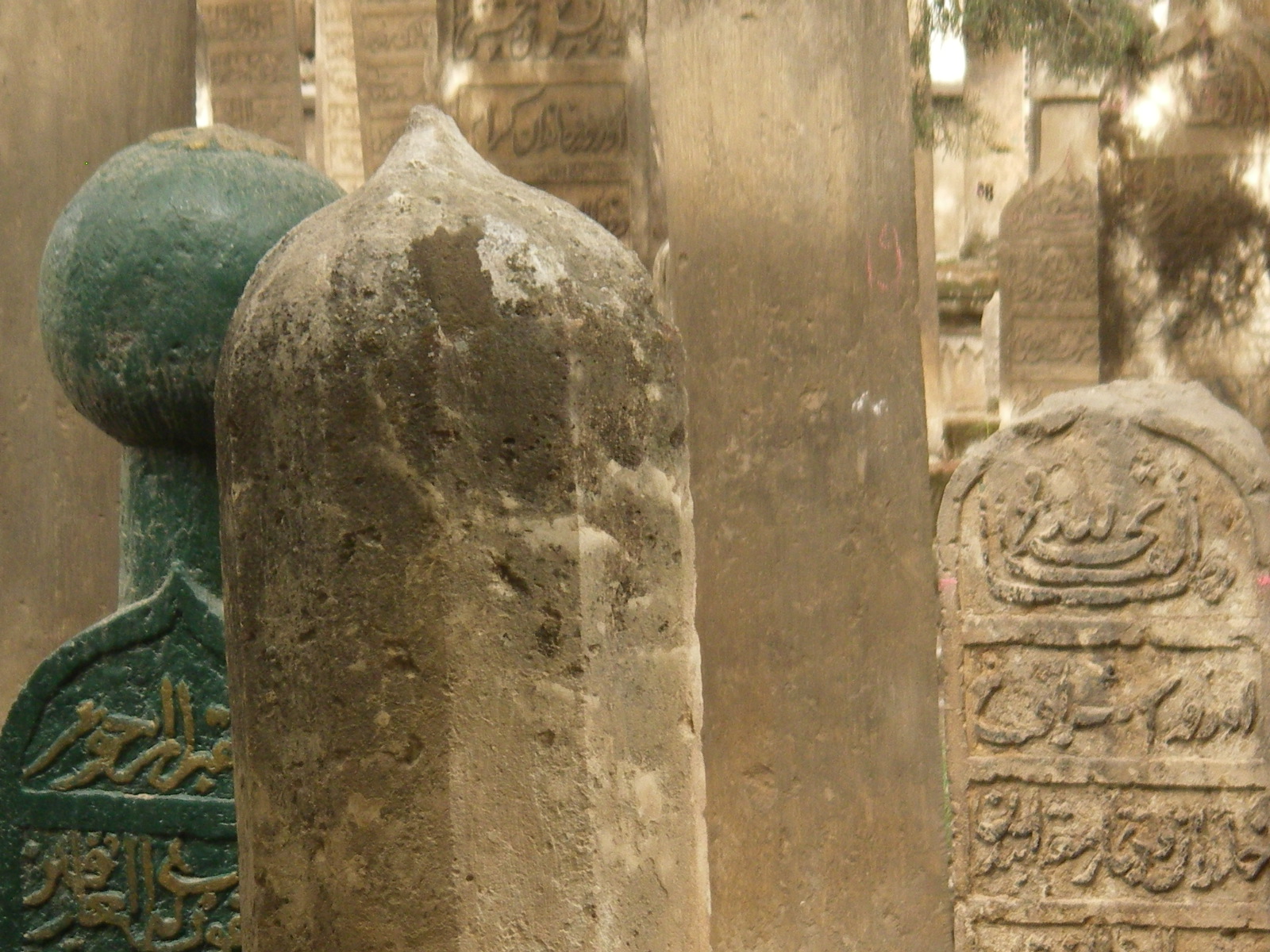
A few Ottoman Turkish gravestones in Urfa (photo by Liz Cameron)

Once nestled into every imaginable nook and cranny of the space in and around our airplane seats, the Karagöz puppet troupe breathed a sigh of relief at making it through the security lines unscathed and relatively un-bothered, all things considered.Karagöz puppets, you see, have their own version of scanners, in which their bring-to-life dowels must be removed before boarding the metal giants known as airplanes.Karagöz himself had settled in to the top of the seat in front of me – needling the young boy in front of me so much that he began kicking the back of his chair frantically, nearly giving me a bruise as big as a hydroponic grape leaf as I tried to right my lanky self from stowing my bag under the seat.Annoyed at Karagöz as well as the boy, but determined to support the already mortified young parents in front of me, I let it out inside my mind. “Really, a sigh of relief? You think you have it bad?” I snapped at them as I adjusted my long legs into the small space, “you are a puppet figment of my imagination, don’t you realize that I just made up an EASY passage through security for puppets? Didn’t you see what we had to go through?” The little chorus of dancing ladies saw my hot-and-bothered-ness and in the absence of a tea cooking implement, just began to jump up and down on my shoulders in a chain-reaction unison in order to massage the grump out of me.And it was into this moment, that M. leaned his head on my shoulder, told me he loved me, and explained that he would like to know what to expect in the weeks to come with my Father in hospice.”What,” he said carefully and respectfully, “exactly is hospice? And what do I need to do? And what should I expect? And…what happens after the end?”Pleased at his questions, and surprised by an uncharacteristically gentle approach to posing what can be interpreted as difficult or challenging statements, I kissed him and began to explain a bit about what I know about death in America, the hospice care movement, religious services in the Unitarian Universalist tradition and the tradition of cremating vs. embalming a body.

Holding my hand carefully as he listened to me, M. was calm and thoughtful as he took it in. The puppets, however, were looking on in increasing horror as I got to the cremation part of the explanation – and nearly fell out of their cornice-like squirrel spots when I got to the firy end.

“You mean,” Hacivad Bey said carefully, speaking for the troupe, “you BURN the body?”

“Well, my dear friend Hacivad,” Yehuda Rebbe chided, “it is not as bad as the purity-seeking Zoroastrians, who wash the body with unconsecrated bull’s urine before leaving the body to be eaten by scavenger animals. A poetic ashes-to-ashes like notion to be sure, but not for the faint of heart. I suppose I would take cremation.”

Clucking like the chicken-maiden she is, Kenne, the Queen Puppet of Ladylike Behavior and Manners Maven (her title changes, apparently, to suit the specifics of the occasion) slipped out from the airline safety card manual, and pronounced the following – “Use this, ignorant puppets, as a moment in which you can heighten your inter-cultural awareness, and perhaps gain some key knowledge about the etiquette of death-time management to support M’lady and Sir in the weeks to come!”

Giggling at Kenne, I simultaneously realized that I didn’t know much about death in Turkey, other than burial and mourning happens very fast, I asked the same questions of M. “How, canım, does this all go down in Turkiye?”

“Well,” M. began, rubbing his hands together as if to warm up for a long story, “although this is technically a secular country – which as you know I do not totally agree with – death rituals are mandated. The body must be washed by a gender-matched person and treated in a Muslim-run morgue right away, I think they face the head to Mecca, tie the big toes together and rest the arms on the side of the body. Remember when we visited that village outside of Afrodesias on the way to Bodrum a few years ago – and the man there insisted on giving us that death herb? That is the herb that is used to wash the body.”

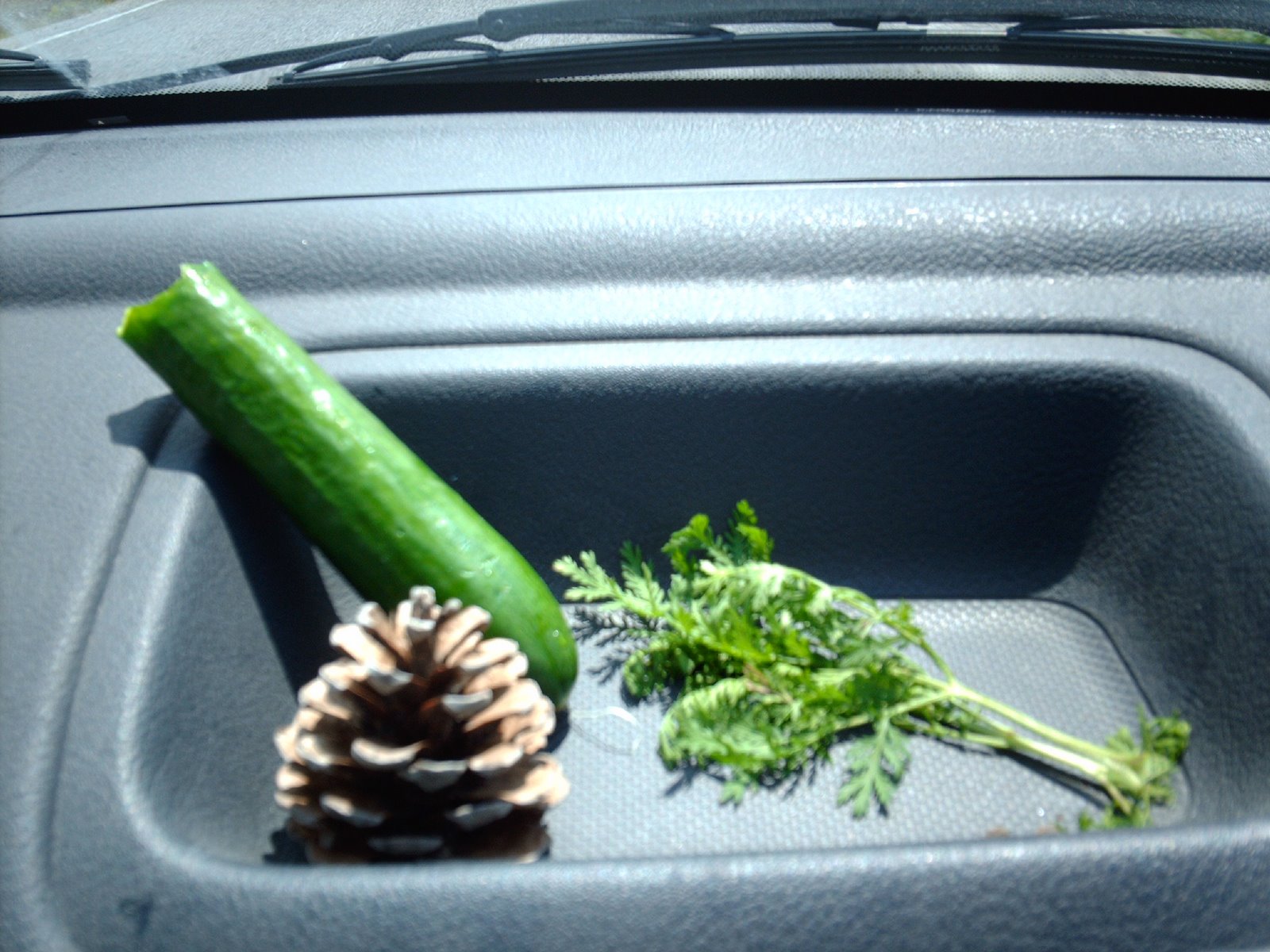
An odd trio – we were gifted one cucumber and an herb used to wash dead bodies by a man at a gas station near Afrodesias one day – I added the items to my solo pine cone and contemplated them for the rest of the drive into Bodrum… (photo by Liz Cameron)

Stuck on my memory of that odd interaction – and how I considered the herb afterwards on our dashboard all afternoon (it was placed next to the cucumber the man also gave us, and a large pine cone I picked up for my mother’s collection) – my brow was furrowed. I was particularly interested in the mandated end-of-life Mecca direction positioning and wondered what happened to the religious minorities in Turkey upon death. Instead of asking, I listened on.

“There is always a service at the mosque, usually within three days. The body is dressed in white…After the service, the imams come to your house afterwards to loudly-intone the mevlit prayers. You know about the İrmik Helvası.”

Reaching a crossroads in our conversation, M. stopped, perhaps pondering his words a bit, or clearing his mind. “You know, he said firmly, “I do not want this. I want to be cremated and spread in the ocean…so let’s hope I don’t die in Turkiye!” With this we had a good laugh as the puppets giggled out of some nervous attempt to engage in respectful behavior, even Karagöz. I think, however, that Karagöz was just pretty excited to hear M. utter this utterly oppositional request!


Posted in Cross-cultural learning moments, Family Challenges, Gendered moments, Visits from the Karagöz puppets | Tagged , , , , , , , | 8 Comments

Pul biber stockpile: Mercan Bey high-tails it to the Mısır Çarşısı


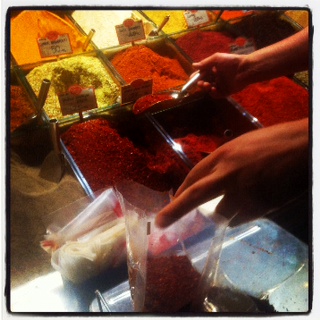
And there he is, Mercan Bey, the spice trader from the Arabian peninsula – oh – wait – you can’t see him? That’s right, he’s just a figment of my imagination. Regardless, he orchestrated the purchase of 10 vacuum-packed bags (i.e. TSA-proof) of pul biber (which masquerades in the U.S. as the name “Aleppo pepper”)…enough to last a nuclear war?

As soon as he heard that we were heading out of Istanbul as soon as possible, Mercan Bey went into panic mode.  You may recall that Mercan Bey is a spice trader from the Arabian Peninsula (as I wrote about here) who collects (some say hoards) as many spices as he can during his jaunts around Turkey.

With three fewer weeks to search out interesting new baharat mixtures for mangal mania moments during hurricanes, or pul biber for spice-oil making or teyze-thyme-picking collectives on Bozcaada, Mercan Bey was feeling, well, antsy. He quickly wrapped himself up in a cool white cloth, clambered up the kitchen window and hitched a ride with a spice-friendly pigeon all the way down to the Mısır Çarşısı.

As Mercan Bey commenced to scope out the spice situation, who had the best deals, the most interesting new mixtures, etc., Esma, Karagöz and I were over in Taksim Square, in the midst of a jasmine-Coca-Cola tug of war about the joys and pains of seeing the old and new Istanbuls live and converge, M. was battling the usual bureaucracy, as in the red tape management needed for just about any interaction, just about anywhere in Turkey. It has always seemed to me that this is both an annoyance – but somewhat of a national pride in pastime as well.  See, for example, Istanbul’s Stranger writing the wonderful tale about how she ended up BEATING the red-tape-making-machine otherwise known as TurkCell

Emerging victorious with our revised tickets in hand and a fresh story about the most recalcitrant of Turkish street-level bureaucrats besotted by his charm and twinkle, M. kissed me and pulled me back out into the sunlight.  This had the effect of brushing the tug-of-war swarm aside and dispatching Esma and Karagöz back home to G’s apartment via a trolley-cum-puppet zip line..

“I know,” M. said with a glimmer of glee in his hell-bent on cheering me up eyes, “we need to pick up Mercan Bey on the way home – and perhaps get some lunch at Hamdi (see Istanbul Eats’ review of this once-hole-in-the-wall now larger-than-life eatery here) to boot. We can eat pistachio kebap and pistachio baklava in honor of your Father since he wasn’t able to make a trip here…”

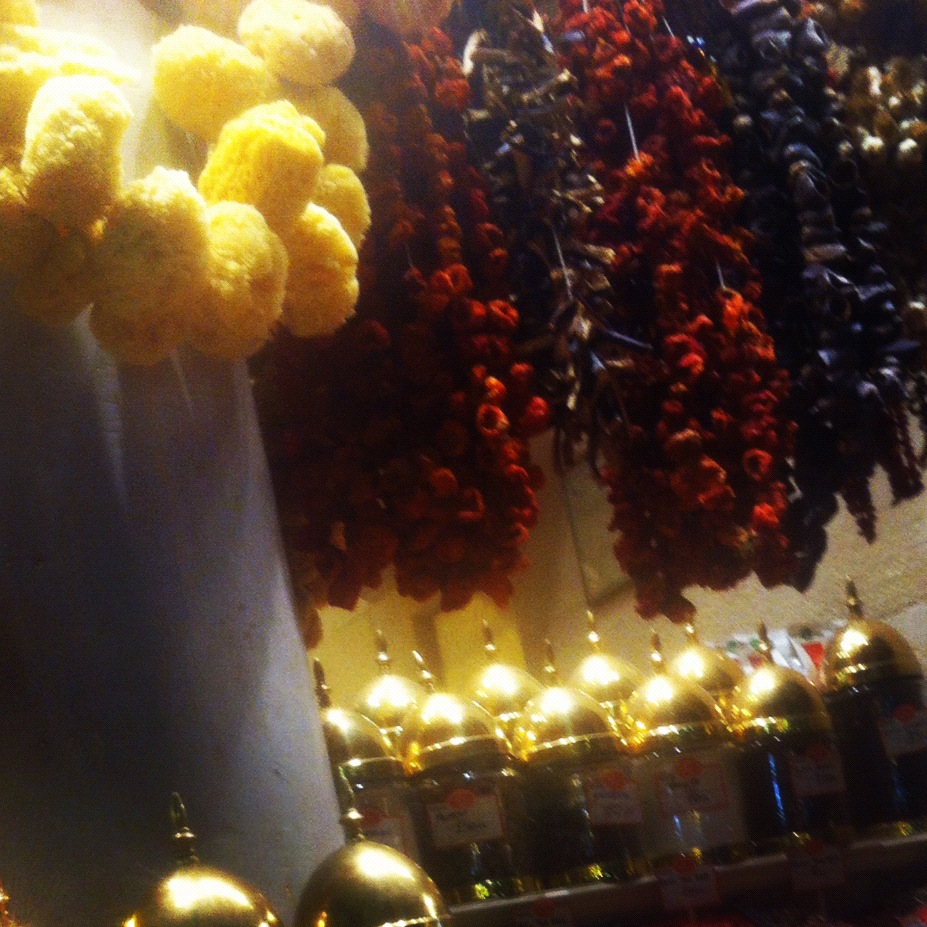
Mercan Bey’s dark and smoky playground consists of hanging sponges to swing on, grabbing swingy snacks of dried peppers and squash from rustling hangers while avoiding getting impaled on the burnished brass domes of lovely, tourist-friendly spice cannisters such as these in the Egyptian Spice Market (Photo by Liz Cameron)

And although the kind thought did result in more than one tear, off we went, to drown our sorrows in the best of Turkish meze and kebap, in honor of my Father, who sadly never got the chance to taste those tastes on M.’s home soil.  Mercan Bey finally tore himself away from the market and met us on the Hamdi patio, and as the afternoon namaz rang out, he sprinkled some pul biber over my food, softly offering gentle words for my Father, who he respected a great deal, even if my Father was spice-averse…”Şerefe baba” (To your honor, Father)

Posted in Family Challenges, Turkish Food!, Visits from the Karagöz puppets | Tagged , , , , , , , , | 2 Comments