‘Burqini’ street theatre to combat the “skinny bitch” hegemony (Part I)


Two ladies in 'burqinis" from http://ilovehishmatheblog.blogspot.com/

Once there was and once there wasn’t a lady who went on the search for the perfect burqini (a.k.a. hashema, odema in Turkish, per a reader, thanks again!).  If you are wondering what in the world I am talking about, you may need to read my previous posts here and here to understand what the heck this is all about.  A ‘burqini’ is actually the name of a specific product, it terms out, made by the Ahiida company, but is also becoming a term that is used to sell a range of “Islamic bathing suits.”  Taking Fatima Mernissi’s explanation of Islamic feminism as a frame here, the use of a burqini is one ‘arm’ of hijab, or the practice of modest dress in Islam in which the goal is to allow for people to focus on the content of character and words of a woman vs. their body.

Basically, I had been spending the past two weeks in a locked beach compound near Bodrum, with a lot of very well-off folks and a range of ladies that would in 2011 parlance refer to themselves with what I am surprised to say is actually an honorific –  “skinny bitches.”  See the bestseller info here.  Although this took place in 2004, as I am recounting this in retrospect, I take the liberty of using this term so embraced by the likes of Bethenny Frenkel, and others.  It has, I realize, become an accepted term of honor in the pop culture of the day, along with skinny jeans, skinny milk and skinny cocktails.  These skinny ladies had a lot to say about my weight, thus my dreaming of burqini post.

In any case, it was 2004, and I must admit, although I think my body was just fine at the time, I really got into a complex as a result of the actions and comments made (and not made, but intoned) by the lovely ladies at the cement beach.  And this is what led to my interest in donning a burqini for my very own self – so that people might focus more on me and my words than on my bikini body – or lack thereof.  I had become interested in the burqini as I had seen ladies at a public beach outside of the gated compound wearing them…M. had snorted at the sight, thinking it was ridiculous.  I, of course, had run to the Internet café to learn all about it, and to try to relate it back to Fatima Mernissi’s work on Islamic Feminism (see my previous post here for more information on all that).

However, let me focus on my search for the perfect burqini for now.  So, after hitting on the idea of the burqini as a central element to some sort of feminist-revenge cement-beach-located street theatre, I spent a great deal of time pouring over my memories of the community activism I engaged in during the 1990s in New York City during the infamous welfare reform era.  As part of a student activist group, we had hoots and hollars worth of fun planning and conducting street-theatre protests with large-scale costuming events, quirky and poignant hand-made signs and interesting chants.  All I could think of was watching the reactions of the ladies on the swim parade to my donning an Islamic bathing suit, a.k.a. a burqini and strutting my stuff in exaggerated form over to the water before throwing myself in with abandon.  If I was really this ‘obese,’ at 5 feet ten inches and 160 pounds, maybe a burqini would save my fellow females from the horror of having to check me out on the way to the water each day (again, you can get the recap here).

While I was thinking these thoughts one day on the couch, having forgone the day’s activity of to-ing and fro-ing from cement beach in favor of a trip to Kos Island with M.  I was waiting for him to catch up on the latest gossip about his futbol team with his brother, so that we could make our exit.  I took out my Turkish grammar book while I waited, and caught the din of the shadow puppet dancing lady chorus began biting their nails.  It was a sound that was new to me – and quite alarming en masse as it was.  The tiny chomping and soft chipping of shredding nails reverberated off of the adobe-like walls of the outdoor living room in which I was ensconced, studying my Turkish verbs and gazing out at the view as I repeated them in my head.  “Gidiyorum, Gidyorsun, what was the next one again?  I wonder if I could make a verb for ‘to burqinify’.”

Bending over to take a pen from my purse to work on my verb conjugation, I caught sight of one of the shadow puppet dancing lady chorus.  “We’re all for performance, m’lady, don’t get us wrong, we love us some performance,” the frog-voiced leader said with conviction from the usual spot inside my cavernous purse, her filmy veil floating a bit in the breeze, “but this does not sound like a very NICE performance for your audience.”  A murmur of agreement ensued from the pockets of my purse, so I shut it fairly quickly.  I made a mental note that not only did the dancing lady chorus have the ability to use their x-ray vision to see events beyond the purse but also had the magical ability to hear my thoughts.  “This sounds,” a meeker voice said, “like you really want to show up all of these ladies because they are so appearance-focused.  Isn’t that the point of being a lady?  To look pretty and please those around you with your kindness?  This street theatre thing, it does not sound very kind to polite society.”

Before I could respond to the little ladies through the top of my purse, slouched next to me on the white canvas couch, Kenne made her appearance.  “I will not tolerate this notion of a burqini street theatre protest, as you call it,” she said with the firm conviction of a matriarch on parade.  “You will fit in here, if that means losing weight to be as skinny as they are – even if you are judged just right elsewhere.  When I had to join my husband’s family’s home upon my marriage back in the year 1382, I had to make do with the expectations in that household, and this is the lot of women, really, isn’t it?”

Trying to tamp down her anger (perhaps disgust?) at me, I saw Kenne was taking a different tact, she was working hard to gently twist her face and words into a kind and engaging approach designed to draw me out, and towards her side in the matter, clearly. “You need to go to that salon again,” the lady chorus cried with renewed conviction, as if they had hit on just the right solution that had eluded them before, “perhaps another waxing? Or hair dyeing? Or eyebrow shaping?  Maybe you need to tattoo some eyebrows on that right-side, it is a little thin by nature, a thyroid problem, perhaps?  The salon always leads us to feel better and not worry so much about what is the natural parade of women checking other women out.”  They have a point, I thought, I do always feel better after the salon visit, but perhaps without the wax torture.  Why does it take the salon for me to feel ok about myself around here?

“Ready to go?” M. asked me – stretching out his hand to pull me back from my self-infused reverie. “Yes, I’m ready, um, do you think we could do a little shopping on the way home today – I could use a new, ahem, bathing suit.”  The chorus of dancing shadow puppet ladies sighed as we walked up the steps to the car.

Posted in Cross-cultural learning moments, Visits from the Karagöz puppets | Tagged , , , , , , , , , , | 8 Comments

I dream of “burquini”


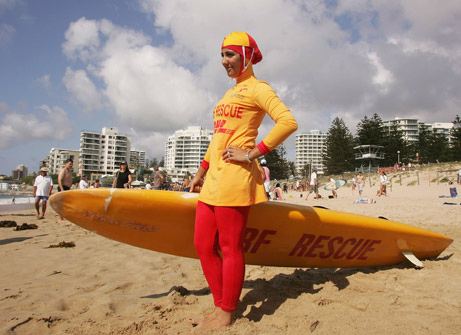
An Australian woman in a burquini - hijab/modest dress for swimming

I’m up in the night again, a month into the visit, no way to blame the jetlag for this sleeplessness. I am thinking about the swim parade the next day, of course. M.’s brother has convinced/conned us to join them on the cement beach for the morning. I am not sure why he wants us there, but I know that these brothers share a deep bond, despite living vastly different lives and making vastly different life choices. I have grown used to the sibling rivalry exuding from big brother to second brother (M.) – these last few days, it has been in English, for my benefit, I presume.

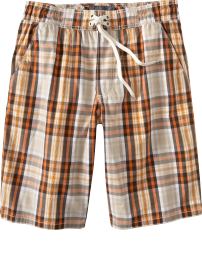
Madras swimming trunks that are in a lot better shape than M.'s

As I twist and turn, trying to get myself back to sleep amidst the too-tangle-prone sheets, I go over yesterday’s cement beach scene in my mind. I am trying to figure out the English-language hazing of M. by his brother. It usually involves the requisite teasing about threadbare, but favorite, madras cotton swim trunks worn year after year. I am guessing that this should be an indicator that it is my duty to “retire” the madras trunks in favor of something else. “It’s too early, I think,” I say, attempting to join the fun, “for me to be retiring his swim trunks.” Kenne pops up out of nowhere, and relays this dictate “if you are meeting the family, it is not too early, in my humble opinion!”

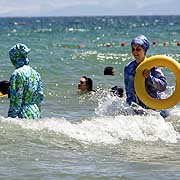
Ladies enjoying the water in burquinis a.k.a. islamic bathing suits (from Der Spiegel)

It is only then that I realize that Kenne is now ensconced in her Islamic bathing suit, keen to leave her early Ottoman Empire attire for something more modern, something I learn to refer to as the “burquini.” After engaging in a few twirls, the plasticated fabric covering her in grey-ish lavender glory, she bids me adieu, and jumps off the tanning chair, jaunts across the cement platform and for once, screams at the top of her lungs like a Japanese fighter pilot crashing into a U.S. ship in the middle of the Pacific on a suicide mission…and she’s over, swimming in the Ege Deniz, or Aegean Sea, to her heart’s delight. “OK, I think,” I guess I am on my own now.” Hacivad clears his throat, reminding me of his presence. “Remember, dear girl, this action of Kenne’s may be the lesson – as the common people say, ‘let’s blow this popsicle stand’ and get in the water, whatever a popsicle is, I don’t know!” Hacivad stores his paper under his chartreuse parasol, strips to his pants, and heads for the water.

If the matter of the threadbare madras bathing suit is a parallel to the torture of the swim parade, I think, M. sure has elephant skin and an ego made of steel. “Perhaps,” Karagöz says from his sleepy place next to me on the air-conditioned-cool of the pillow, “perhaps you just need to buy a BURQUINI!” He jumps up at full riot stance at the mention of the Islamic bathing suit, as if he was faking sleeping. “A burquini – now that would really shock them, that would be WAY more shocking than your out-of-style bikini, second-rate pedicure and cancerous growth in your tummy story.” Giggling, I relax as fantasy images of me in a burquini on the swim parade. Slowly, the relaxed muscles around my smile assist their cousin muscles around my body to relax and ease back into sleep as Karagöz whispers: ‘ If you can’t beat ’em, join ’em, on your own terms”

Posted in Cross-cultural learning moments, Visits from the Karagöz puppets | Tagged , , , , , , , | 11 Comments

It’s a mantı melee


Home-style mantı with garlicky-buttery yogurt, kekik (dried thyme) and pul biber (red pepper) and nane (mint)

After dispersing from this afternoon’s hilarity with Kalinka in the kitchen, I fell into a deep sleep, my feet aching from the cobblestones of Bodrum town.  As sweet as the falling into sleep was, the slow-awakening to the fragrant, savory steam of what I later came to know as mantı was even better.

Quickly freshening up, I made my way to the upper floors, where M. was already sitting on the counter, chin in hand, watching the manti preparation being handled by Kalinka and supervised by M.’s sister-in-law as close as really strong saran wrap to the edge of a bowl.  I can see the ENTIRE troupe of Karagoz puppets lying on their tummies in gender-segregated order from the top of the spice cabinet, folded arms allowing for their heads to watch, tennis-match-like, the preparation process.  The rolling of the dough, the filling of the packet, the boiling of the mantı.  There is not a peep from any one of them, which is highly uncharacteristic.  Even Karagöz is wrapped up in the event, and his narcolepsy has not even kicked in.

After I take in the sight of the quiet puppet troupe, I see that M.’s back is to me.   I am happy to see M.’s other hand around his brother, whose arm was also around M.’s back.  No shame in the expression of brotherly love here in Turkey, which I found both surprising and such a refreshing relief as well.  They were clearly talking about their Anne (mother) and her mantı, but I could also hear them congratulating and thanking Kalinka with the common phrase said to a cook “elinize sağlık” or, “health to your hands.”

Upon seeing me, M.’s brother jumps up from the counter and leads me by both hands to the kitchen – “come, you must smell this! this is a wonderful smell!  this is what we will have for dinner, my wife has worked on it all afternoon.”  My mouth is watering, and I am able to ignore my observation that it is Kalinka, not the sister-in-law that has been working all afternoon.  “You will have this for dinner,” the sister-in-law says with haughty pride, “it is mouth-watering, first class, haute cuisine, the French have nothing on us.  We are not a third-world country, you see, we have CUISINE.”  Ignoring his wife, M.’s brother explains the process to me – describing it with words that only the gourmand in him can conjure, he explains that this dish has “peasant roots” from across central Asia.

We can barely contain ourselves as the table is set and we spill into our places at the table.  Even M.’s usually missing teen cousins are hovering somewhat close to their oh-so-uncool parents in order to not miss out on the possibility of delicious, home-made mantı.  I can barely contain my own saliva in this moment, sorry for the graphic, folks, but this is more carbohydrate than I have allowed myself in days given the constant battle on the swim parade front. As Kalinka ladles out the bowls of mantı, M.’s sister in law spoons generous heapings of buttery yogurt with garlic, thyme (kekik) and pul biber (red pepper without the acrid bitterness from the yellow-orange seed as in the U.S.).  Nobody says a word, enraptured by the fragrance around us.  Even the neighbors call out a wan “afiyet olsun” (bon appetit), perhaps in hopes of an invitation.

Although I wait for the hostess to raise her fork before eating, she never does.  She does not serve herself, instead retreating to the kitchen to uncharacteristically “take the dishes to the sink.” I see her sneaking serving-spoonfuls of the mantı.  She doesn’t notice it, but the puppet troupe have made a mantı assembly line with the remains of the mantı, yogurt-butter sauce and spices left on the counter.   I wonder if those mantı will fill them up too much to fold into their waxy selves at night.  Mmms and aaaahs abound in the kitchen.  No time for me, it is clear.  I am on my own.

All attempts to remain on par with my sister-at-law are thwarted and I whole-heartedly give in.  As soon as M.’s brother begins to eat, I take a first taste.  It is unctuous to the tooth, not the al dente of pasta, sort of a gummy firmness which is a lot more appetizing than one might imagine.  The meat, full fat of course, is flavored with garlic, salt and pepper in just enough of a way to highlight its natural rich, meaty tones.  The buttery yogurt slides around my mouth, and the herbs and spice make my tastebuds pop with abandon.  Everyone is happy and smiling, thoughts of Turkish and American obesity vanish for now, and the table is ravaged.  All bets are off, it seems, when it comes to a mantı melee!

Postscript on how to make mantı:  Martha Stewart, and I am a proud supporter, I have to admit, had a wonderful issue on dumplings in her February 2008 Living magazine.  The images and recipe reprinted here (and commented on in a wonderful manner) are from The Bitten Word’s great posting:

Manti styled by Martha Stewart's team

Makes About 100: Serves 4 to 5

Each of these tiny dumplings is about the size of your fingertip, so you can easily serve 20 to 25 to each person.  It’s traditional to invite two or three friends to help fill and seal the manti; after all, many hands make light work.  They can be frozen for up to 1 month.

For the Dough:
1 cup all-purpose flour, plus more for dusting
1/2 teaspoon course salt
1 large egg, lightly beaten
3 tablespoons cold water

For the filling:
8 ounces ground lamb
1 medium yellow onion, grated on the large holes of a box grater (1/2 cup)
2 tablespoons finely chopped fresh flat-leaf parsley
1 teaspoon course salt
1 teaspoon freshly ground pepper

For Cooking and Serving:
8 tablespoons (1 stick) unsalted butter
3 cups homemade or low-sodium store-bought chicken stock
1 cinnamon stick
2 bay leaves
course salt
1 1/2 cups plain Greek yogurt or labneh
2 garlic cloves, minced and mashed to a paste with a pinch of salt
1 1/2 teaspoons dried mint
3/4 teaspoon Turkish red pepper (Marash Biber; or papikra) (Note from Slowly-by-slowly, in the U.S., you can get “aleppo pepper” online at Penzeys.com)

1.  Make the dough: Sift together flour and salt in a large bowl.  Make a well in the center and add egg. Using your hands, gently draw flour mixture into egg.  Gradually add the cold water, and continue to work dough with your hands or a spoon until it forms a smooth paste.

2.  Turn dough onto a lightly floured surface. Kneed until dough is smooth and springs back when pressed, 5 to 8 minutes.  Divide dough into 2 balls, cover with a damp kitchen towel and let rest at room temperature for 30 minutes.

3. Make the filling: Gently combine lamb, onion, parsley, salt and pepper.  (Filling can be refrigerated in an airtight container for up to 2 days.)

4.  On a lightly floured work surface, roll out 1 portion of dough into a 16-by-10 inch oblong about 1/16 inch think.  Using a ruler, cut dough into 1 1/4 inch squares with a pizza wheel or a paring knife.  Keep remaining dough covered with a damp kitchen towel while you work.

5.  Spoon 1/4 teaspoon filing in center of 1 dough square.  Gently pull 2 opposite corners outward to stretch dough slightly, then pull up to meet in center, and pinch to seal.  Repeat with remaining 2 corners, making sure all air has been pressed out.  Pinch together all 4 corners to form a point, then pinch along all 4 seams to seal.  Place on a parchment lined baking sheet, and cover with a damp kitchen towel.  repeat.  Remove towel, and cover with a piece of parchment. (Dumplings can be refrigerated on baking sheets, wrapped in plastic, for up to 1 day.  Alternatively, freeze on baking sheets, uncovered, for 2 hours, then transfer to an airtight container and freeze for up to 1 month.)

6.  For cooking and serving: Preheat oven to 400 degrees.  Coat a 13-by-9-inch baking dish with 1 tablespoon butter.  Arrange manti in a single snug layer in the dish.  Bake until fragrant and tops and corners are golden brown, about 25 minutes.

7. Meanwhile, bring stock, cinnamon, bay leaves and 1 teaspoon salt to a boil in a saucepan.  Remove baking dish from oven, and add enough stock to dish so that all but the tops of the manti are submerged.  Cover tightly with parchment and then foil, and bake until soft, about 2 minutes more.

8.  Meanwhile, stir together yogurt or labneh and garlic paste in a medium bowl.  When manti have finished cooking, tile baking dish, collect about 1/4 cup liquid with a ladle, and stir into yogurt sauce (sauce should be spoonable).

9.  Melt remaining 7 tablespoons butter in a small saucepan over medium-high heat.  Reduce heat to medium, and cook until amber, about 7 minutes.
10.  Divide manti among shallow serving bowls.  Spoon yogurt sauce over top, drizzle with browned butter, and spring with mint and red pepper.

Posted in Cross-cultural learning moments, Visits from the Karagöz puppets | Tagged , , , , | 4 Comments